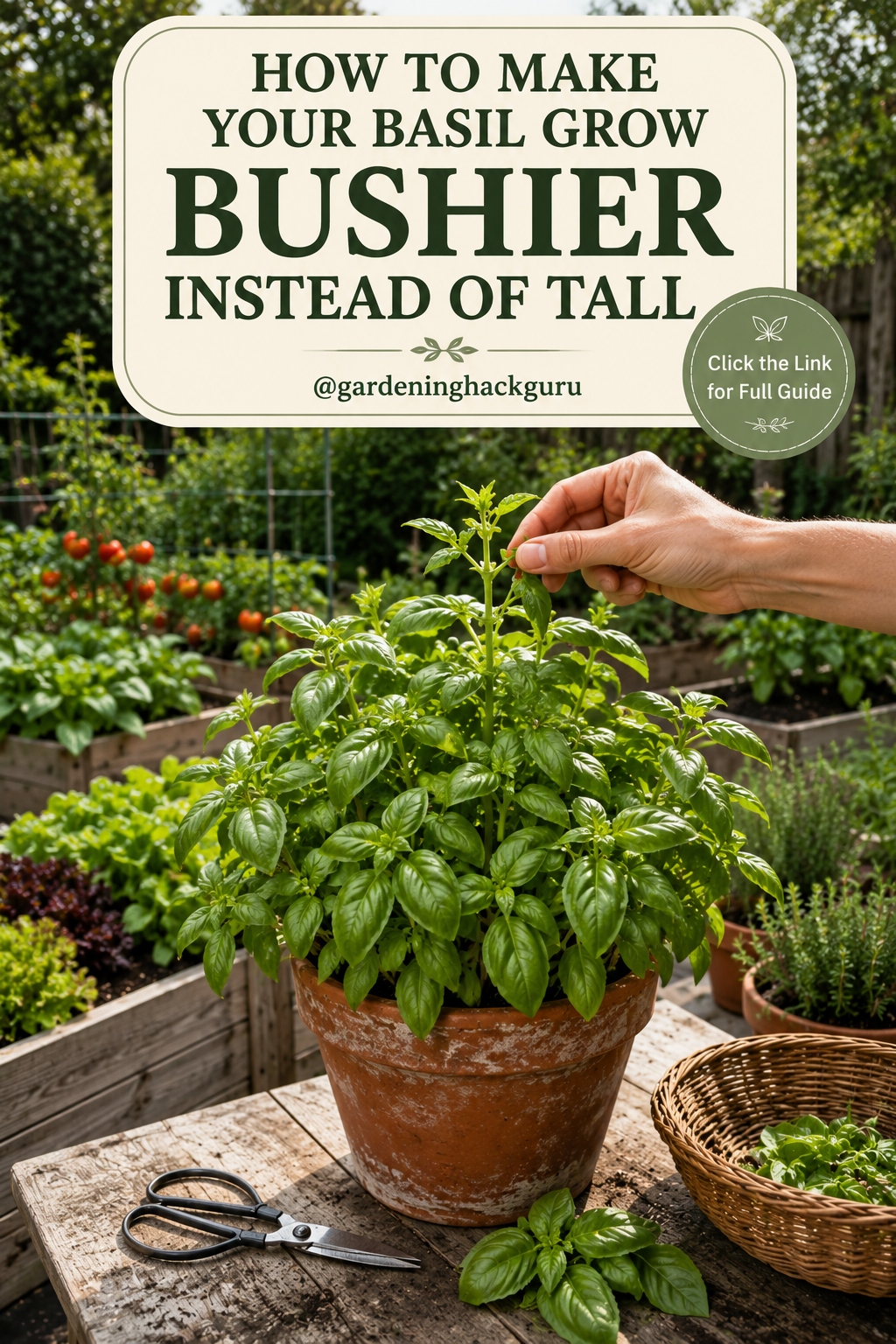
Basil is one of the most rewarding herbs to grow at home, but there’s a common problem: instead of becoming a lush, leafy plant, it shoots upward with a few long stems and starts looking thin and leggy.
The good news is that tall, sparse basil can often be prevented with a few simple changes.
The secret to bushy basil isn’t simply adding more fertilizer or water. Regular pruning, proper harvesting, and plenty of light encourage the plant to produce more side branches instead of putting all its energy into one tall central stem.
Whether you’re growing basil in a patio container, raised bed, kitchen garden, or sunny windowsill, here’s how to encourage a fuller plant with plenty of leaves to harvest.
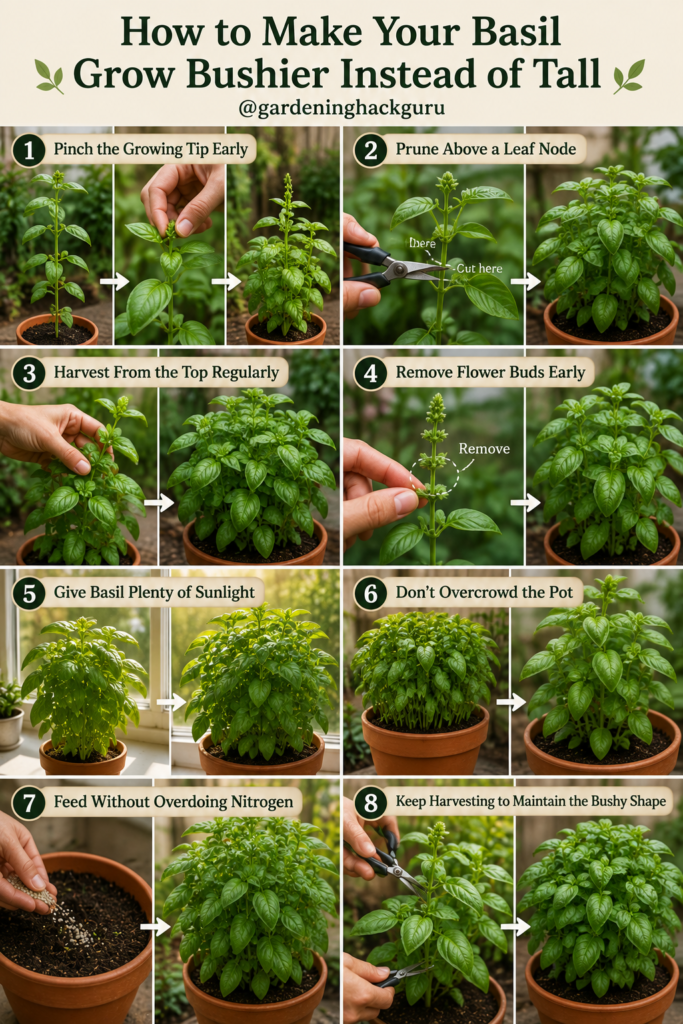
1. Pinch the Growing Tip Early
One of the most important things you can do is start pruning while your basil is still young.
Once the plant is established and has several sets of true leaves, look at the main stem. You’ll notice pairs of leaves growing opposite each other.
Just above these leaf pairs is the growing tip.
Pinching off the tip above a healthy leaf pair removes the dominant upward-growing point. The buds near that node can then develop into side branches.
Instead of continuing as:
1 tall stem ↑
the plant can begin developing:
2 branching stems ↖ ↗
As those branches grow, they can eventually be pruned in the same way, creating progressively fuller growth.
Don’t remove too much from a very young or stressed plant. Allow it to establish first.
2. Always Prune Above a Leaf Node
Where you make the cut matters.
Look along a healthy basil stem for a pair of leaves growing from the same point. You’ll often see tiny new shoots developing where those leaves meet the main stem.
Make your cut just above that leaf pair.
Leave the node and the leaves below your cut intact.
Those small shoots can develop into new branches, helping the plant become wider rather than simply taller.
This is much more effective for shaping the plant than randomly removing individual leaves.
3. Harvest From the Top
A common mistake is picking the largest individual leaves from the bottom of the plant whenever you need basil.
While occasionally taking a leaf isn’t disastrous, regularly harvesting entire stem tips can do much more to encourage branching.
When you need basil for cooking, look for a healthy upper stem and cut it just above a leaf pair.
You get fresh basil for dinner while simultaneously pruning the plant.
It’s essentially harvesting and shaping at the same time.
Over time, regularly removing the tallest shoots can help maintain a compact, productive plant.
4. Remove Flower Buds Early
Eventually, basil naturally wants to reproduce.
You’ll notice small flower spikes beginning to form at the ends of stems.
If your main goal is producing lots of tender leaves, pinch off flower buds when you see them.
Allowing basil to flower isn’t inherently bad—flowers can be attractive and useful to pollinators—but flowering signals a shift in the plant’s growth cycle and can affect leaf production and flavor.
If you want seeds or flowers for pollinators, you can intentionally allow some stems to bloom.
But for a leafy kitchen basil plant, regular flower removal generally helps prolong vegetative growth.
5. Give Basil Plenty of Light
Pruning alone won’t fix basil that’s stretching desperately toward a light source.
Basil is a sun-loving herb.
Outdoors, it generally performs best with plenty of direct sunlight, though extremely hot climates may benefit from some protection during the harshest part of the afternoon.
Insufficient light can result in:
- Longer spaces between leaves
- Thin stems
- Smaller foliage
- Plants leaning toward the light
- Weak, stretched growth
If you’re growing basil indoors, place it at your brightest suitable window.
If natural light isn’t sufficient, an appropriate grow light can help produce stronger, more compact growth.
6. Don’t Overcrowd Your Basil
It can be tempting to leave a cluster of basil seedlings growing together because the pot immediately looks full.
But there’s a difference between a pot containing many crowded plants and one healthy plant that has become genuinely bushy through branching.
Crowded basil plants compete for:
- Light
- Root space
- Water
- Nutrients
- Airflow
Give plants enough room to mature.
If you’ve purchased a supermarket basil pot containing many tightly packed seedlings, separating some of them into additional containers can give individual plants more room to develop.
Make sure every container has drainage holes.
7. Feed Basil Without Overdoing It
Basil grows quickly and appreciates fertile soil, especially when you’re regularly harvesting leaves.
Start with good-quality potting mix and incorporate finished compost where appropriate.
Container-grown basil may benefit from periodic fertilizer during active growth. Follow the directions for the fertilizer you’re using rather than assuming more fertilizer will produce a better plant.
Excessive fertilizer—particularly too much nitrogen—can produce very soft growth and isn’t a substitute for adequate light and correct pruning.
The goal is steady, healthy growth.
8. Keep Pruning Throughout the Growing Season
One pruning session won’t keep basil bushy forever.
New branches eventually become tall stems themselves.
Once those branches develop several sets of leaves, prune or harvest their growing tips above another healthy leaf pair.
The process continues:
One stem → two branches → more branching → fuller plant.
Regular light pruning is usually better than allowing basil to become huge and leggy and then attempting an extreme haircut.
Think of bushy basil as something you maintain, rather than something you create once.
💧 Water Basil Correctly
Water also affects the quality of your basil.
Basil generally prefers evenly moist soil but doesn’t appreciate sitting in waterlogged conditions.
Check the soil regularly, particularly when growing in containers during hot weather.
Water thoroughly when needed and allow excess water to drain from the bottom.
Try to avoid constantly alternating between extremely dry soil and soaking-wet conditions.
A container with drainage holes is essential.
🪴 Choosing the Right Pot
A tiny pot can restrict an otherwise vigorous basil plant.
Choose a container large enough to accommodate the plant’s developing root system, with drainage holes at the bottom.
Terracotta pots look beautiful and allow moisture to evaporate through their walls, but they may require more frequent watering during hot weather.
Larger containers generally dry out more slowly than tiny pots.
If you’re growing several basil plants together, increase the container size accordingly rather than squeezing them into a small pot.
✂️ Where Exactly Should You Cut Basil?
This is the most important technique to remember.
Look for a stem with a healthy pair of leaves.
Just above those leaves, you’ll often find the growing portion of the stem. Make your cut slightly above the leaf pair, leaving the node intact.
Afterward, the buds around that node can continue developing.
Cut here:
Growing tip ✂️
↑
🌿 Leaf ← NODE → Leaf 🌿
↙️ New shoot New shoot ↘️
Avoid cutting below every healthy node and leaving a bare stem without enough foliage to support recovery.
🌱 Can You Fix Basil That’s Already Tall and Leggy?
Often, yes—provided the plant is still healthy.
Instead of cutting the entire plant down dramatically, inspect each tall stem and find healthy leaf nodes lower down.
Prune the stem above an appropriate node while leaving enough healthy foliage on the plant.
Then improve whatever caused the legginess in the first place.
Usually that means checking:
Light + pruning frequency + spacing + general growing conditions.
As new side shoots develop, continue pinching them strategically.
The plant may gradually become considerably fuller.
🚫 Common Mistakes That Keep Basil Tall and Thin
Only picking individual leaves
Harvesting stem tips above nodes is more useful when your goal is branching.
Waiting too long to prune
Starting while the plant is young makes maintaining a compact shape easier.
Cutting in the wrong place
Prune above a healthy leaf node instead of leaving random bare sections of stem.
Not providing enough light
A plant stretching for light will continue looking leggy regardless of how often you pinch it.
Allowing every flower spike to develop
If leaf production is your priority, remove flower buds regularly.
Overcrowding
Ten weak seedlings packed into a tiny pot aren’t necessarily better than a few well-branched plants with adequate space.
Overfeeding
Fertilizer can’t compensate for poor light or incorrect pruning.
🌿 What Does Healthy Bushy Basil Look Like?
Don’t expect your basil to become a perfectly round ball.
Real plants are naturally uneven.
Healthy bushy basil should have multiple branching stems, relatively compact spacing between leaves, abundant foliage, and several active growing points rather than one dominant stalk towering above everything else.
Some stems will always grow faster than others.
Simply harvest the tallest ones first.
That’s part of maintaining the shape naturally.
🍃 Turn Pruning Into Harvesting
Perhaps the best part about shaping basil is that very little needs to go to waste.
Use freshly pruned basil for:
- Pesto
- Pasta
- Pizza
- Tomato salads
- Sandwiches
- Soups
- Sauces
- Infused oils
- Garnishes
Instead of thinking, “My basil needs pruning,” think:
“It’s time to harvest dinner.”
Regular kitchen use naturally encourages the kind of repeated tip pruning that helps maintain a fuller plant.
🌿 Final Thoughts
If your basil keeps growing tall instead of bushy, don’t immediately reach for more fertilizer.
Start with the growing tips.
Pinch young basil above healthy leaf nodes, harvest from the top regularly, remove flower buds when leaf production is your priority, and provide plenty of light.
Give the plant enough space, keep the soil appropriately moist, and continue lightly pruning new branches as they grow.
With consistent care, your basil can shift from one tall, sparse stem into a fuller, branching plant packed with fresh leaves—and every pruning session gives you another excuse to use fresh basil in the kitchen.