Starting a garden can feel surprisingly complicated.
You walk into a garden center planning to buy a few tomato plants, and suddenly you’re surrounded by hundreds of seed packets, fertilizers, soil mixes, watering systems, plant labels, and tools you didn’t even know existed.
Then you go online and things somehow become even more confusing.
One person says water every morning. Another says never water every day. Someone insists you need expensive fertilizer, while another gardener seems to grow beautiful vegetables using little more than compost and patience.
The good news is that gardening doesn’t need to be complicated.
Most successful gardens come down to understanding a handful of basic principles: sunlight, soil, water, timing, spacing, and paying attention to your plants.
You will make mistakes. Every gardener does. But plants are often far more forgiving than beginners expect.
If you’re planning your first vegetable garden—or you’ve already planted one and aren’t quite sure what you’re doing—here are 21 things every beginner gardener should know.
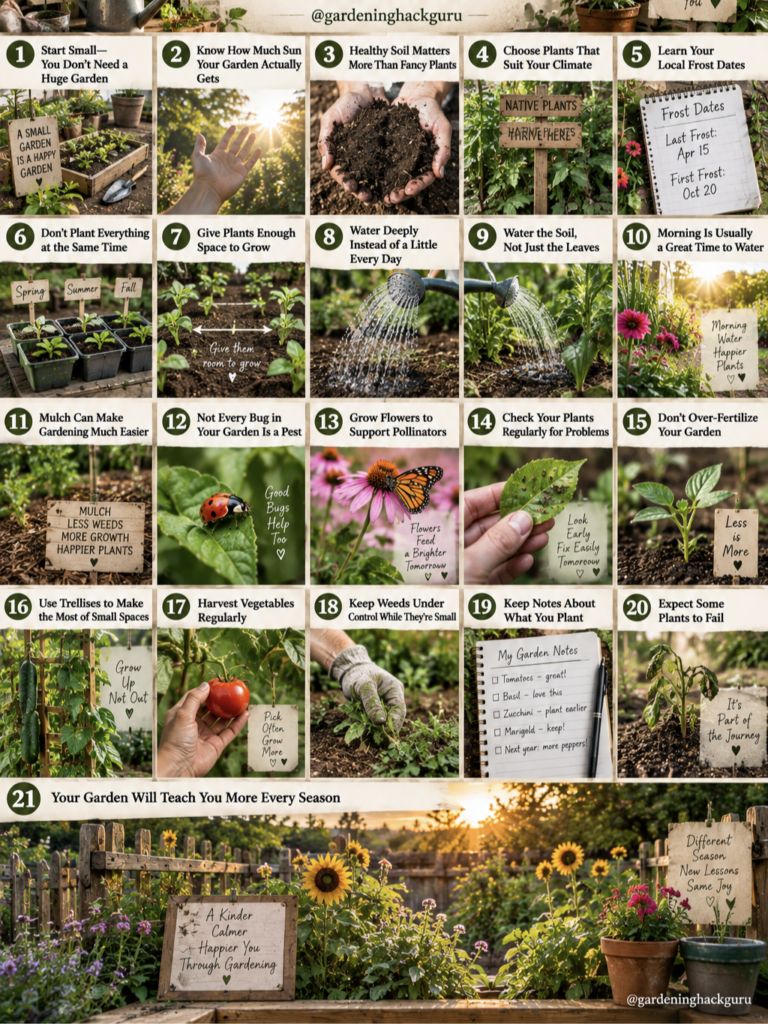
1. Start Small—You Don’t Need a Huge Garden
One of the most common beginner mistakes is starting with too much.
It’s easy to look at beautiful vegetable gardens online and imagine yourself growing tomatoes, cucumbers, peppers, carrots, pumpkins, herbs, berries, potatoes, corn, and twenty kinds of flowers.
Then July arrives.
Everything needs watering.
The weeds are growing.
The tomatoes need tying.
The zucchini is taking over the path.
And suddenly gardening feels like another full-time job.
For your first season, start with one or two raised beds, a few containers, or a manageable patch of ground.
You can always expand next year.
A small garden that receives regular attention will usually be more enjoyable than a huge garden you can’t keep up with.
2. Know How Much Sun Your Garden Actually Gets
Before buying plants, spend some time watching your yard.
Not where you think the sun shines.
Where it actually shines.
A spot that looks sunny at breakfast might be shaded by the house by noon. Another area might receive several hours of strong afternoon sun.
Many fruiting vegetables—including tomatoes, peppers, cucumbers, and beans—generally perform best with plenty of direct sunlight.
Some leafy crops can tolerate less.
Watch your potential garden area throughout the day and write down roughly when sunlight reaches and leaves it.
Doing this before planting can save you months of wondering why a sun-loving vegetable isn’t producing well.
3. Healthy Soil Matters More Than Fancy Plants
You can buy the healthiest tomato seedling at the nursery, but if you put it into poor soil, it will struggle.
Soil is the foundation of your garden.
Healthy garden soil should provide roots with access to water, nutrients, and oxygen while draining appropriately.
Adding well-finished compost or other suitable organic matter can improve many garden soils over time.
If you’re creating raised beds, start with a quality soil mixture appropriate for vegetable gardening rather than filling the entire bed with whatever inexpensive material happens to be available.
And if you’re gardening directly in the ground, a soil test can be incredibly useful.
Instead of guessing what your soil needs, you’ll have actual information.
4. Choose Plants That Suit Your Climate
Pinterest can convince you that you can grow anything anywhere.
Unfortunately, plants haven’t seen Pinterest.
A vegetable that thrives in one region may struggle badly somewhere with very different temperatures, humidity, rainfall, or growing-season length.
Before choosing varieties, learn your general growing conditions.
Look at seed packets and plant labels for information about temperature, maturity time, and growing requirements.
Local nurseries and university extension resources can also be useful because they’re familiar with plants that perform well in your region.
Growing the right plant in the right climate is much easier than constantly trying to rescue something that doesn’t want to be there.
5. Learn Your Local Frost Dates
This is one of the first pieces of gardening information worth learning.
Your approximate last spring frost helps guide when frost-sensitive plants can safely move outdoors.
Your approximate first fall frost gives you an idea of how long your growing season may last.
But remember that frost dates are estimates based on historical patterns—not appointments nature promises to keep.
Weather can always surprise you.
Use frost dates as planning tools while continuing to watch your actual forecast.
This is especially important with tender plants such as tomatoes, peppers, cucumbers, basil, and many warm-season flowers.
6. Don’t Plant Everything at the Same Time
Imagine planting 30 heads of lettuce on the same Saturday.
Sounds productive.
Then they all become ready at roughly the same time.
Suddenly you’re eating lettuce for breakfast, lunch, and dinner while desperately giving bags of it to your neighbors.
For crops that can be planted successively, consider sowing smaller amounts at intervals rather than planting everything at once.
This is called succession planting.
It can help spread your harvest over a longer period.
You can also replace finished crops with another suitable planting when your season allows.
A garden doesn’t have to be planted once in spring and then left unchanged until winter.
7. Give Plants Enough Space to Grow
Seedlings are deceptive.
A tiny tomato transplant sitting in the middle of a raised bed can make the bed look ridiculously empty.
So beginners naturally think:
“I can definitely fit another six plants in here.”
Then summer arrives.
Those tiny seedlings become enormous.
Overcrowded plants compete for light, water, nutrients, and physical space. Dense growth can also reduce airflow.
Check the recommended spacing for the particular variety you’re growing and think about its mature size, not how small it looks today.
Your newly planted garden may look slightly empty.
That’s okay.
Give it a few weeks.
8. Water Deeply Instead of a Little Every Day
Many beginners walk outside with a hose, sprinkle the garden surface for a minute, see wet soil, and assume they’re finished.
But wetting only the surface doesn’t necessarily mean water has reached the root zone.
For many established garden plants, less frequent but thorough watering is preferable to repeatedly applying tiny amounts of water.
How often you need to water depends on your soil, weather, plant type, growth stage, containers, rainfall, and temperature.
There isn’t one universal schedule.
Instead, check the soil.
Learn how quickly your particular garden dries.
Your plants will tell you much more than an arbitrary “water every Tuesday” rule.
9. Water the Soil, Not Just the Leaves
When watering, aim primarily for the root zone.
Plants take up water through their roots, so soaking leaves while barely wetting the soil isn’t particularly helpful.
Keeping foliage unnecessarily wet can also encourage certain disease problems under suitable conditions.
A watering wand, soaker hose, drip irrigation system, or careful hand watering can help deliver water closer to the soil.
You don’t need an expensive irrigation system to grow a good garden.
You simply need to get water where the plants can actually use it.
10. Morning Is Usually a Great Time to Water
When practical, morning is often a convenient time to water the garden.
Temperatures are typically cooler than later in the day, and plants have access to moisture as conditions warm.
It also gives accidentally wet foliage time to dry.
That doesn’t mean a thirsty plant should suffer because you missed the “correct” watering hour.
If your garden genuinely needs water, give it water.
Gardening advice should help you care for plants—not make you afraid to touch the hose after 9 a.m.
11. Mulch Can Make Gardening Much Easier
If there’s one simple habit that can make a vegetable garden easier to manage, it’s mulching appropriately.
A layer of suitable mulch can help:
- reduce moisture loss
- suppress many weeds
- moderate soil temperatures
- reduce soil splashing onto foliage
- gradually contribute organic matter when organic mulches decompose
Materials might include clean straw, shredded leaves, or other appropriate organic materials available in your area.
Don’t pile mulch tightly against plant stems.
Leave a little breathing room around the base of plants.
Mulch won’t eliminate every garden problem, but it can reduce several chores at once.
12. Not Every Bug in Your Garden Is a Pest
You notice an insect on your tomato plant.
Your first instinct might be to get rid of it.
Don’t.
At least not until you know what it is.
Gardens contain pollinators, predators, decomposers, and countless other organisms. Lady beetles, lacewings, spiders, parasitic wasps, and other beneficial creatures can play useful roles in the garden ecosystem.
Before spraying something, identify the insect.
Ask:
Is it actually damaging my plant?
Sometimes the creature you’re about to remove is helping control the creature that’s causing the problem.
13. Grow Flowers to Support Pollinators
A vegetable garden doesn’t need to contain only vegetables.
Flowers can make the garden prettier while providing resources for bees and other beneficial insects.
Consider suitable flowers such as marigolds, calendula, nasturtiums, alyssum, cosmos, sunflowers, or zinnias, depending on your climate and available space.
Mix flowers among vegetables or create small flowering borders.
Try to include different flower shapes and blooming periods when possible.
And don’t worry about making the garden perfectly neat.
A little diversity can be a wonderful thing.
14. Check Your Plants Regularly for Problems
One of the best gardening tools you own is your attention.
Walk through the garden regularly.
Turn over a few leaves.
Look at new growth.
Check developing fruits.
Notice whether leaves are changing color or something has been chewing holes overnight.
Small problems are usually easier to deal with than large ones.
Ten caterpillars are easier to manage than hundreds.
One diseased leaf is easier to investigate than an entire collapsing plant.
You don’t need to inspect every leaf with a magnifying glass each morning.
Just spend time in your garden.
Observation is one of the skills experienced gardeners develop without realizing it.
15. Don’t Over-Fertilize Your Garden
More fertilizer doesn’t automatically mean more vegetables.
Plants require nutrients, but excessive fertilization can cause problems.
Too much of certain nutrients may encourage excessive leafy growth, damage plants, contribute to nutrient imbalances, or move into the wider environment.
Instead of feeding plants every time you’re worried about them, determine whether they actually need additional nutrients.
Follow product directions carefully and consider soil testing when appropriate.
A struggling plant might have a watering problem, root problem, pest problem, temperature stress, or insufficient light.
Fertilizer can’t fix all of those.
16. Use Trellises to Make the Most of Small Spaces
If your garden is small, don’t only look at the ground.
Look up.
Vertical growing can dramatically increase how efficiently you use limited space.
Pole beans, peas, cucumbers, indeterminate tomatoes, and other suitable climbing or trainable plants can grow on trellises or sturdy supports.
Instead of allowing vines to spread across several feet of soil, guide them upward.
This can also make some crops easier to see and harvest.
Install strong supports early.
Trying to force a mature, tangled cucumber vine onto a trellis halfway through summer isn’t nearly as enjoyable.
17. Harvest Vegetables Regularly
Don’t spend months growing vegetables only to forget to pick them.
Many crops benefit from regular harvesting.
Beans, cucumbers, zucchini, herbs, and various other productive plants may continue producing when harvested appropriately.
Learn what the ideal harvest stage looks like for each crop.
Bigger isn’t always better.
That enormous zucchini hiding underneath the leaves may look impressive, but younger fruits are often more pleasant for many kitchen uses.
Make harvesting part of your regular garden walk.
Bring a basket.
You’ll probably find something.
18. Keep Weeds Under Control While They’re Small
Pulling a tiny weed takes seconds.
Removing a mature weed with a deep root system after it has produced seeds is another story.
You don’t need a completely weed-free garden.
But staying ahead of weeds while they’re young can save a tremendous amount of work.
Mulch helps.
So does quickly pulling a handful of weeds whenever you walk through the garden.
Five minutes here and there is far easier than waiting until the entire vegetable bed needs a rescue operation.
19. Keep Notes About What You Plant
You think you’ll remember everything.
You won’t.
By next spring, you may be standing in your garden wondering:
“Which tomato variety was the one we loved?”
Keep simple garden notes.
Record things such as:
- what you planted
- varieties
- approximate planting dates
- where you planted them
- major pest or disease problems
- particularly successful crops
- disappointing varieties
- harvest timing
- anything you want to change next season
You don’t need a beautiful gardening journal.
A notebook or simple phone document works perfectly.
After several seasons, those notes become incredibly valuable because they’re based on your garden, not somebody else’s.
20. Expect Some Plants to Fail
This might be the most important thing beginners need to hear.
You will lose plants.
Seeds won’t germinate.
A storm may flatten something.
A pest might discover your cabbage before you do.
A tomato plant may struggle for reasons you don’t immediately understand.
And sometimes you’ll do everything reasonably well and a plant still won’t perform.
That’s gardening.
Don’t measure your success by whether every seed becomes a perfect vegetable.
Experienced gardeners lose plants too. They’ve simply learned not to treat every failure like a catastrophe.
Investigate what happened, learn what you can, and plant something else.
21. Your Garden Will Teach You More Every Season
Books, videos, blogs, and seed packets can teach you a lot.
But eventually, your own garden becomes your best teacher.
You’ll discover which corner warms up first in spring.
You’ll learn where water collects after heavy rain.
You’ll notice which tomato varieties thrive in your summer weather.
You’ll figure out when pests usually arrive.
You’ll discover which vegetables your family actually eats and which ones simply looked exciting in the seed catalog.
Every season gives you information.
And that’s why your second garden will probably be better than your first.
Your fifth will be better still.
You Don’t Need to Know Everything Before You Start
This is where many would-be gardeners get stuck.
They spend months researching soil amendments, companion planting, fertilizers, raised-bed materials, pruning techniques, seed-starting schedules, and irrigation systems.
Eventually gardening starts sounding like something that requires a university degree.
It doesn’t.
Start with the basics.
Choose a reasonably sunny location.
Prepare decent soil.
Plant a few vegetables suited to your climate.
Give them appropriate space.
Water them when they need it.
Watch what happens.
You can learn the complicated things later.
What Should a Beginner Grow First?
For your first garden, choose vegetables and herbs you actually enjoy eating and that are suitable for your climate.
Depending on local conditions, beginner-friendly choices might include things like lettuce, radishes, beans, zucchini, cherry tomatoes, cucumbers, basil, parsley, or other commonly grown crops.
But don’t blindly follow a list.
A plant that’s easy in one climate can be frustrating in another.
Your local conditions always matter.
And there’s little point growing twenty pounds of zucchini if nobody in your house likes zucchini.
Raised Beds, Containers, or In-Ground Garden?
All three can work.
Raised beds can make it easier to control your growing medium and create an organized garden layout, although building and filling them costs money.
Containers are excellent for patios, balconies, renters, and gardeners with very limited space. Just remember that containers can dry out faster than garden soil and need adequate drainage.
In-ground gardens can be economical and highly productive when your existing soil and drainage are suitable.
There isn’t one “correct” type of garden.
Choose the method that fits your space, budget, mobility, soil, and lifestyle.
Don’t Try to Make Your Garden Look Perfect
Real gardens have holes in leaves.
Tomatoes lean sideways.
Carrots sometimes come out looking like they have legs.
A bird may steal something.
One lettuce plant will somehow be twice the size of all the others.
That’s normal.
The perfectly symmetrical vegetable gardens you see online represent a moment in time—often after someone has weeded, watered, arranged everything, and chosen the best camera angle.
Your garden doesn’t need to look like that to be successful.
If you’re harvesting fresh food, learning something new, supporting a little more life in your backyard, and enjoying the process, your garden is doing its job.
Start Small and Let the Garden Grow With You
Your first garden doesn’t need twelve raised beds.
Start with one.
Grow a tomato plant.
Try some lettuce.
Add basil.
Plant a few flowers nearby.
Learn how quickly the soil dries.
Notice where the sunlight falls.
Figure out which insects visit.
Harvest something you grew yourself and take it directly into the kitchen.
Then next season, add a little more.
That’s how beautiful gardens are usually created—not in one enormous weekend makeover, but gradually, as the gardener learns alongside the plants.
Because the most important thing every beginner gardener should know is this:
You don’t have to be an expert to start gardening. You become a better gardener by starting. 🌱