
Transforming your life rarely happens because of one dramatic decision.
More often, it happens quietly.
It happens when you start waking up with intention, taking better care of your body, protecting your attention, completing the work you keep postponing, and ending your days in a way that prepares you for tomorrow.
The exciting part? You don’t need a perfect life to begin.
You simply need a better daily rhythm.
If you’ve been feeling scattered, unmotivated, constantly tired, or like your days disappear without you accomplishing what matters, this routine can help you create more structure without turning your life into an exhausting productivity challenge.
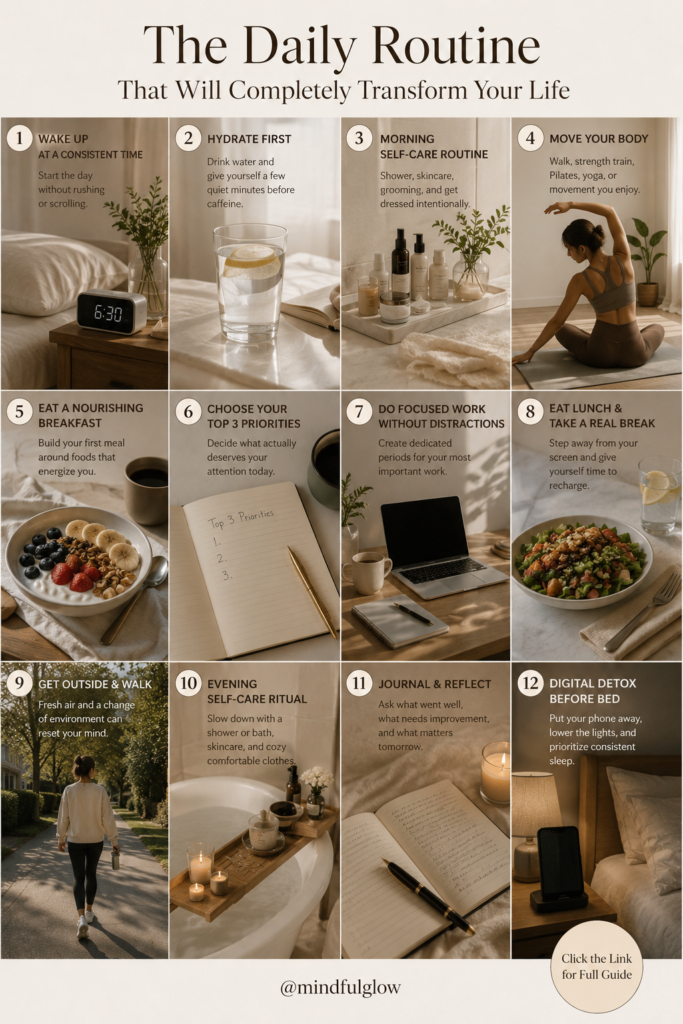
Here is a realistic morning-to-night daily routine designed to help you feel healthier, calmer, more focused, and more in control of your life.
7:00 AM — Wake Up With Intention
How you begin your morning can influence the tone of everything that follows.
Instead of immediately grabbing your phone and entering everyone else’s world, give yourself a few minutes before notifications, emails, and social media.
Open the curtains.
Make your bed.
Drink some water.
Stretch.
Take a few slow moments to actually wake up.
You don’t need an elaborate 5 a.m. routine. A calm, consistent start matters more than waking up ridiculously early.
Try giving yourself 20–30 phone-free minutes after waking.
Your morning should belong to you before it belongs to the internet.
7:15 AM — Hydrate
After sleeping through the night, having some water is an easy way to start your morning.
Keep a glass or bottle somewhere visible so you don’t have to think about it.
You don’t need an elaborate wellness drink every morning. Plain water is perfectly fine.
Then enjoy your coffee, matcha, or tea if that’s part of your routine.
Small habits become powerful when they’re easy enough to repeat.
7:30 AM — Get Ready for Yourself
Even if you’re working or studying from home, getting ready can create a psychological transition between resting and starting your day.
Take a shower.
Do your skincare.
Brush your hair.
Put on clothes that make you feel comfortable and put together.
Apply your favorite fragrance if you enjoy wearing one.
This doesn’t mean you need full makeup and a carefully styled outfit every morning.
The goal is simply to communicate to yourself:
The day has started, and I’m showing up for it.
8:00 AM — Move Your Body
You don’t have to do an intense workout every morning.
Some days might involve strength training.
Others could be Pilates, yoga, running, cycling, swimming, or simply a brisk walk.
Choose movement you can realistically maintain.
Regular physical activity isn’t only about changing how your body looks. It can support your physical health, mood, sleep, energy, and overall well-being.
A routine you enjoy doing consistently will usually serve you better than an extreme routine you abandon after two weeks.
9:00 AM — Eat a Nourishing Breakfast
After getting ready and moving your body, give yourself something nourishing.
Depending on your preferences and needs, breakfast might include:
Greek yogurt with berries and nuts.
Eggs with avocado and whole-grain toast.
Oatmeal with fruit and seeds.
A smoothie alongside something substantial.
Or another balanced meal you genuinely enjoy.
Don’t worry about making your breakfast Pinterest-perfect.
Aim for food that keeps you satisfied and supports the kind of morning you have ahead.
10:00 AM — Focus & Build
Now comes one of the most important parts of your routine:
Doing meaningful work before distractions consume your attention.
Whether you’re building a business, studying, working remotely, creating content, learning a skill, or completing personal projects, protect part of your day for focused work.
Before starting, ask:
What would make today feel genuinely productive?
Then identify your most important task.
Not the easiest task.
Not checking your inbox.
Not reorganizing your planner.
The task that actually moves something forward.
Choose Your Top 3 Priorities
A giant to-do list can create the illusion that everything is equally important.
It isn’t.
Each morning, write down your three most important priorities.
For example:
1. Finish presentation
2. Complete workout
3. Prepare tomorrow’s meeting notes
You can still accomplish smaller tasks afterward.
But completing three meaningful things often feels better than completing fifteen insignificant ones.
Work in Distraction-Free Blocks
Your attention is valuable.
Protect it.
Put your phone somewhere you can’t automatically reach for it.
Close unnecessary browser tabs.
Turn off nonessential notifications.
Choose one task.
Then work on it for a dedicated period before taking a break.
You might prefer 25-minute sessions, 50-minute sessions, or longer blocks.
The exact number isn’t magical.
The principle is simple:
Do one thing at a time.
1:00 PM — Lunch & Nourish
Don’t treat lunch like an inconvenience between work sessions.
Step away from your desk if possible.
Prepare something satisfying.
Drink some water.
Give yourself time to actually eat.
A simple lunch could include vegetables, protein, whole grains or another carbohydrate source, and healthy fats according to your preferences.
And when possible, don’t spend the entire meal scrolling.
Give your brain a genuine break.
4:00 PM — Move & Recharge
Afternoon energy dips are normal.
Instead of automatically reaching for another hour of social media or forcing yourself through work when your concentration has disappeared, change your environment.
Go outside.
Walk for 15–30 minutes.
Feel the sun.
Listen to music or a podcast.
Or occasionally leave your headphones at home and simply pay attention to your surroundings.
Walking can become one of the easiest daily reset rituals.
It creates a clear transition between the intense part of your day and everything that comes afterward.
Get Some Fresh Air Every Day
Modern life makes it surprisingly easy to spend an entire day indoors.
Bedroom.
Car.
Office.
Car.
Living room.
Bed.
Try intentionally getting outside every day when circumstances allow.
Have coffee outside.
Take your lunch to a park.
Walk after dinner.
Sit in your garden.
Small moments outdoors can make an ordinary day feel much less repetitive.
5:00 PM — Reset Your Space
You don’t need to deep-clean your house every evening.
Do a 10-minute reset instead.
Put clothes away.
Clear your desk.
Wash the dishes.
Wipe the kitchen counter.
Return random objects to their places.
Prepare your bedroom.
Set a timer and stop when it rings.
The goal isn’t perfection.
You’re simply making your environment easier for tomorrow-you to live in.
6:00 PM — Do Something for Yourself
Not every hour needs to be optimized.
Your life needs enjoyment too.
Read.
Cook.
Paint.
Garden.
Call someone you love.
Watch an episode of your favorite show.
Practice photography.
Play music.
Learn something simply because you’re curious about it.
A transformed life shouldn’t just be more productive.
It should be more enjoyable.
7:00 PM — Dinner
Dinner can become the point where your day begins slowing down.
Prepare something nourishing and satisfying.
Sit down when possible.
Talk to your family or partner.
Eat without rushing.
You don’t need to make elaborate healthy meals every evening.
Having a collection of simple meals you can prepare consistently makes everyday nutrition much easier.
8:00 PM — Self-Care
This is where the pace begins to change.
Lower the lights.
Take a warm shower or bath.
Do your skincare.
Moisturize.
Put on comfortable clothes.
Make tea.
Light a candle.
Self-care doesn’t need to be expensive.
Often, it’s simply creating a transition between doing and resting.
9:00 PM — Journal & Reflect
Before ending your day, spend a few minutes checking in with yourself.
You don’t need to write pages.
Answer four questions:
What went well today?
What could I have handled better?
What am I grateful for?
What matters most tomorrow?
This gives you an opportunity to learn from your day instead of immediately moving into the next one.
You can also write down anything that’s occupying your mind.
Sometimes putting worries onto paper makes them feel easier to leave outside the bedroom.
9:30 PM — Prepare for Tomorrow
One of the easiest ways to improve your morning is to prepare for it the night before.
Choose tomorrow’s outfit.
Pack your bag.
Check your calendar.
Write your top priorities.
Prepare breakfast ingredients if necessary.
Put your keys where you can find them.
These tiny actions reduce unnecessary decisions when you’re tired or rushing the next morning.
10:00 PM — Digital Detox
Your brain doesn’t necessarily need another 45 minutes of short videos before sleeping.
Create some distance between your phone and your bedtime.
Turn on Do Not Disturb.
Charge your phone away from your pillow if practical.
Dim your lights.
Stop checking work.
Read a physical book.
Stretch.
Journal.
Listen to something calming.
You don’t need to disappear from technology every evening.
Simply create a point where the day officially ends.
10:30 PM — Sleep & Recharge
Sleep shouldn’t be the thing you sacrifice to fit more productivity into your routine.
A sustainable routine includes adequate rest.
Your ideal bedtime will depend on when you need to wake up and your individual sleep needs, but consistency can be helpful.
Create a bedroom environment that encourages rest.
Lower the lights.
Keep things comfortable.
Put tomorrow’s problems down.
The goal is to wake up with enough energy to actually live the life you’re working so hard to improve.
The Routine at a Glance
A realistic version could look something like:
7:00 AM — Wake up + hydrate
7:30 AM — Skincare + get ready
8:00 AM — Movement/workout
9:00 AM — Nourishing breakfast
10:00 AM — Focused work
1:00 PM — Lunch + real break
4:00 PM — Walk + fresh air
5:00 PM — Reset your environment
6:00 PM — Personal time/hobbies
7:00 PM — Dinner
8:00 PM — Self-care
9:00 PM — Journal + reflect
9:30 PM — Prepare for tomorrow
10:00 PM — Digital detox
10:30 PM — Sleep routine
But don’t become obsessed with the clock.
Your schedule may look completely different depending on work, school, children, commuting, family responsibilities, and your natural energy patterns.
Use the structure—not necessarily the exact times.
Don’t Try to Become a New Person Overnight
This is where most “perfect routine” plans fail.
Someone sees an inspiring routine online and decides that tomorrow they’re going to:
Wake at 5 a.m.
Meditate.
Journal.
Run five miles.
Drink green juice.
Read 50 pages.
Work eight hours.
Cook every meal.
Clean the house.
Do skincare.
Never use social media.
And sleep perfectly.
Three days later, they’re exhausted.
Transformation doesn’t require changing everything simultaneously.
Choose three habits first.
For example:
Week 1: consistent wake time + morning water + evening walk.
Once those feel normal, add something else.
The goal is to make healthy behaviors part of your ordinary life—not perform an extreme routine temporarily.
Discipline Should Create Freedom
A good routine isn’t supposed to make your life feel like a prison.
It’s supposed to reduce unnecessary chaos.
When you know when you’ll work, you can relax without feeling guilty.
When you prepare for tomorrow, your mornings become easier.
When movement becomes routine, you don’t have to debate whether you’ll exercise every day.
When your evening has a stopping point, work doesn’t consume your entire life.
Structure creates space.
And that space gives you more freedom to enjoy your life.
The Real Secret to Transforming Your Life
It’s tempting to believe that transformation will happen after one enormous breakthrough.
Usually, it looks much less dramatic.
It’s making your bed when nobody cares.
Taking the walk when you’d rather scroll.
Completing the work you promised yourself you’d finish.
Preparing tomorrow’s clothes.
Putting your phone away.
Going to bed.
Getting up and doing it again.
Not perfectly.
Consistently.
Your future is being built inside ordinary Tuesdays just as much as birthdays, New Year’s resolutions, and major life events.
So don’t wait for the perfect Monday.
Improve tomorrow.
Then improve the day after that.
Eventually, the habits that once required discipline simply become the way you live.
And that’s when your life begins to look completely different.