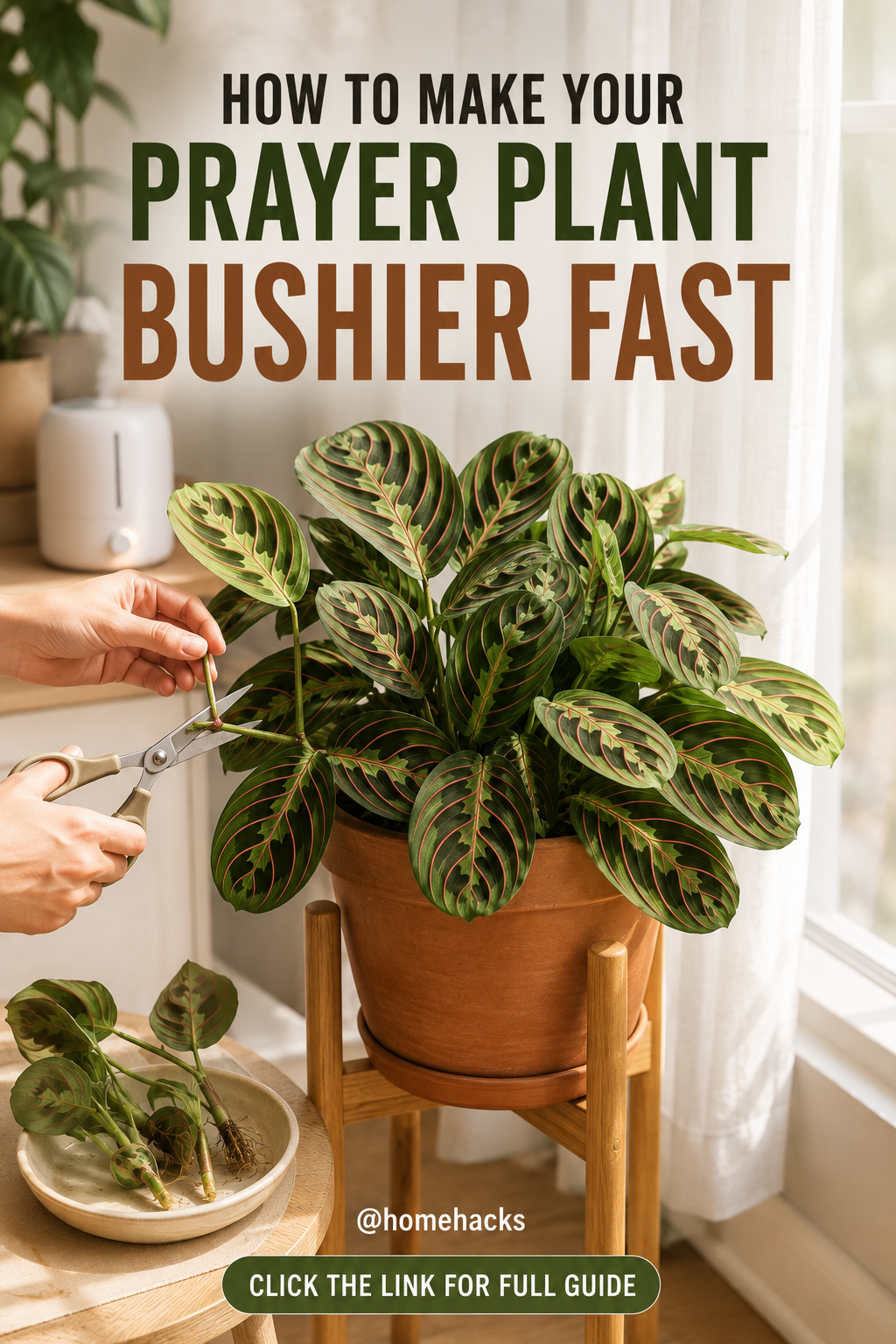
Prayer plants are already some of the most beautiful indoor plants, with their patterned green leaves, colorful veins, and fascinating habit of folding their leaves upward at night. But when a prayer plant starts developing long stems with large gaps between leaves, it can lose that lush, full appearance.
Fortunately, a sparse prayer plant doesn’t have to stay that way. With strategic pruning, good light, proper watering, humidity, and propagation, you can encourage healthier growth and create a much fuller-looking pot.
Here are 10 practical ways to make your Prayer Plant (Maranta) bushier and more beautiful.
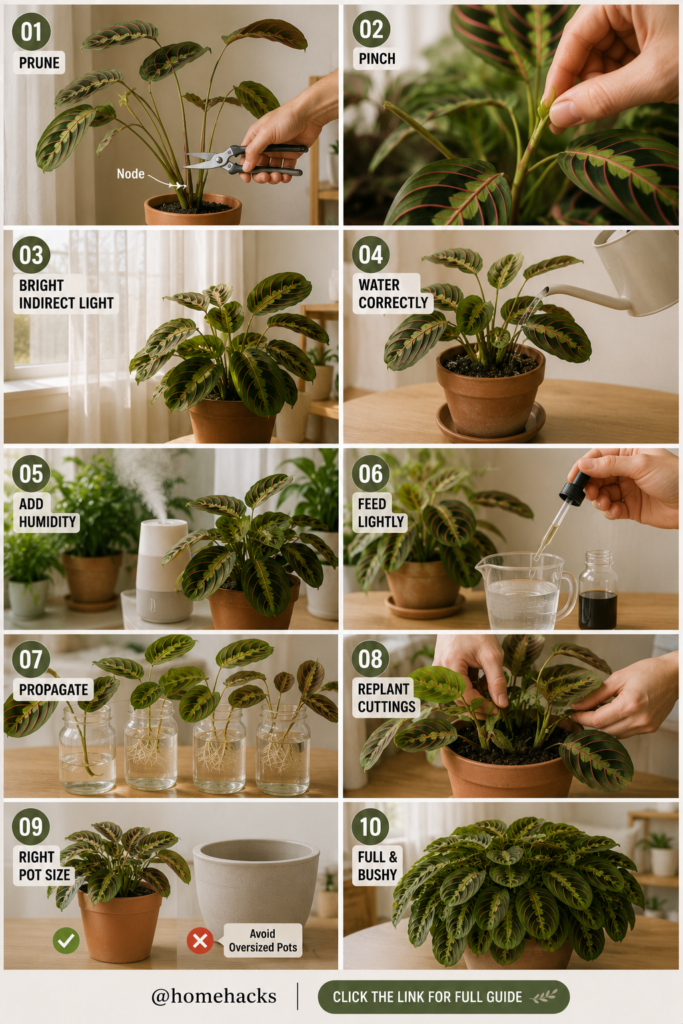
1. Prune Long, Leggy Stems
Pruning is one of the best places to start when your prayer plant looks stretched or uneven.
Look for unusually long stems with large spaces between the leaves. Using clean, sharp scissors, trim the stem just above a healthy node.
A node is the point on the stem where leaves and new growth can emerge.
Pruning helps control the plant’s shape and can encourage new growth rather than allowing individual stems to continue becoming longer and leggier.
Avoid heavily pruning a stressed plant all at once. A gradual approach is usually better.
2. Pinch the Growing Tips
You don’t always need to remove an entire stem.
When your prayer plant is actively growing, selectively pinching or trimming the ends of longer shoots can help maintain a more compact shape.
This works especially well as ongoing maintenance once you’ve achieved the fullness you want.
Regularly inspect the plant and address individual stems before they become excessively long.
3. Provide Bright, Indirect Light
Light has a major influence on the shape of your prayer plant.
When a Maranta doesn’t receive enough light, its stems may stretch toward the brightest available source. This can create the sparse, leggy appearance you’re trying to avoid.
Position your plant where it receives plenty of bright but indirect light.
A location near an east-facing window or behind a sheer curtain can work well in many homes.
Avoid suddenly placing it in harsh direct sunlight. Strong sun can scorch the leaves and fade their beautiful patterns.
Rotate the pot occasionally if one side consistently grows toward the window.
4. Water Consistently
Prayer plants generally prefer their potting mix to remain moderately and consistently moist rather than becoming extremely dry between waterings.
Check the soil regularly and water when the upper portion begins to feel slightly dry.
When watering, thoroughly moisten the potting mix and allow excess water to drain from the bottom.
Don’t allow the plant to sit permanently in standing water. Constantly saturated soil can deprive roots of oxygen and contribute to root problems.
Healthy roots are essential if you want healthy new foliage.
5. Maintain Good Humidity
Marantas originate from humid tropical environments, so extremely dry indoor air can make them unhappy.
Low humidity may contribute to crispy leaf edges and stressed-looking foliage.
If your home’s air is particularly dry, a small humidifier near your plants can provide more consistent humidity. Grouping compatible houseplants together can also help create a slightly more humid microenvironment.
Keep reasonable airflow around the foliage as well.
6. Feed Lightly During Active Growth
Your prayer plant needs nutrients to produce healthy new foliage, but overfeeding won’t magically make it bushier.
During periods of active growth, use an appropriate balanced houseplant fertilizer according to the product instructions.
It’s usually better to fertilize conservatively than to repeatedly apply excessive amounts.
Too much fertilizer can cause root damage and leaf problems—the opposite of the lush appearance you’re trying to achieve.
Reduce feeding when the plant’s growth naturally slows.
7. Propagate Healthy Cuttings
This is where your pruning work can become especially useful.
Instead of throwing away healthy trimmed stems, turn suitable pieces into new plants.
Choose healthy stem cuttings that contain at least one appropriate node. Depending on your preferred method, Maranta cuttings can be rooted in water or a suitable propagation medium.
If rooting them in water, make sure the node is positioned appropriately for rooting while keeping unnecessary foliage out of the water.
Place the cuttings somewhere warm with bright, indirect light and change or refresh the water as needed.
Once a healthy root system develops, they’re ready for the next trick.
8. Plant Rooted Cuttings Back Into the Original Pot
If you want a dramatically fuller-looking prayer plant, this is one of the most effective techniques.
Instead of placing every rooted cutting into a separate pot, plant several back into gaps around the original plant.
This increases the number of stems growing from the container, immediately creating the foundation for a denser display.
Space the cuttings naturally around sparse areas rather than placing them all in one spot.
As the original plant and propagated cuttings continue growing together, the pot can become noticeably fuller.
9. Don’t Use an Oversized Pot
It’s tempting to think a huge container will encourage a huge plant, but that’s not necessarily how it works.
An oversized pot contains more soil than a smaller root system can quickly use. That additional soil may remain wet for longer, increasing the risk of watering problems.
Choose a pot appropriate for the size of your prayer plant’s root system and always make sure excess water can drain.
Repot when the plant genuinely needs more root space rather than simply because you want faster growth.
10. Give Your Plant Stable Growing Conditions
Prayer plants tend to appreciate consistency.
Try to protect your plant from cold drafts, sudden temperature changes, heating vents, and strong air-conditioning.
Once you’ve found a location with suitable light, warmth, and humidity, avoid constantly moving the plant around the house.
Healthy, stable growing conditions give your Maranta the opportunity to concentrate on producing attractive new foliage.
The Fastest Way to Get a Fuller Prayer Plant
If your prayer plant is already very sparse, waiting for one stem to branch won’t necessarily create the dramatic transformation you want.
A more effective strategy is to combine several methods:
Prune the longest stems → propagate the healthy cuttings → improve the plant’s light → root the cuttings → plant them back into the original pot.
This approach improves the shape of the existing plant while physically adding additional growing stems to the container.
That’s why propagation and replanting are particularly useful when your goal is a noticeably fuller pot.
Why Is My Prayer Plant Growing Leggy?
Insufficient light is one common reason.
If the plant has to stretch toward a window, the distance between leaves may increase and the plant can look thinner.
Lack of pruning can also allow older stems to grow long and outward.
Seasonal conditions matter too. Your prayer plant may grow differently during darker or cooler parts of the year.
If legginess appears alongside significant yellowing, wilting, leaf loss, or persistently wet soil, investigate the plant’s overall health before focusing solely on appearance.
How Long Does It Take to Become Bushier?
Pruning changes the plant’s shape immediately, but producing substantial new foliage takes time.
Under favorable growing conditions, you may notice new growth developing over the following weeks. Creating a dramatically fuller plant—especially through propagation—can take longer because cuttings first need to establish roots and begin producing their own foliage.
Think of bushiness as a gradual transformation rather than an overnight fix.
Common Mistakes to Avoid
Some well-intentioned care can actually slow your progress. Avoid overwatering because you’re trying to encourage faster growth, using excessive fertilizer, suddenly exposing the plant to intense direct sunlight, placing a small plant into an enormous pot, or aggressively removing too much foliage at once.
Also don’t expect misting alone to solve consistently dry indoor conditions. If humidity is genuinely low, a humidifier can provide a more meaningful improvement.
Final Thoughts
A lush prayer plant isn’t created by one secret product. It’s the result of healthy roots, appropriate light, consistent moisture, good humidity, sensible feeding, and strategic pruning.
For the biggest visual transformation, don’t throw away those healthy pruned stems. Propagate them and plant the rooted cuttings back into sparse areas of the original pot.
With good growing conditions and a little patience, your leggy Prayer Plant can gradually become the dense, vibrant, bushy houseplant you’re hoping for.