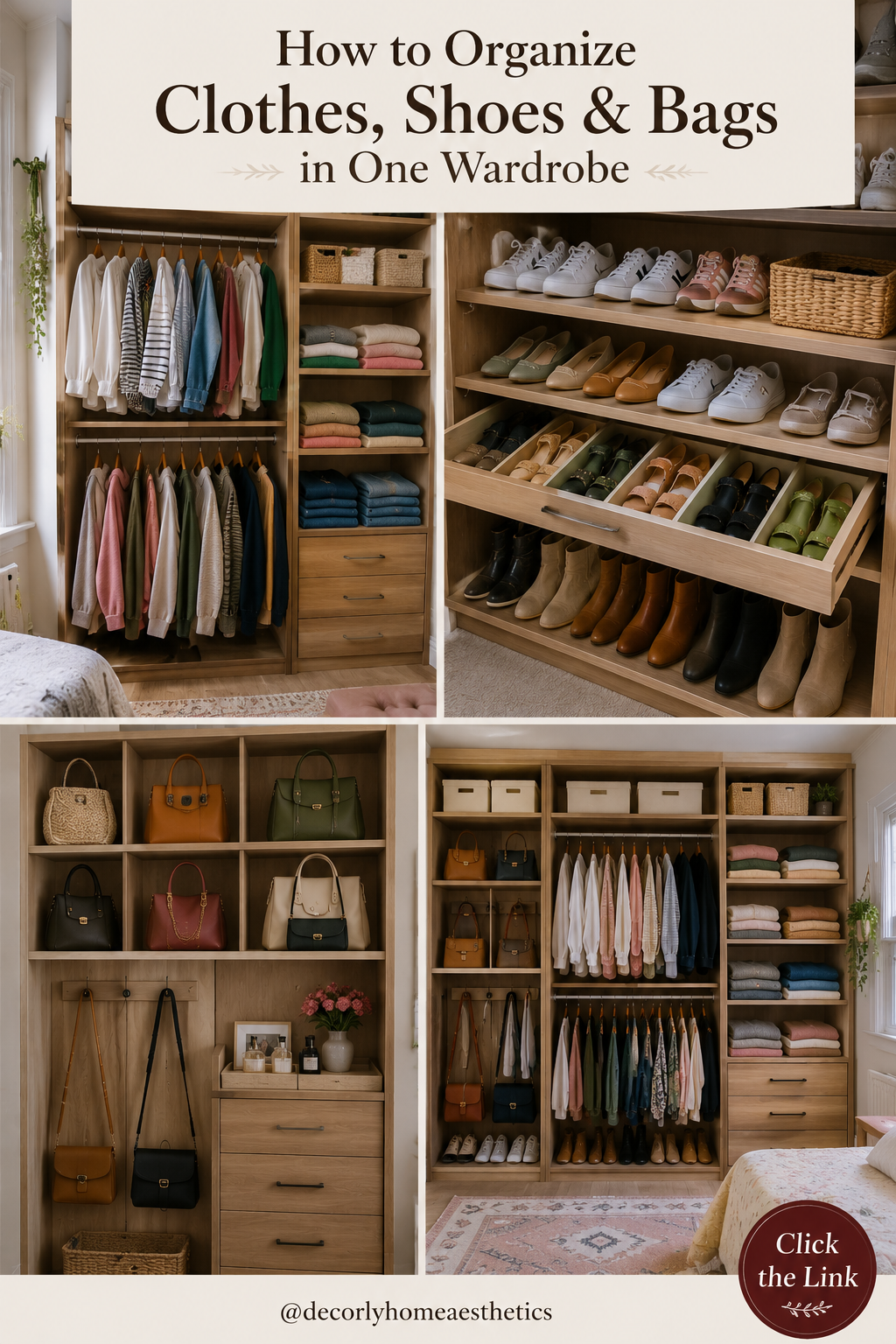
A wardrobe can be surprisingly big and still feel like there’s never enough room.
You hang up a few jackets, stack some sweaters, put your shoes along the bottom, and suddenly there’s nowhere sensible for your handbags. Before long, clothes are pushed together, shoes are hiding behind each other, and the top shelf becomes the place where everything you don’t know what to do with ends up.
I’ve found that the problem usually isn’t the size of the wardrobe. It’s how the space is divided.
When clothes, shoes, bags, and accessories all have their own little zones, even an ordinary bedroom wardrobe can hold much more than you’d expect. More importantly, you can actually see what you own.
If you’re working with one wardrobe rather than a separate walk-in closet, here are 15 practical ways to organize clothes, shoes, and bags without making the space feel packed.
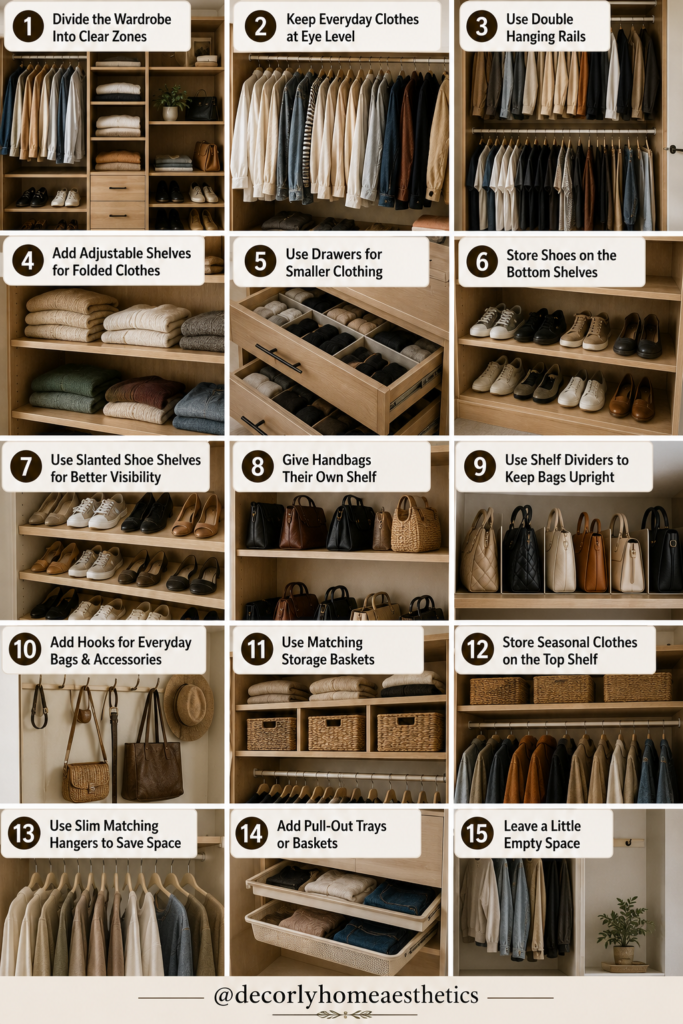
1. Divide the Wardrobe Into Clear Zones
Before buying organizers, empty the wardrobe and look at the space itself.
Then decide what each section is going to do.
For example, you might have:
- one section for hanging clothes
- one for folded clothes
- lower shelves for shoes
- upper shelves for bags
- drawers for smaller items
- the very top for seasonal storage
This sounds simple, but it makes a huge difference.
Without zones, wardrobes slowly become mixed storage spaces. A handbag gets placed beside sweaters, sneakers end up beneath dresses, and scarves somehow appear everywhere.
Once everything has a designated area, putting things away becomes much easier.
2. Keep Everyday Clothes at Eye Level
The easiest part of your wardrobe to reach should hold the things you wear most often.
That might mean work shirts, everyday trousers, jeans, favorite sweaters, or whatever you normally reach for during the week.
Special-occasion dresses and rarely worn pieces don’t need prime wardrobe space.
I like to think of the middle of the wardrobe as the everyday zone. The higher and lower you go, the less frequently you should need those items.
It makes getting dressed in the morning much quicker.
3. Use Double Hanging Rails
A single hanging rail often wastes a surprising amount of vertical space.
If most of your wardrobe consists of shirts, blouses, jackets, skirts, and folded trousers, consider installing two rails—one above the other.
You could hang shirts and jackets on the upper rail and trousers or shorter pieces underneath.
Keep one full-height section for long dresses, coats, and other pieces that genuinely need the extra drop.
This is one of the simplest ways to increase hanging storage without making the wardrobe itself any bigger.
4. Add Adjustable Shelves for Folded Clothes
Not everything belongs on a hanger.
Sweaters, knitwear, jeans, sweatshirts, and casual clothing often work better folded.
Adjustable shelves are particularly useful because your storage needs will probably change over time.
And don’t make the stacks too high.
A tower of twelve sweaters might look organized for five minutes, but the moment you pull one from the middle, the whole thing starts leaning.
Several smaller stacks are much easier to maintain.
5. Use Drawers for Smaller Clothing
Some items simply don’t behave well on open shelves.
Underwear, socks, sleepwear, gym clothes, and small accessories are much easier to manage inside drawers.
Drawer dividers can help, but you don’t necessarily need a complicated organizing system.
Even a few simple sections are enough.
The goal is to prevent the drawer from becoming one large pile that you have to dig through every morning.
6. Store Shoes Along the Bottom
The bottom of the wardrobe is naturally one of the best places for shoes.
They’re heavier than clothing, they don’t need to be at eye level, and keeping them low prevents dirt from being carried over clean clothes and handbags.
Arrange the shoes you wear regularly where they’re easiest to reach.
Occasional heels, formal shoes, and seasonal footwear can go slightly farther back or on a higher shoe shelf.
If possible, avoid throwing shoes into one large basket. It saves space initially but makes finding a matching pair surprisingly annoying.
7. Try Slanted Shoe Shelves
If you’re designing a wardrobe from scratch, slightly angled shoe shelves can be worth considering.
They allow you to see more of each shoe rather than only the heel or toe.
They’re particularly nice for heels, loafers, and sneakers.
For a smaller wardrobe, though, flat shelves may actually use space more efficiently.
So I wouldn’t add angled shelving just because it looks good in luxury closet photos. Choose whichever option gives your particular wardrobe the most usable storage.
8. Give Handbags Their Own Shelf
Handbags are awkward to organize because they’re all different shapes.
Some stand beautifully on their own. Others collapse the moment you put them down.
Giving bags their own shelf solves a lot of that frustration.
Keep the bags you use frequently at eye level or slightly above it. Occasion bags can go higher.
And don’t squeeze them together too tightly.
Leather and structured bags can lose their shape when they’re constantly pressed against one another.
A little breathing room makes the shelf look better and protects the bags at the same time.
9. Use Shelf Dividers to Keep Bags Upright
If handbags keep falling into one another, simple shelf dividers can help.
Think of them almost like bookends.
Each bag gets its own small section, which makes it easier to take one out without disturbing everything beside it.
This works particularly well for totes, clutches, and medium-sized structured bags.
You don’t need a divider between every single bag, either. Sometimes adding just two or three is enough to keep the whole shelf under control.
10. Add Hooks for Everyday Bags and Accessories
Not everything needs a shelf.
A few hooks on the inside wall or door of the wardrobe can be incredibly useful for everyday pieces.
Use them for a crossbody bag, belt, lightweight scarf, hat, or tomorrow’s outfit.
Just be careful not to cover every available surface with hooks.
Once too many things are hanging from the doors and walls, the wardrobe starts feeling cluttered again.
I prefer a small number of hooks reserved for things I genuinely use regularly.
11. Use Matching Storage Baskets
Baskets are perfect for all the awkward things that don’t fit neatly into another category.
Scarves, hats, swimwear, small purses, spare accessories, and seasonal items can all live inside them.
Using similar baskets gives the wardrobe a calmer appearance, especially when they’re sitting on open shelves.
Woven baskets look beautiful in warm wood wardrobes, while fabric boxes work well in more modern closets.
Labels can also help if the baskets are above eye level.
There’s nothing particularly efficient about pulling down four boxes just to discover which one contains your winter scarves.
12. Move Seasonal Clothes to the Top
The highest shelf is valuable storage, but it’s usually not convenient storage.
That’s exactly why it’s perfect for seasonal clothing.
During summer, store bulky sweaters, scarves, and winter accessories there. When colder weather arrives, swap them with summer dresses, swimwear, and other warm-weather pieces.
Use breathable fabric storage bags or appropriate boxes rather than simply pushing loose clothing onto the shelf.
A seasonal wardrobe swap also gives you a good opportunity to notice clothes you haven’t worn in a very long time.
13. Switch to Slim Matching Hangers
Bulky hangers can quietly take up a huge amount of wardrobe space.
Slim hangers allow clothes to sit closer together without needing another rail.
Using the same style also makes the wardrobe visually calmer.
That doesn’t mean every hanger has to be identical if certain clothes need more support. Heavy coats and structured jackets may still need sturdier hangers.
But for shirts, dresses, and lightweight clothing, slim hangers are usually a very easy upgrade.
14. Add Pull-Out Trays or Baskets
Deep wardrobes often have one annoying problem: things disappear at the back.
Pull-out storage solves this beautifully.
A pull-out basket can hold folded clothing, workout clothes, scarves, or accessories. A shallow pull-out tray is great for jewelry, sunglasses, belts, watches, or smaller handbags.
Being able to bring the entire storage area toward you means you’re much more likely to use what you’ve stored there.
If you’re planning custom cabinetry, this is one feature I’d seriously consider.
15. Leave a Little Empty Space
This might be the most overlooked wardrobe organization tip.
Don’t try to fill every inch.
A perfectly packed wardrobe might look efficient, but it’s difficult to use.
Clothes need enough room to slide along the rail. Bags shouldn’t be crushed together. Shoes should be easy to remove without pulling out three other pairs first.
And realistically, you’ll probably buy something new eventually.
Leaving even 10–15% of the wardrobe relatively open makes the entire closet feel easier to manage.
How to Decide Where Everything Should Go
A simple rule works surprisingly well:
Most-used items = easiest to reach.
Occasionally used items = slightly higher or lower.
Rarely used and seasonal items = top shelf or deeper storage.
It sounds obvious, but many wardrobes are organized according to what fits rather than how often things are actually used.
That’s how you end up reaching over a suitcase every morning to get your favorite sweater.
Organize around your routine instead.
A Simple Wardrobe Layout That Works
If you’re starting from scratch, I would divide a medium-sized wardrobe roughly like this:
Use the upper shelf for seasonal clothing and storage baskets.
Use the middle section for hanging everyday clothes and folded pieces.
Give one side section to handbags and accessories.
Use drawers for underwear, socks, sleepwear, and smaller clothing.
Reserve the bottom section for shoes.
It doesn’t need to be perfectly symmetrical.
A good wardrobe should reflect what you actually own. Someone with twenty pairs of shoes needs a different layout from someone with five pairs of shoes and fifteen handbags.
Don’t Organize Things You Don’t Actually Want
Before investing in new baskets, shelves, or organizers, go through your clothes.
This is probably the least exciting part, but it saves the most space.
If something doesn’t fit, hasn’t been worn for years, is damaged beyond repair, or simply isn’t your style anymore, decide whether it needs to keep occupying valuable wardrobe space.
Do the same with shoes and bags.
Organizing 30 things you don’t use isn’t really organization. It’s just arranging clutter more neatly.
How to Keep Your Wardrobe Organized
The best closet system is one that’s easy enough to maintain on a normal Tuesday evening when you’re tired.
Don’t create a system where every T-shirt has to be folded perfectly or every handbag has to be wrapped and boxed after each use.
Make putting something away almost as easy as taking it out.
Hang clothes back on the correct rail.
Return shoes to their shelf.
Put bags back in their section.
Drop smaller accessories into their designated drawer or basket.
Then spend five or ten minutes every couple of weeks straightening anything that’s started to wander.
That small reset is much easier than reorganizing the entire wardrobe every few months.
Make It Look Good Without Making It Impractical
A beautiful wardrobe can make getting dressed more enjoyable, but functionality should come first.
Matching hangers help.
A few attractive baskets help.
Warm wood, good lighting, and simple labels can make the whole closet feel more intentional.
But don’t hide everyday items inside beautiful boxes if opening those boxes becomes annoying.
And don’t arrange your shoes like a boutique if it means you can’t actually fit the shoes you wear.
The prettiest wardrobe is one that still works when nobody is taking a photograph of it.
Final Thoughts
You don’t necessarily need a walk-in closet to have an organized wardrobe.
You need clear zones, useful shelves, enough hanging space, practical shoe storage, a proper place for handbags, and a little breathing room.
Start with what you use most.
Put everyday clothes where you can see them. Keep shoes low. Give bags enough room to hold their shape. Move seasonal pieces up high. Use drawers and baskets to control all the smaller things that usually create clutter.
Most importantly, don’t try to make your wardrobe look perfect.
Make it easy to live with.
Because when every shirt, pair of shoes, and handbag has an obvious place to return to, keeping your wardrobe organized stops feeling like another job—and starts becoming part of your normal routine.