
If you make coffee every morning, you’ve probably thrown away hundreds of spoonfuls of used coffee grounds without thinking twice.
I used to think of them as nothing more than kitchen waste. But coffee grounds contain organic matter and small amounts of nutrients, which means they can have a second life in the garden.
That doesn’t mean you should finish your coffee and immediately dump a thick layer of wet grounds into your favorite houseplant.
That’s where a lot of gardening advice online gets misleading.
Used coffee grounds are generally most useful when added to compost, incorporated sparingly into appropriate garden systems, or used as part of a balanced soil-building routine. Fresh coffee grounds and brewed coffee aren’t the same thing either, and plants don’t automatically become healthier simply because coffee is involved.
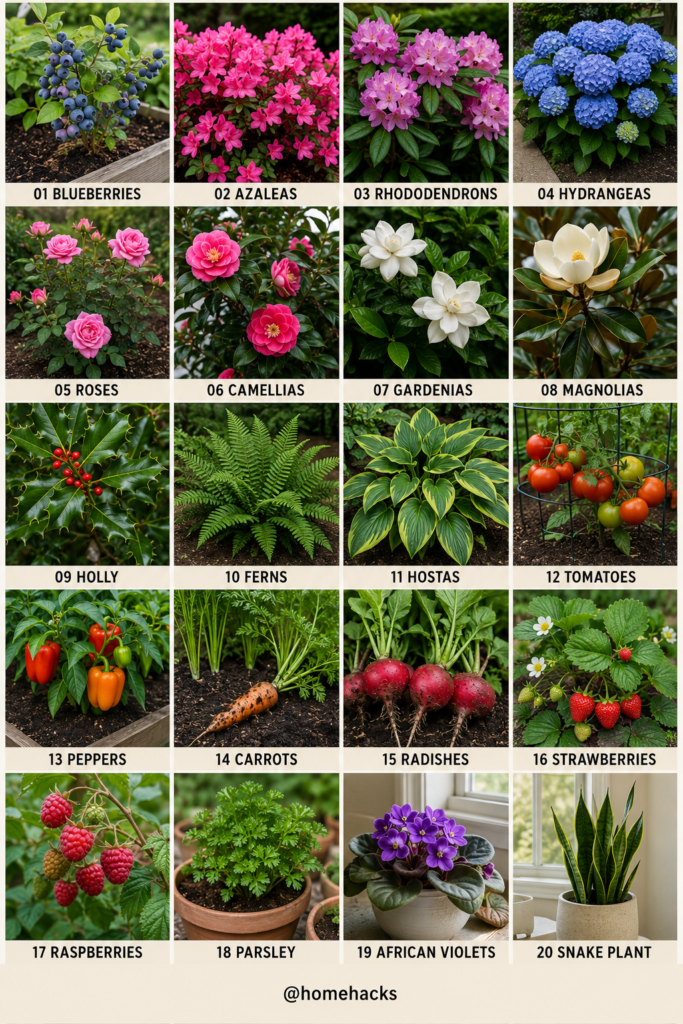
So, if you’ve been wondering which plants may benefit from coffee grounds and how to use them properly, here are 20 popular plants worth knowing.
1. Roses
Roses are probably one of the first plants people mention when talking about coffee grounds.
Used grounds contain some nitrogen and organic material, but they shouldn’t replace a proper rose fertilizer.
A better approach is to add your grounds to a compost pile and later use the finished compost around your roses.
This gives the grounds time to break down alongside other organic materials.
Your roses get the benefit of richer organic matter without sitting under a thick mat of wet coffee.
2. Hydrangeas
Coffee grounds and hydrangeas are often paired online because people assume coffee will automatically turn hydrangeas blue.
It’s not quite that simple.
Hydrangea flower color in suitable varieties is influenced by soil chemistry, particularly pH and aluminum availability. Used coffee grounds aren’t a reliable way to dramatically change soil pH.
They can, however, become part of the organic material going into your compost.
If you’re trying to change hydrangea color, test your soil first rather than guessing.
3. Blueberries
Blueberries genuinely prefer acidic growing conditions, which is why they’re constantly included in lists about coffee grounds.
But don’t assume coffee grounds alone will create the soil blueberries need.
Blueberries can be quite particular about soil pH.
If you’re growing them seriously, use a soil test and manage the soil according to the plant’s actual requirements.
Composted coffee grounds can contribute organic matter, but they’re not a substitute for proper soil management.
4. Azaleas
Azaleas also prefer acidic soil, making them another popular candidate.
Again, the safest way to think about used coffee grounds is as an ingredient rather than a treatment.
Mix them into a balanced compost pile with leaves, plant trimmings, and other appropriate compostable materials.
Once everything has decomposed, that finished compost can become much more useful in the garden.
5. Rhododendrons
Rhododendrons share similar soil preferences with azaleas.
They generally appreciate organic-rich conditions, but dumping fresh piles of coffee grounds around their roots isn’t necessary.
Use compost containing coffee grounds instead.
A good garden is rarely built around one magical ingredient.
It’s usually the result of consistently improving soil over time.
6. Camellias
Camellias are another acid-loving garden favorite.
Their glossy leaves and beautiful flowers make them worth looking after properly.
Coffee grounds can go into the compost that eventually feeds organic matter back into the garden.
But if your camellia is yellowing or struggling, don’t immediately reach for the coffee pot.
Yellow leaves can have many causes, so investigate the plant’s light, moisture, drainage, nutrients, and soil conditions first.
7. Gardenias
Gardenias have a reputation for being a little fussy.
They like suitable acidic soil and consistent growing conditions.
Because of that, randomly changing their soil with kitchen leftovers isn’t something I’d recommend.
Instead, compost your used coffee grounds first and use the finished material as part of a thoughtful garden-care routine.
Gardenias will appreciate good growing conditions much more than gardening gimmicks.
8. Magnolias
Magnolias can benefit from healthy soil containing plenty of organic matter.
Coffee grounds can contribute to that organic matter when they’re composted with other materials.
For established trees and shrubs, think bigger than individual handfuls of kitchen scraps.
Good mulching practices, suitable soil, adequate water, and species-appropriate care will have a much greater impact.
9. Ferns
Ferns look like obvious candidates for coffee-ground gardening hacks because many enjoy moisture and organic-rich conditions.
But that doesn’t mean a layer of wet coffee grounds belongs on top of every fern pot.
For outdoor ferns, finished compost containing coffee grounds may help improve organic matter.
For indoor ferns, I’d be more conservative. Houseplant containers are small ecosystems, and adding decomposing kitchen waste directly to them can create unnecessary problems.
10. African Violets
You’ll often see African violets mentioned on lists of houseplants that supposedly “love coffee.”
Be careful with this one.
African violets have specific requirements for potting mix, moisture, light, and fertilization.
I wouldn’t pour leftover coffee into the pot or routinely bury coffee grounds around the roots.
If you’re growing African violets indoors, a fertilizer and potting mix designed for their needs is much more predictable.
Coffee grounds are better sent to your compost pile.
11. Peace Lilies
Peace lilies are another plant that appears frequently in coffee-ground hacks.
They’re beautiful houseplants, but they’re also easy to overwater.
Adding wet organic kitchen material directly to a container can complicate moisture management and may encourage unwanted fungal growth or pests.
If you want to reuse your coffee grounds, compost them elsewhere.
Your peace lily doesn’t need to become the compost bin.
12. Pothos
Pothos are famously forgiving houseplants.
That still doesn’t mean they need coffee grounds.
A healthy pothos generally needs appropriate light, sensible watering, good drainage, and occasional suitable fertilization.
If your pothos is already thriving, there’s little reason to start burying coffee grounds in its pot because you saw the trick online.
Use the grounds in compost instead and keep your houseplant routine simple.
13. Monstera
The big glossy Monstera in Pinterest photographs makes coffee-ground gardening look very convincing.
But direct application isn’t necessary.
Monsteras prefer an airy, well-draining growing medium. Regularly adding wet coffee grounds can work against that goal if the material accumulates or compacts.
For indoor Monsteras, stick with an appropriate potting mix and fertilizer.
Your used grounds can still be useful—just send them to the compost pile instead.
14. Snake Plants
Snake plants are particularly important to mention because they’re easy to care for largely because they don’t want constant attention.
They’re also susceptible to problems when kept too wet.
So I wouldn’t add damp coffee grounds directly to a snake plant pot.
Give the plant good drainage and appropriate watering instead.
Sometimes the best gardening hack is knowing when not to add something.
15. Tomatoes
Now we’re back outdoors.
Tomatoes are hungry plants, and healthy soil matters enormously when you’re trying to produce a good crop.
Used coffee grounds can become one ingredient in compost that eventually goes into your vegetable beds.
Don’t rely on coffee grounds as your tomato fertilizer, though.
Tomatoes need balanced nutrition throughout their growing season, and coffee grounds alone won’t provide everything they require.
16. Carrots
Carrots prefer loose soil that allows roots to develop without obstruction.
Organic matter can help improve garden soil structure when it’s properly decomposed.
Finished compost containing coffee grounds can therefore be useful when preparing suitable vegetable beds.
But avoid turning the planting row into a layer of fresh coffee waste.
The goal is healthy soil—not visible coffee grounds.
17. Radishes
Radishes grow quickly, which makes them a fun crop for beginner gardeners.
Like carrots, they benefit from appropriately prepared soil.
If you’ve been composting coffee grounds with your other kitchen and garden materials, mature compost can be incorporated into the garden according to your soil’s needs.
It’s another example of coffee grounds being useful indirectly rather than acting as a miracle fertilizer.
18. Strawberries
Strawberries enjoy fertile, well-managed soil and can benefit from organic matter.
Composted coffee grounds can become part of that system.
But fruit production depends on much more than one soil amendment.
Sunlight, water, drainage, plant nutrition, variety, climate, and pest management all matter.
Think of coffee grounds as one tiny piece of the gardening puzzle.
19. Hostas
Hostas are loved for their lush foliage and ability to brighten shady garden areas.
Adding good finished compost around established hostas can help support healthy soil.
Coffee grounds can contribute to that compost.
You may also hear that coffee grounds repel slugs. I wouldn’t rely on them as your main slug-control strategy. If pests are causing serious damage, use proven management methods appropriate for your garden.
20. Christmas Cactus
Christmas cactus is another houseplant frequently included on “coffee-loving plants” lists.
But it doesn’t need coffee poured into its pot.
These plants have their own watering, light, drainage, and feeding requirements.
If you have a healthy Christmas cactus, there’s no reason to experiment with regular doses of kitchen coffee waste.
Compost the grounds and give the plant the conditions it actually needs.
So, What Is the Best Way to Use Coffee Grounds?
For most home gardeners, the simplest answer is:
Compost them.
Used coffee grounds can be mixed with other compostable materials rather than forming the entire pile.
Think of your compost as a recipe.
Coffee grounds are one ingredient.
You also want plenty of carbon-rich materials such as dry leaves, cardboard appropriate for composting, or other suitable “brown” materials, alongside your nitrogen-rich “greens.”
Once everything has broken down into mature compost, you’ve created something much more versatile for your garden.
Can You Put Coffee Grounds Directly on Soil?
A tiny amount mixed appropriately into an outdoor soil or compost system is very different from repeatedly dumping your entire coffee filter around one plant.
Avoid creating a thick layer.
Fine coffee grounds can clump together, and a dense layer may interfere with the movement of water and air.
If you’re experimenting with direct garden use, keep quantities modest and mix them with other organic material rather than creating a coffee-ground blanket.
For indoor potted plants, I’m much more cautious.
Containers have limited soil volume, drainage, and biological activity compared with an outdoor garden bed. Directly adding kitchen waste can also encourage mold, odors, or pests.
Composting first is the easier option.
Are Used Coffee Grounds Acidic?
This is probably the biggest misconception surrounding coffee grounds.
Coffee itself is acidic, so it’s easy to assume the grounds left behind must dramatically acidify your soil.
But much of coffee’s acidity ends up in the drink during brewing, and used grounds aren’t a reliable substitute for actually testing and managing soil pH.
That’s especially important with plants such as blueberries, hydrangeas, azaleas, and rhododendrons.
If soil acidity matters, test the soil.
Don’t let your morning coffee make the diagnosis.
Fresh Coffee Grounds vs. Used Coffee Grounds
They’re not interchangeable.
Fresh, unbrewed coffee grounds can behave differently from grounds that have already been brewed.
Most household garden-reuse discussions are referring to used coffee grounds.
If your goal is simply to reduce kitchen waste, used grounds are easy to collect.
Let them cool, then add them to your compost with a good mixture of other materials.
You don’t need to save enormous quantities.
Regular small additions are plenty for most household compost systems.
Don’t Pour Leftover Coffee Into Every Houseplant
This trend deserves its own warning.
Plants don’t need milk, flavored syrups, sugar, artificial sweeteners, cream, or whatever else might be sitting at the bottom of your coffee cup.
Don’t pour specialty coffee drinks into your plants.
Even plain coffee isn’t necessary as a routine houseplant treatment.
Your plants will generally be happier when you give them the correct water, light, potting mix, and fertilizer rather than treating the pot like somewhere to dispose of leftovers.
Coffee Grounds Aren’t a Complete Fertilizer
Coffee grounds contain nutrients, but that doesn’t make them a complete replacement for plant nutrition.
Different plants need different nutrient levels at different stages of growth.
Tomatoes producing fruit have different demands from a slow-growing indoor snake plant.
That’s why “feed all your plants coffee grounds” is such an oversimplification.
Use coffee grounds to support a broader soil-building and composting strategy, not as the only thing feeding your garden.
Other Ways to Reduce Coffee Waste
If you produce a lot of coffee grounds and your garden can’t use all of them, you still don’t have to throw everything away.
Depending on your local options, you might be able to add them to municipal food-waste or compost collection.
Gardeners with larger compost systems can combine them with leaves and other compostable materials.
The important part is not forcing coffee grounds into every flowerpot simply because you want to reuse them.
Sometimes the compost bin really is the perfect destination.
Final Thoughts
Coffee grounds can absolutely have a second life after breakfast.
But the smartest approach isn’t walking around your house sprinkling them into every plant pot.
Instead, collect your used coffee grounds, combine them with a balanced mix of compostable materials, let nature break everything down, and eventually return that finished organic matter to your garden.
Plants such as roses, blueberries, hydrangeas, azaleas, rhododendrons, tomatoes, strawberries, hostas, and many others can benefit from healthy, organic-rich soil—and coffee grounds can play a small role in creating it.
For houseplants such as Monstera, pothos, peace lilies, African violets, and snake plants, be much more careful with direct application. Good potting mix, drainage, watering, light, and appropriate fertilizer are far more important.
So tomorrow morning, don’t necessarily throw those grounds in the trash.
Just don’t dump the whole coffee filter into your Monstera either.
Compost them, use them thoughtfully, and let your morning coffee become one small part of a healthier garden.