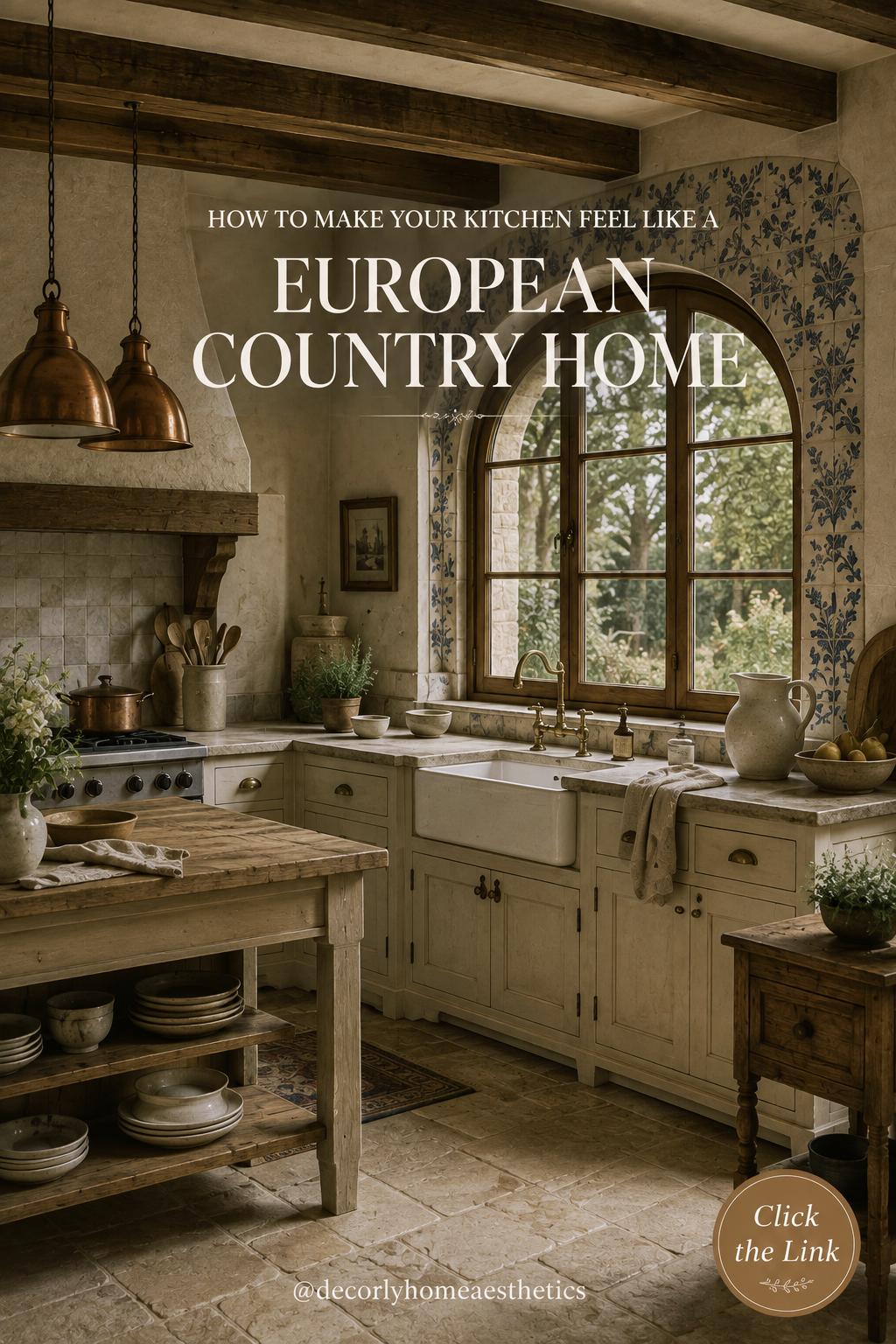
There’s something about a European country kitchen that feels almost impossible to recreate with brand-new furniture and perfectly coordinated finishes.
The best ones don’t look as though someone decorated them in a weekend.
They look as though the house has been there for generations. A wooden table has picked up scratches from years of family meals. Copper has slowly developed a patina. Ceramic bowls don’t quite match. Stone floors have little variations, and the cabinets aren’t necessarily the exact same shade of cream.
That slightly imperfect, collected feeling is what gives these kitchens so much character.
And the good news is that you don’t need to live in an old cottage in England or a farmhouse in the French countryside to bring some of that feeling into your own kitchen.
You also don’t need to remodel everything.
A few thoughtful materials—warm cream, natural wood, aged metal, stone, handmade tile and linen—can completely change the atmosphere.
Here are 17 ways to make your kitchen feel like a European country home without making it look overly themed.
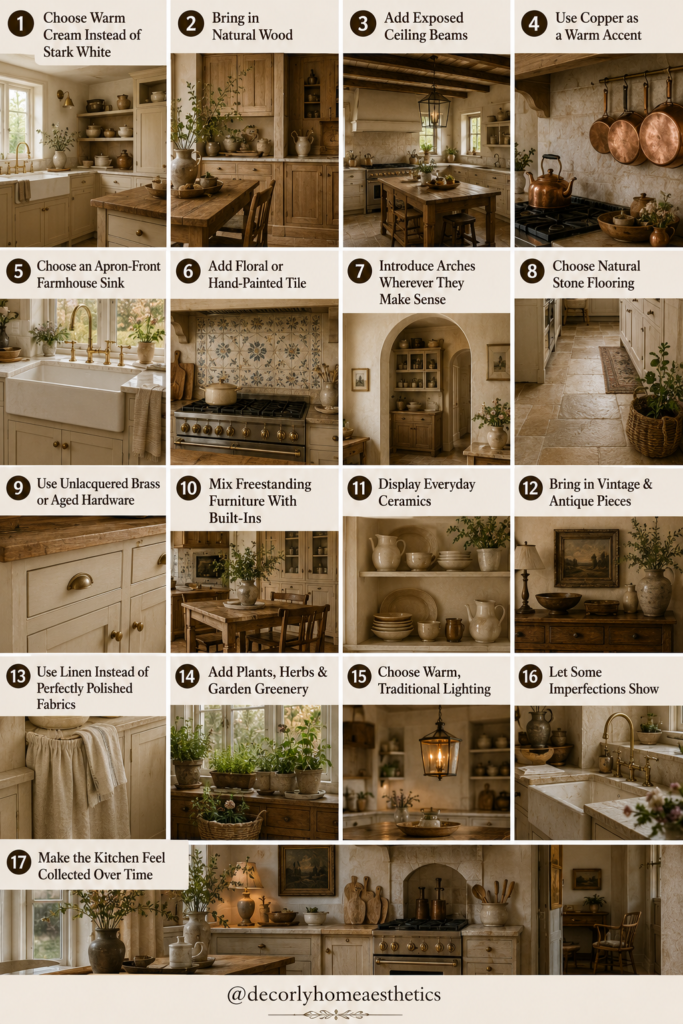
1. Choose Warm Cream Instead of Stark White
White kitchens aren’t going anywhere, but the shade of white makes a huge difference.
Bright, cool white can sometimes feel too crisp for a country-style kitchen. Instead, look for creamy whites with warm undertones.
Think buttercream, antique ivory, warm linen or soft putty.
These shades work beautifully with wood beams, copper, stone and aged brass because they don’t create such a sharp contrast.
If you already have white cabinets, you don’t necessarily need to repaint them. Warm up the room around them with wooden cutting boards, pottery, linen, brass hardware and warmer lighting.
Sometimes that’s enough.
2. Bring in Natural Wood
European country kitchens almost always have wood somewhere.
And preferably, it looks like actual wood.
You want to see the grain, knots and natural variations rather than a perfectly smooth brown surface.
Try introducing wood through a farmhouse table, kitchen island, open shelves, stools, cutting boards or an antique cupboard.
You don’t need every piece to match.
Actually, I think it looks better when they don’t.
A medium oak table beside darker reclaimed beams can feel much more natural than having every wooden element finished in exactly the same stain.
3. Add Exposed Ceiling Beams
Few architectural details change the mood of a kitchen as quickly as exposed beams.
They immediately make a room feel older and more grounded.
Of course, not every home has structural beams waiting to be uncovered. Decorative beams can also work, but they need to look believable.
Avoid beams that are overly smooth or perfectly identical.
Real-looking wood should have subtle grain, knots and color variation.
And you don’t need an entire ceiling covered with them. A few well-proportioned beams can be enough to create that old-country feeling.
4. Use Copper as a Warm Accent
Copper looks especially beautiful in cream kitchens.
A copper farmhouse sink can become an incredible focal point, but you can introduce the material much more subtly.
Try copper pendant lights, a saucepan hanging near the range, an old kettle, a small tray or a few cooking utensils.
The important thing is not to make everything copper.
One or two pieces usually have more impact.
I also prefer copper once it begins developing a little patina. That lived-in finish feels far more appropriate in a country kitchen than something polished until it looks brand new.
5. Choose an Apron-Front Farmhouse Sink
An apron-front sink instantly adds country character.
White fireclay is the classic choice and works beautifully with cream cabinetry, stone countertops and brass fixtures.
Copper is another option if you want something more dramatic.
Whichever material you choose, keep the surrounding design fairly simple.
The sink itself already makes a statement.
Pair it with a traditional bridge faucet or gently curved fixture in aged brass, unlacquered brass or another warm metal.
6. Add Floral or Hand-Painted Tile
This is one of my favorite details in the kitchens that inspired this article.
A little pattern can completely transform cream cabinetry.
Blue-and-white botanical tile feels particularly appropriate because it adds color without making the room feel loud.
You could use it behind the range, around a window, inside a small niche or across one section of backsplash.
Look for patterns that feel slightly irregular.
Perfectly repeated digital-looking flowers can sometimes feel too modern for this style. Handmade or handmade-inspired tiles with small differences in tone and shape create much more character.
And don’t feel like the entire kitchen needs patterned tile.
A smaller section can be even prettier.
7. Introduce Arches Wherever They Make Sense
European architecture is full of curves and arches.
An arched doorway immediately softens all the straight lines created by cabinetry and countertops.
An arched window can become the focal point of the entire kitchen.
Even smaller architectural details—an arched cabinet opening, niche or range hood—can bring some of that softness into the room.
But this is another feature where restraint matters.
You don’t need arches everywhere.
One beautiful arch usually looks much more convincing than trying to curve every doorway, window and cabinet.
8. Choose Natural Stone Flooring
Perfectly uniform flooring can make an otherwise traditional kitchen feel unexpectedly new.
Natural limestone, travertine and other stone surfaces have variations that work beautifully with European country interiors.
Some pieces are lighter.
Some are darker.
Edges may not look perfectly identical.
That’s exactly the point.
If natural stone isn’t practical for your home, look for porcelain tile that convincingly mimics stone without having an overly obvious repeating pattern.
Choose warm beige, sandy limestone or muted cream rather than cold gray.
9. Use Unlacquered Brass or Aged Hardware
Hardware is one of the easiest ways to change the personality of existing cabinets.
Polished chrome can look beautiful, but aged brass, unlacquered brass and antique bronze usually feel more natural in a European country kitchen.
Try traditional knobs, cup pulls or simple handles.
And don’t worry if the metal changes slightly over time.
That’s part of what makes unlacquered brass so appealing. Instead of remaining perfectly shiny, it gradually develops character through everyday use.
You don’t necessarily need every metal in the kitchen to match perfectly, either.
Copper and aged brass can live very happily together.
10. Mix Freestanding Furniture With Built-Ins
Modern kitchens are usually designed as one continuous wall of fitted cabinetry.
Older European kitchens often feel different because furniture was added over time.
Try introducing one piece that doesn’t look built in.
It could be an antique cupboard, wooden worktable, freestanding hutch, butcher’s block or vintage cabinet.
This instantly makes the kitchen feel less like a showroom.
Even a small vintage table used as an island can completely change the mood.
Look for something with a little age rather than a piece designed to look artificially distressed.
11. Display Everyday Ceramics
You don’t need decorative objects everywhere when your everyday kitchen pieces are already beautiful.
Keep a stack of ceramic bowls on an open shelf.
Leave a stoneware pitcher on the counter.
Store wooden spoons inside an old ceramic crock.
Display a few mugs rather than hiding every single thing behind cabinet doors.
The trick is not displaying everything you own.
Choose pieces that you actually use and leave a little breathing room around them.
The kitchen should look lived in, not like a pottery shop.
12. Bring in Vintage and Antique Pieces
A room starts feeling collected when not everything came from the same store.
Look for pieces with history.
An old landscape painting can hang near the breakfast table. A vintage breadboard can lean against the backsplash. An antique stool can sit beside the island.
Other easy additions include old pottery, brass candlesticks, wooden bowls, framed botanical prints and vintage kitchen tools.
You don’t need valuable antiques.
Flea markets and thrift stores are often better places to find this kind of character because you’re looking for age and personality rather than perfection.
13. Use Linen Instead of Perfectly Polished Fabrics
Linen has that relaxed, slightly rumpled quality that fits country interiors beautifully.
Use it for tea towels, café curtains, Roman shades, tablecloths and napkins.
Choose natural colors like oatmeal, flax, ivory, muted stripe or faded blue.
And let it wrinkle a little.
Perfectly pressed fabric can sometimes feel too formal here.
A linen towel casually hanging beside the sink feels much more at home in a relaxed European-style kitchen.
14. Add Plants, Herbs and Garden Greenery
Country kitchens should feel connected to the outdoors.
A pot of rosemary beside the sink is enough to begin.
You could also grow basil or thyme near a sunny window, place garden branches in a ceramic pitcher, or keep a small leafy plant on an open shelf.
Fresh flowers don’t need to look professionally arranged.
A handful of garden flowers loosely placed in an old jug can be much more charming.
This is especially effective if your kitchen already has a window overlooking greenery.
Let the outside landscape become part of the room.
15. Choose Warm, Traditional Lighting
Lighting can make or break this style.
Very cool recessed lighting can flatten all the beautiful warmth you’ve created with wood, stone and brass.
Instead, layer the lighting.
You might have recessed lights for practical tasks, pendants over the island, a small wall sconce near open shelving and perhaps even a tiny table lamp on a counter if you have enough room.
Copper, aged brass, ceramic and glass fixtures all work beautifully.
At night, you want the kitchen to feel warm and inviting rather than brightly illuminated from every direction.
16. Let Some Imperfections Show
This might be the most important part.
Don’t make everything perfect.
European country style becomes much more believable when materials are allowed to age naturally.
A wooden table can have scratches.
Copper can tarnish.
Linen can wrinkle.
Stone can vary in color.
Pottery can have slightly irregular edges.
Those aren’t problems you need to disguise.
They’re what prevent the kitchen from feeling like a reproduction of an old home rather than a place that has actually developed character.
Of course, there’s a difference between charming wear and something being damaged or difficult to maintain.
The goal isn’t neglect.
It’s simply allowing real materials to look real.
17. Make the Kitchen Feel Collected Over Time
This is where everything comes together.
Try not to buy the entire look at once.
If you purchase matching vintage-style jars, matching distressed furniture, matching pottery and matching antique-looking accessories in one shopping trip, the room can actually start feeling more themed.
Instead, build it slowly.
Find a beautiful old wooden board.
Later, add a ceramic pitcher.
Bring home a painting you genuinely love.
Replace cabinet hardware when you’re ready.
Maybe someday you find the perfect antique cupboard.
Over time, those individual pieces begin telling a story together.
That’s when the room starts feeling authentic.
The European Country Kitchen Color Palette
If you’re unsure where to begin, I love this combination:
Warm cream + aged oak + natural limestone + copper + antique brass + dusty blue + muted sage
Cream gives the kitchen its light foundation.
Wood and stone add warmth.
Copper and brass introduce depth.
Dusty blue works beautifully in botanical tile, pottery or fabric.
And muted green can come naturally through herbs and plants.
You don’t need equal amounts of every color.
Most of the room might simply be cream and wood, with the other shades appearing in smaller details.
How to Get the Look Without Remodeling
You can bring a surprising amount of European country character into an existing kitchen without touching the cabinets.
Start with hardware.
Switching shiny modern handles for warmer aged-brass hardware can make an immediate difference.
Then look at your countertops.
Remove some of the small appliances and replace purely decorative clutter with useful, beautiful objects: wooden boards, a stoneware crock, an old bowl and a pot of herbs.
Add a vintage runner.
Hang a small painting.
Introduce linen towels.
Replace one modern light fixture with something warmer.
Display a few copper pieces.
None of these changes require knocking down walls, but together they can completely change how the kitchen feels.
What Makes a European Country Kitchen Look Too Themed?
Usually, it’s trying too hard.
You don’t need signs that say Farmhouse Kitchen.
You don’t need decorative roosters everywhere.
You don’t need ten copper pans hanging from the ceiling.
And you definitely don’t need every object to look artificially old.
Instead, focus on materials.
Real wood. Stone. Linen. Pottery. Aged metal. Plants.
When the materials feel authentic, you need far fewer decorative objects to communicate the style.
Mix Old and New
A European country kitchen doesn’t need to reject modern convenience.
Hide the dishwasher behind a cabinet panel if you want, but use the dishwasher.
Install good task lighting.
Choose practical countertops.
Keep the modern range you actually enjoy cooking on.
Then surround those contemporary necessities with warmer materials and older pieces.
That contrast often makes a kitchen more interesting.
An antique wooden table beside beautifully fitted modern cabinetry can look wonderful.
The goal isn’t recreating a kitchen from 1850.
It’s borrowing the warmth and character of older European homes while still creating a kitchen that works for life today.
Don’t Forget How the Kitchen Feels
Sometimes we focus so much on how kitchens photograph that we forget what they’re actually for.
European country kitchens feel inviting because they look ready to be used.
There’s a cutting board nearby.
Herbs are growing beside the window.
A bowl of pears sits on the counter.
Mugs are within reach.
A linen towel hangs beside the sink.
Nothing feels too precious to touch.
That’s the atmosphere worth recreating.
Not simply the beams or copper sink.
The feeling that someone could walk into the room, put water on for coffee, cut some bread, and stay for the next two hours talking.
Final Thoughts
You don’t need a centuries-old farmhouse to create a kitchen with European country character.
Start with warmth.
Choose cream instead of stark white, natural wood instead of perfectly uniform finishes, aged brass instead of overly polished metal, and handmade-looking materials instead of surfaces that feel too perfect.
Then add character slowly.
A copper saucepan here.
An old ceramic pitcher there.
Maybe a botanical tile backsplash, linen curtain, vintage cupboard or reclaimed wooden shelf.
Let some things age.
Let a few things mismatch.
Leave enough empty space that every beautiful object has room to be noticed.
Because the kitchens that feel most authentically European aren’t usually the ones with the most decoration.
They’re the ones that feel as though they’ve been loved, cooked in, changed, and added to for years.
And that’s a kind of charm you can bring into almost any home.