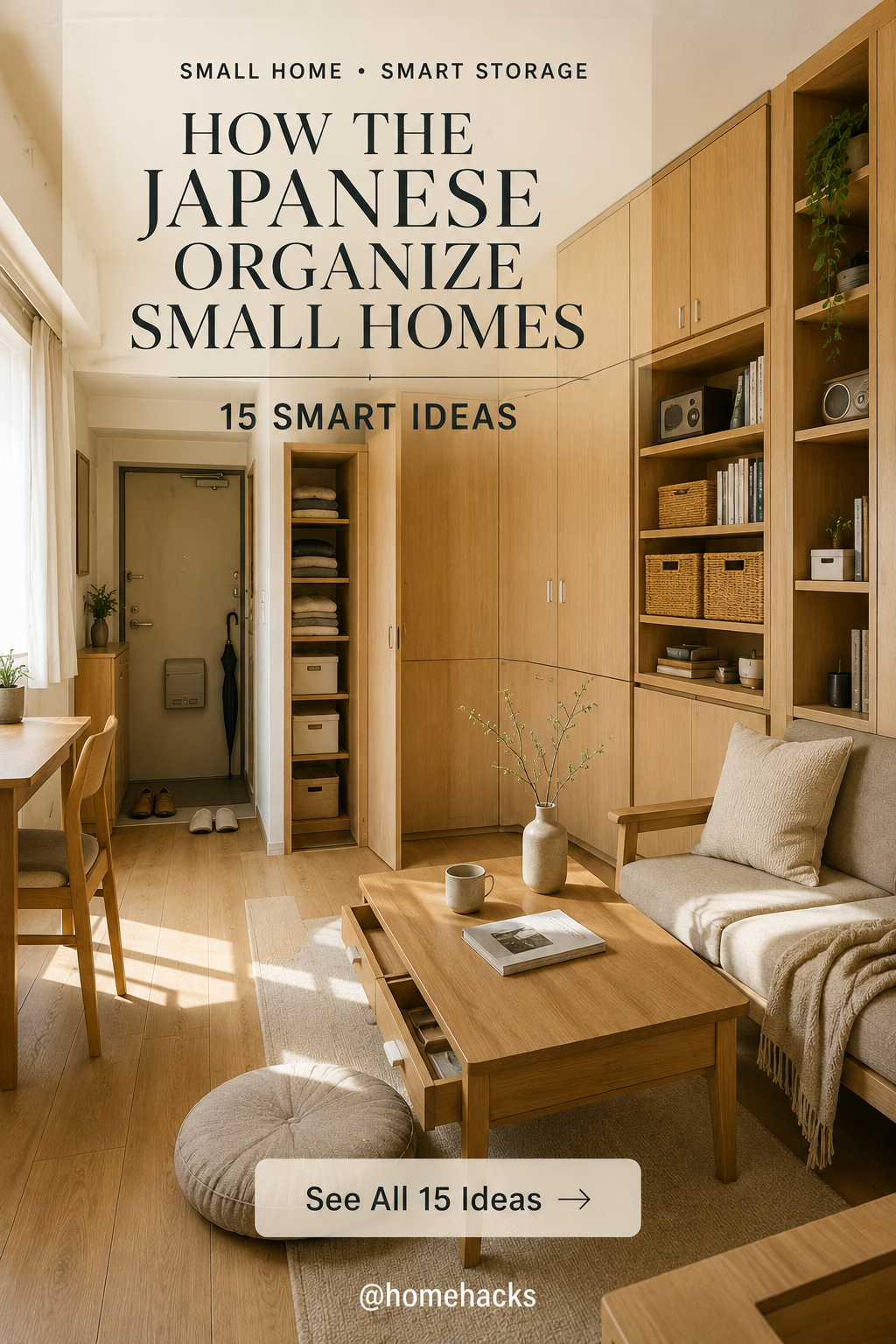
A small home has a funny way of showing you exactly how much stuff you own.
In a larger house, the things you don’t know what to do with can disappear into a spare room, an extra closet, or the back of a cabinet. In a compact apartment, there’s nowhere for clutter to hide. Leave a few bags by the door, pile some clothes on a chair, and suddenly the whole place feels crowded.
That’s one reason Japanese small-home organization is so interesting.
Japan has everything from spacious family houses to tiny city apartments, so there isn’t one single “Japanese way” of organizing a home. Still, Japanese interiors are often associated with ideas that make a lot of sense in limited spaces: using vertical storage, choosing flexible furniture, keeping everyday items accessible, and being more selective about what deserves space in the first place.
And perhaps the biggest lesson is this:
A small home doesn’t necessarily need more storage. It needs better use of the storage it already has.
Here are 15 Japanese-inspired organization ideas worth borrowing for your own home.
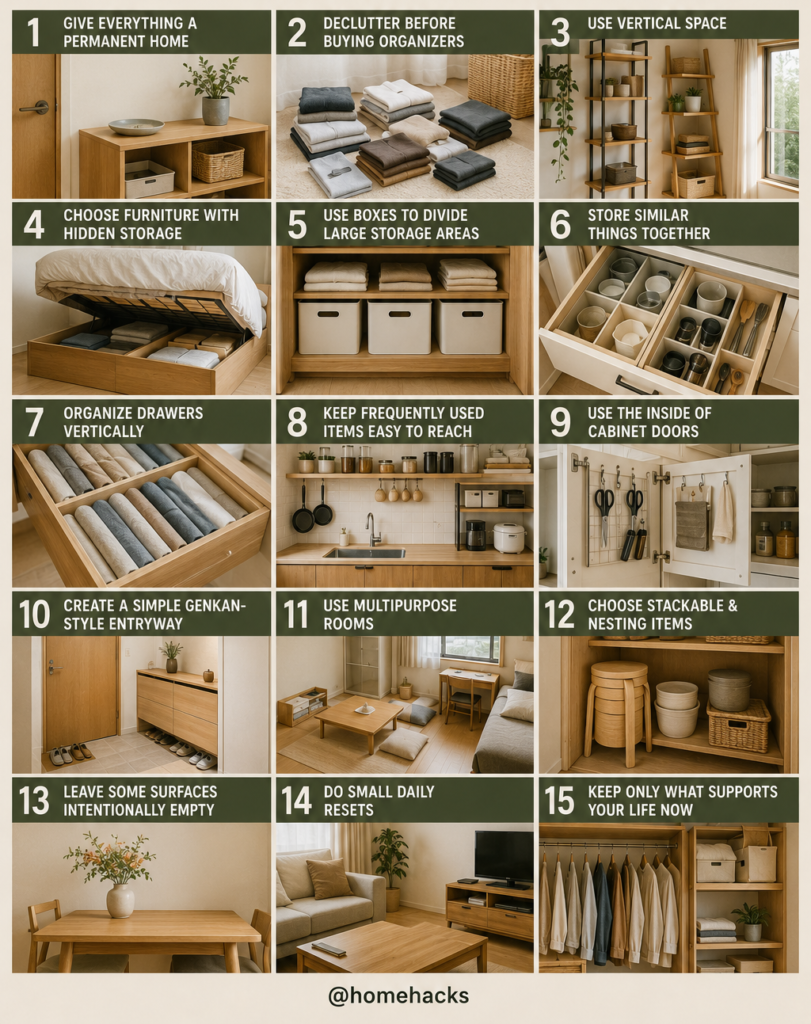
1. Give Everything a Permanent Home
One of the easiest ways for clutter to begin is when an object doesn’t really belong anywhere.
The mail lives on the kitchen counter. The charger moves between three rooms. Your keys are wherever you happened to drop them yesterday.
In a small home, those little things quickly become visual clutter.
Try giving frequently used belongings one permanent location.
Keys might always go in a small tray near the entrance. Chargers could live in one drawer. Cleaning supplies might have one designated cabinet.
The rule is simple: if you use it, know where it goes when you’re finished with it.
It sounds almost too obvious, but it can completely change how easy your home is to reset.
2. Declutter Before Buying Organizers
This is where many organizing projects go wrong.
You open a messy closet, decide you need storage, and immediately order ten matching baskets.
Now you have the same amount of stuff—plus ten baskets.
Instead, remove everything first.
Look at what you genuinely use. Get rid of obvious rubbish, duplicates, broken items, and possessions that no longer make sense for your life.
Only after you’ve decided what stays should you start thinking about containers.
The goal isn’t to become a minimalist or throw away everything you own.
It’s simply to avoid spending valuable space organizing things you don’t actually need.
3. Look Up: Use Your Vertical Space
When floor space is limited, walls become incredibly valuable.
Tall shelving, properly installed wall storage, over-door solutions, and floor-to-ceiling cabinetry can provide storage without filling the middle of the room.
This works especially well in kitchens and small bedrooms.
Instead of adding another wide cabinet, consider whether you can extend existing storage upward.
Keep frequently used objects at comfortable reaching height and reserve harder-to-reach upper storage for seasonal or rarely used belongings.
You don’t need every inch of wall covered, though.
Good small-space organization balances storage with visual breathing room.
4. Choose Furniture With Hidden Storage
In a tiny room, furniture that only does one job can feel like a missed opportunity.
A bed might hide drawers underneath.
A bench can contain blankets.
An ottoman can store games.
A coffee table can have drawers for remotes and chargers.
Hidden storage is particularly useful because it removes visual clutter without requiring another cabinet.
But don’t use hidden compartments as permission to keep everything.
There’s a difference between useful concealed storage and simply creating more places to forget things.
5. Divide Large Storage Areas Into Smaller Zones
Have you ever opened a deep cabinet and found one giant pile?
Large storage spaces aren’t always easy to use.
Small boxes, bins, trays, and dividers can turn one chaotic cabinet into several manageable zones.
Imagine a bathroom cabinet.
Instead of tossing everything together, you might have one container for hair products, another for skincare, another for spare toiletries, and a separate section for cleaning supplies where appropriate.
You don’t necessarily need expensive matching organizers.
Simple containers that fit properly and have a clear purpose are often better.
6. Store Similar Things Together
This idea sounds basic until you realize how often we don’t do it.
Scissors in the kitchen.
More scissors in the office.
Another pair in the bedroom.
Batteries in three drawers.
Cleaning cloths in four different cabinets.
Grouping similar items together makes it easier to see what you already own.
It also helps prevent accidental duplicates.
Create categories that make sense for your household rather than trying to copy someone else’s perfect pantry.
If you naturally think “coffee,” keep coffee supplies together.
If you think “morning routine,” perhaps those items belong together instead.
Your organization system should match how you actually live.
7. Try Vertical Folding in Drawers
Clothing drawers are often organized in horizontal piles.
The problem is that the moment you want the T-shirt at the bottom, everything above it gets disturbed.
Vertical or file-style folding can make individual pieces easier to see at once, depending on the garment and drawer.
It’s particularly handy for T-shirts, casual tops, pajamas, and certain smaller clothing items.
You don’t need every fold to look perfect.
The useful part is visibility.
If you can open a drawer and immediately see what you own, you’re much less likely to forget half your clothes exist.
8. Put Everyday Items in the Easiest Places
Not every storage location is equally convenient.
The shelf directly in front of you is prime real estate.
The cabinet above the refrigerator probably isn’t.
Use your easiest-to-reach areas for things you use constantly.
Everyday dishes should be convenient.
The pan you use three nights a week shouldn’t live behind a holiday serving platter.
Your daily skincare shouldn’t require moving six backup products.
Put rarely used objects higher, lower, or farther back.
A well-organized home isn’t just neat.
It’s easy to use.
9. Use the Inside of Cabinet Doors
The back of a cabinet door is often completely forgotten.
Depending on the cabinet construction and clearance, a slim organizer can provide useful storage for lightweight items.
In the kitchen, that might mean small appropriate accessories.
In a bathroom, perhaps a few everyday toiletries.
Inside a utility cabinet, it could help organize cleaning cloths or lightweight tools.
Just don’t overload the door.
Check that whatever you add is suitable for the cabinet, properly installed, and doesn’t prevent it from closing.
Tiny unused surfaces can be surprisingly helpful in a small home.
10. Create a Genkan-Inspired Entryway
One Japanese feature that’s particularly interesting from an organization perspective is the genkan, the entrance area where outdoor footwear is typically removed before entering the main living space.
You don’t need an actual Japanese-style home to borrow the organizational principle.
Create a clear transition zone at your entrance.
Give shoes somewhere to go.
Add a tray or small container for keys.
Create a designated place for umbrellas.
Use a hook for the bag you carry every day.
Keep the area relatively simple.
The entryway is the first place clutter enters your house. Catch it there, and you’re less likely to find shoes, bags, and jackets migrating into every other room.
11. Let Rooms Do More Than One Job
In a small home, dedicating an entire room to something you use twice a month isn’t always practical.
Flexible spaces make more sense.
A dining table can also be a work surface.
A living room corner can become a temporary workspace.
A guest room can double as an office.
A foldable or movable piece of furniture can allow the room to change throughout the day.
Traditional Japanese interiors have long included examples of flexible use of space, but you don’t need to recreate a traditional room to borrow the principle.
Ask yourself:
Does this room need to stay arranged this way all day?
Sometimes flexibility is more useful than adding storage.
12. Choose Things That Stack, Fold or Nest
If two objects do the same job, the one that takes up less room when stored usually has an advantage in a small home.
Think nesting bowls.
Stackable containers.
Folding drying racks.
Stackable stools.
Collapsible laundry baskets.
Furniture that folds away when it isn’t needed.
These choices aren’t very exciting individually, but together they can free up a surprising amount of space.
Before bringing something new into a small home, consider not only how much space it takes while you’re using it, but how much space it takes when you’re not.
13. Leave Some Surfaces Empty
This may be my favorite idea on the list.
Empty space doesn’t need fixing.
You don’t have to put something on every shelf.
You don’t need decor on every section of wall.
And your kitchen counter doesn’t need to display every appliance you own.
Leaving some surfaces intentionally clear makes a compact room feel calmer and gives the objects you do display more impact.
Try clearing one surface completely.
Then return only what genuinely needs to be there.
You may be surprised by how much larger the room feels.
Organization isn’t always about finding somewhere to put more things.
Sometimes it’s about allowing somewhere to contain nothing at all.
14. Do a Small Reset Every Evening
The problem with small homes is that they get messy incredibly quickly.
The advantage?
They can often be reset quickly too.
Spend five or ten minutes in the evening putting things back where they belong.
Return cups to the kitchen.
Fold the throw blanket.
Put shoes away.
Clear the table.
Return chargers to their drawer.
Hang tomorrow’s clothes instead of leaving them over a chair.
You’re not deep-cleaning the house.
You’re simply returning it to its baseline.
When everything already has a permanent home, this becomes much easier.
15. Keep What Supports Your Life Now
This is probably the hardest idea because it isn’t really about storage.
It’s about deciding what deserves storage.
We often keep things for imaginary future versions of ourselves.
Clothes we’ll wear “one day.”
Kitchen equipment for recipes we never make.
Supplies for hobbies we haven’t touched in years.
Boxes we haven’t opened since the last move.
You don’t have to get rid of sentimental possessions or things that genuinely matter to you.
But occasionally ask:
Would I still choose to give this space in my home today?
That’s a very different question from “Could I possibly need this someday?”
In a small home, every object has a cost—not only financially, but in the physical space and attention it occupies.
What Japanese-Inspired Organization Isn’t
It’s easy to look at beautiful photographs of Japanese interiors online and assume the secret is owning almost nothing.
That’s an oversimplification.
Real Japanese homes can be busy, colorful, crowded, traditional, modern, spacious, tiny, minimalist—or anything in between.
The useful lesson isn’t that you need to make your home “look Japanese.”
It’s that certain small-space principles are worth considering wherever you live:
Use space intentionally.
Keep frequently used things accessible.
Make furniture work harder.
Reduce unnecessary possessions.
And create systems that are easy to maintain.
That’s much more practical than trying to copy an aesthetic.
Start With One Small Area
If your home currently feels cluttered, don’t empty every closet this weekend.
You’ll probably create an enormous mess, become exhausted halfway through, and wonder why you started.
Choose one small area.
Maybe it’s your entryway.
Give shoes a home. Create somewhere for keys. Remove the jackets nobody wears.
Then tackle one drawer.
Then perhaps the bathroom cabinet.
Small organization projects have an advantage: you actually finish them.
And once you’ve created a system that works, maintaining it requires far less effort.
Avoid Over-Organizing
There is such a thing as too much organization.
If you need to open a cabinet, remove a basket, open another box, lift a divider and move three objects just to get something you use every morning, the system isn’t helping you.
The best organization is almost invisible.
You reach for something.
It’s where you expect it to be.
You use it.
You put it back.
Done.
You don’t need twenty labels and a complicated color-coded system unless that genuinely makes your life easier.
A small home needs simple systems more than perfect systems.
A Simple Room-by-Room Approach
In the kitchen, prioritize clear counters, vertical cabinet space, drawer dividers, and easy access to everyday cookware.
In the bedroom, look underneath the bed, organize drawers so clothes are visible, and keep bedside clutter minimal.
In the bathroom, group similar products, keep backups away from prime storage areas, and avoid filling the counter.
In the living room, choose furniture that can provide hidden storage while leaving some surfaces deliberately empty.
And at the entryway, stop clutter before it travels farther into the home.
You don’t need to implement all 15 ideas.
Even three or four can make a noticeable difference.
Final Thoughts
A beautifully organized small home isn’t one that somehow manages to hide an enormous amount of stuff.
It’s a home where the things inside have been chosen and placed intentionally.
That’s the part of Japanese-inspired organization that’s worth borrowing.
Use the walls.
Make furniture multitask.
Divide awkward cabinets.
Keep everyday items accessible.
Create a proper entryway.
Let rooms change purpose.
Leave some surfaces empty.
And perhaps most importantly, think carefully before bringing more things into a home that’s already working hard to accommodate what you own.
Your space doesn’t have to be perfectly minimalist.
It doesn’t have to look like a magazine.
It just needs to work for your real life.
Because when everything has a place—and putting it back isn’t complicated—even a very small home can feel surprisingly calm, comfortable, and spacious.