You don’t need a huge backyard to grow an impressive amount of food.
In fact, some of the most productive vegetable gardens I’ve seen aren’t particularly large at all. What makes them work is how carefully the available space is used. Instead of leaving large empty paths, planting everything in isolated rows, or letting sprawling vegetables take over entire beds, every part of the garden has a purpose.
A thoughtful garden layout can give you more vegetables, easier harvesting, fewer wasted spaces, and a garden that still looks beautiful.
Whether you’re starting a small backyard vegetable garden or trying to get more from the one you already have, these 17 garden layout secrets can help you grow more without needing more land.
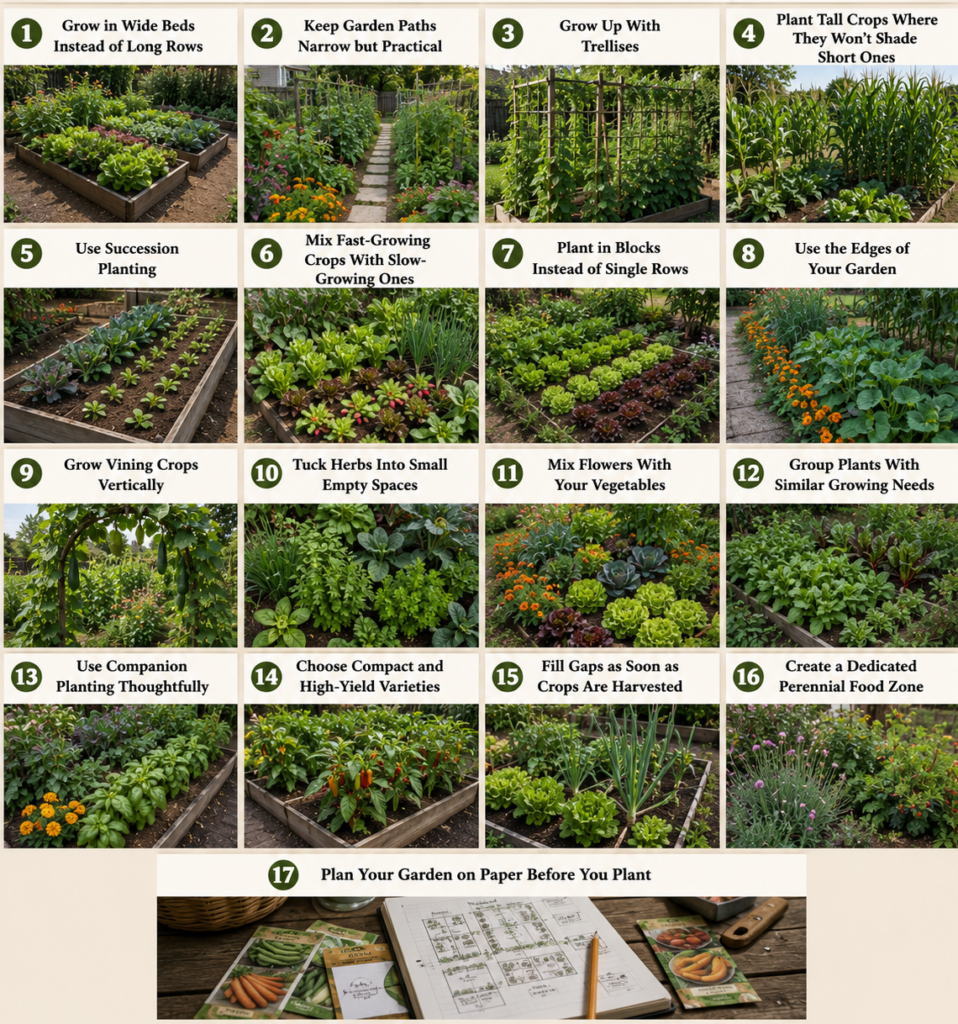
1. Grow in Wide Beds Instead of Long Rows
Traditional vegetable gardens often have a row of vegetables, a walking path, another row, another path—and so on.
It works, but in a small garden, those paths can consume a surprising amount of valuable growing space.
Instead, consider creating wider permanent growing beds that you can reach from either side.
The idea is simple: keep the soil where plants grow and keep your feet in designated pathways.
A bed should never be so wide that you have to step into it regularly to reach the middle. For many gardeners, something around 3–4 feet wide works well, although the right width depends on your reach and access.
Once you stop walking through growing areas, you can plant more efficiently while also reducing soil compaction.
2. Keep Garden Paths Narrow but Practical
Paths are essential. You need room to plant, weed, water, harvest, and carry baskets around the garden.
But they don’t have to occupy half the backyard.
In a compact garden, make paths only as wide as they genuinely need to be.
Frequently used main paths may need to be wider, especially if you use a wheelbarrow. Smaller paths between beds can often be narrower.
Before building permanent beds, physically walk through the proposed layout.
Can you turn comfortably?
Can you kneel beside the plants?
Can you carry a full harvest basket through?
The goal isn’t to create the narrowest possible path. It’s to stop wasting growing space on unnecessarily oversized ones.
3. Grow Up With Trellises
When you’re short on ground space, start looking upward.
Vertical gardening is one of the easiest ways to increase the growing capacity of a small vegetable garden.
Use trellises, arches, sturdy stakes, cages, or other suitable supports for crops that naturally climb or can be trained vertically.
Depending on the variety, you might grow:
- pole beans
- peas
- cucumbers
- indeterminate tomatoes
- some small-fruited squash or melons
Instead of allowing a cucumber vine to wander across several feet of soil, guide it upward.
Suddenly, that ground underneath and around it becomes available for other plants.
Vertical crops can also make harvesting easier because fruits aren’t hidden underneath a jungle of leaves.
4. Plant Tall Crops Where They Won’t Shade Short Ones
This is one of those garden-layout details that seems obvious only after you’ve made the mistake once.
A beautiful row of tall tomatoes can become a wall of shade.
Before planting, pay attention to the direction sunlight moves across your garden and consider how tall each crop will eventually become—not how tall the seedlings are today.
Place tall crops and trellises where their shadows are least likely to deprive sun-loving shorter vegetables of the light they need.
The exact orientation depends on your location and garden conditions, so spend some time watching the sun before finalizing your layout.
A little planning in spring can prevent a very shaded lettuce or pepper bed later in summer.
5. Use Succession Planting
A productive garden shouldn’t have empty soil sitting around for half the growing season.
That’s where succession planting becomes incredibly useful.
Instead of thinking of one bed as belonging to one vegetable for the entire year, think of it as a space that can potentially produce several crops over the season.
For example, depending on your climate, you might grow a quick cool-season crop, harvest it, then replace it with a warm-season vegetable, followed by another cool-season planting later.
The exact sequence depends on your local frost dates, temperatures, and growing season.
The principle is what matters:
When one crop finishes, have another ready to take its place.
6. Mix Fast-Growing Crops With Slow-Growing Ones
Not every vegetable grows at the same speed.
You can use that to your advantage.
Imagine planting a slower-growing crop that will eventually need considerable space. When it’s still young, there may be open soil around it.
Instead of leaving that space unused, grow a quick crop nearby that can be harvested before the larger plant needs the room.
Radishes and some leafy greens are classic examples of crops that can mature relatively quickly.
This technique is sometimes called intercropping.
It requires a little timing, but it can significantly improve how efficiently a small garden produces food.
7. Plant in Blocks Instead of Single Rows
Long single rows make sense when you’re growing at field scale and using machinery.
They don’t always make sense in a backyard.
For suitable crops, planting in blocks or appropriately spaced clusters can make better use of a garden bed than running one thin row down the middle.
Leaf lettuce, carrots, beets, onions, and various greens can work particularly well in intensive bed layouts when given the correct spacing.
Don’t interpret intensive planting as crowding plants together as tightly as possible.
Plants still need sufficient light, water, nutrients, and airflow.
The goal is simply to eliminate unnecessary unused soil between widely separated rows.
8. Use the Edges of Your Garden
Garden edges are often forgotten.
We carefully plant the center of every bed and then leave the borders empty.
Those edges can be useful.
Depending on light and growing conditions, you can plant compact herbs, flowers, leafy greens, strawberries, or other relatively small plants along suitable borders.
Nasturtiums can spill attractively over an edge rather than taking up valuable interior space.
Parsley can fill a small corner.
Chives can fit into places where a tomato plant never could.
When your garden is small, these little spaces add up.
9. Grow Vining Crops Vertically
Some vegetables are innocent-looking when they’re young.
Then summer arrives.
Suddenly one squash vine seems determined to annex the neighboring garden bed.
Cucumbers, pole beans, peas, and suitable vining varieties are excellent candidates for vertical growing.
Some heavier fruits need appropriate support, and not every large vining crop is practical for every trellis, so choose your varieties and structures carefully.
A strong trellis isn’t merely decorative.
By moving suitable vines upward, you’re essentially creating additional growing space without making the garden itself any larger.
10. Tuck Herbs Into Small Empty Spaces
You don’t necessarily need an entire separate bed for herbs.
Many can be incorporated into the vegetable garden.
Basil can grow near other summer crops where conditions suit it.
Parsley can fill a small opening.
Chives occupy relatively little space.
Thyme can work around suitable edges.
The key is matching each herb with the right amount of sunlight, water, and room.
Also remember that some herbs—mint being the famous example—can spread aggressively. Mint is often easier to manage in a container rather than casually planting it in your carefully organized vegetable bed.
A few strategically placed herbs can turn otherwise wasted pockets of soil into something useful.
11. Mix Flowers With Your Vegetables
A productive vegetable garden doesn’t have to look purely utilitarian.
Flowers can make it beautiful while also supporting garden biodiversity.
Consider incorporating flowers such as marigolds, calendula, nasturtiums, alyssum, cosmos, or zinnias, depending on your climate and available space.
Flowers can attract bees and other pollinating insects, which is particularly useful around crops requiring pollination.
They may also provide habitat or food resources for beneficial insects.
But don’t fall for exaggerated claims that one particular flower magically protects every vegetable from every pest.
Think of flowers as part of a diverse garden ecosystem, not as a replacement for sensible pest management.
12. Group Plants With Similar Growing Needs
Efficient gardens aren’t only about fitting more plants into the ground.
They’re also about making those plants easier to care for.
Try grouping crops with reasonably similar watering and growing requirements.
If one corner contains plants that love consistently moist soil while another prefers drier conditions, separating those areas can make watering much easier.
You can apply the same thinking to sunlight.
Put sun-loving vegetables in your brightest areas and reserve naturally shadier locations for crops that can tolerate those conditions.
This creates a garden that works with your backyard instead of constantly fighting it.
13. Use Companion Planting Thoughtfully
Companion planting is one of the most popular gardening topics online—and one of the easiest to exaggerate.
You’ll find charts claiming one vegetable “loves” another while two different plants should never be allowed within sight of each other.
Real gardens are more complicated.
Instead of treating companion planting charts like strict rules, focus on practical relationships.
Ask questions such as:
Does one crop shade another too much?
Do they compete heavily for space?
Can flowers nearby support pollinators?
Will a tall crop provide useful temporary shade for a crop that benefits from it?
Do the plants require similar watering?
Good garden design is usually more valuable than memorizing a giant list of supposed plant friendships.
14. Choose Compact and High-Yield Varieties
Sometimes the secret isn’t how you arrange the garden.
It’s what you plant in it.
If space is limited, look for varieties specifically suited to compact gardens, containers, intensive beds, or vertical growing.
A sprawling vegetable that produces a small harvest may not deserve half of your tiny garden.
Meanwhile, a productive climbing crop might produce repeatedly while occupying relatively little ground.
Read seed descriptions carefully.
Words such as compact, patio, bush, dwarf, container-friendly, early, and high-yielding can be helpful when choosing varieties for small spaces.
Choose crops you actually eat, too.
Growing enormous quantities of something nobody in your household enjoys isn’t an efficient use of space.
15. Fill Gaps as Soon as Crops Are Harvested
One of the biggest differences between an ordinary vegetable garden and a highly productive one is what happens after the harvest.
Suppose you pull a row of radishes.
Now there’s bare soil.
Don’t automatically leave it empty until next year.
If enough growing season remains, plant something else.
Keep a few packets of quick-growing vegetables ready so you can fill unexpected openings.
You can even start replacement seedlings in advance if you know when a particular crop is likely to finish.
Think of every empty patch as an opportunity.
16. Create a Dedicated Perennial Food Zone
Not everything in an edible garden needs to be replanted every spring.
Depending on your climate, perennial crops might include things such as:
- asparagus
- rhubarb
- strawberries
- certain herbs
- berry bushes
- suitable perennial vegetables
Because these plants remain in place for multiple seasons, give them a permanent location where they won’t interfere with annual bed preparation.
I like the idea of putting perennial food plants around edges or in a dedicated section of the garden.
Over time, that area can produce food without requiring you to start everything from seed each year.
Just research what is perennial in your particular climate before designing the space.
17. Plan Your Garden on Paper Before You Plant
This might be the simplest secret on the list, but it can save you from plenty of mistakes.
Before buying seedlings, sketch your garden.
It doesn’t have to look professional.
Draw your beds.
Mark the paths.
Note where the sunniest and shadiest areas are.
Add your trellises.
Estimate the mature size of each crop.
Think about where you’ll walk, where you’ll put the hose, and how you’ll reach the middle of every bed.
Then think about timing.
What will be planted first?
What will replace it?
Where will your tall crops grow?
Where can flowers and herbs fit?
A ten-minute sketch can reveal problems that are difficult to fix once twenty tomato plants are already in the ground.
The Real Secret: Stop Thinking Only in Square Feet
When gardeners say they don’t have enough space, they’re usually thinking only about the surface area of the soil.
But a productive garden has more dimensions than that.
There’s vertical space above the soil.
There’s time, because the same patch can grow more than one crop during a season.
There are edges and corners that might support herbs or flowers.
There are gaps between young slow-growing plants where quick crops may temporarily fit.
Once you begin looking at your garden this way, a small backyard starts feeling much bigger.
Don’t Overcrowd in the Name of Growing More
There is one important warning.
Growing intensively doesn’t mean squeezing plants into every available inch.
If plants are packed too tightly, they can compete for sunlight, nutrients, and water. Poor airflow may also contribute to disease problems.
Always consider the mature size and recommended spacing of the particular variety you’re growing.
The best compact garden looks full and abundant at maturity—not suffocating.
Sometimes giving one tomato plant enough room to thrive will produce more than trying to squeeze three struggling plants into the same spot.
Make Your Garden Beautiful Too
Productivity doesn’t have to come at the expense of beauty.
Some of the loveliest gardens mix vegetables with herbs and flowers.
Imagine neat rows of lettuce edged with marigolds.
Tomatoes climbing wooden supports behind a bed of basil.
Nasturtiums spilling over a path.
Beans climbing an arch.
Parsley filling small green pockets between larger plants.
A vegetable garden can be somewhere you enjoy spending time—not simply somewhere food happens to grow.
And when you enjoy being in the garden, you’re more likely to notice when something needs watering, harvesting, tying up, pruning, or protecting.
Beauty and productivity can work together.
Start With the Space You Have
It’s easy to look at enormous vegetable gardens online and think you need more land before you can grow meaningful amounts of food.
You don’t.
Start with the sunny corner you already have.
Create a few well-designed beds.
Keep the paths practical.
Grow suitable crops vertically.
Use your edges.
Plant again when something finishes.
And pay attention to what actually performs well in your particular garden.
Every season teaches you something.
Maybe you’ll discover that cucumbers love your back fence.
Perhaps lettuce grows beautifully in a spot you assumed was too shady.
Maybe three zucchini plants were two zucchini plants too many.
That’s gardening.
The perfect layout isn’t something you create once and never change. It evolves as you learn your soil, sunlight, climate, plants, and the way you actually use the garden.
And eventually, you may realize that the secret to growing more food was never having a bigger backyard.
It was simply making better use of the one you already had.