
There’s always a strange little moment after Christmas when the decorations come down and the house suddenly feels… empty.
The tree is gone. The stockings have been packed away. The garlands disappear from the mantel. And after weeks of warm lights and layers everywhere, the rooms can feel a little bare.
But I don’t think taking down Christmas decor means taking away everything that made the house feel cozy.
Winter still has plenty of its own beauty.
Soft blankets, bare branches, warm wood, candlelight, textured rugs, handmade pottery, deep neutral colors—none of these things need a Christmas tree beside them to feel seasonal.
In fact, I often prefer winter decorating once the obvious holiday pieces have disappeared. It feels quieter and less busy. The house can breathe again, while still feeling warm enough to make you want to stay inside with a cup of coffee.
If you’re wondering what to do with your home after the holidays, here are 17 ways to create an elegant winter home without using Christmas decor.
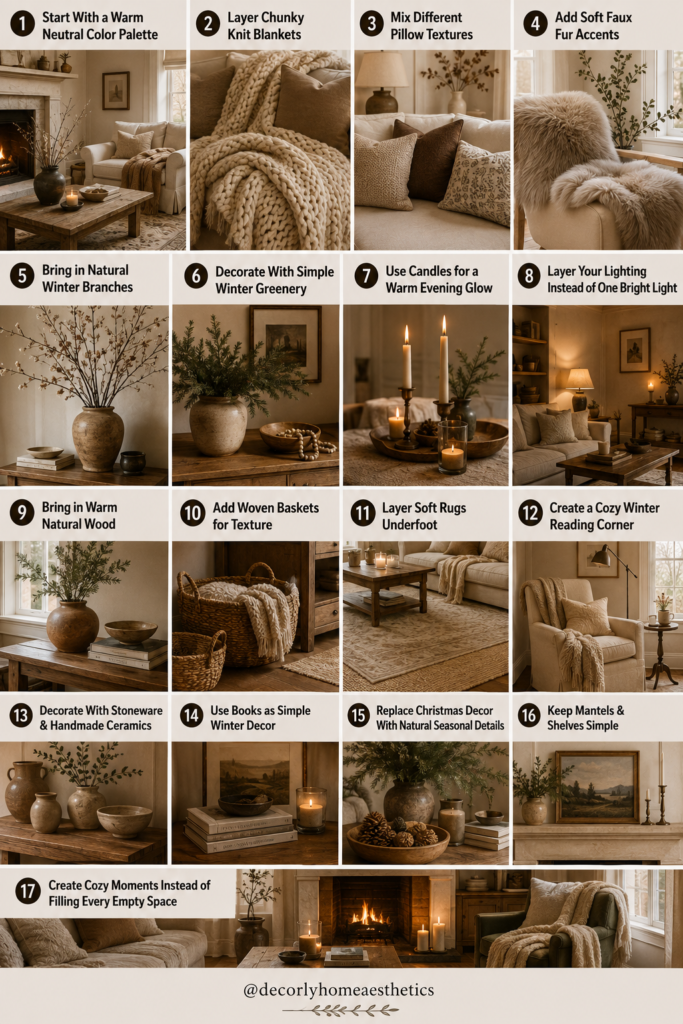
1. Start With a Warm Neutral Color Palette
Winter neutrals shouldn’t feel cold.
Instead of decorating entirely with crisp white and pale gray, bring in warmer shades such as ivory, oatmeal, taupe, camel, mushroom, chocolate brown, and natural wood.
These colors instantly make a room feel softer.
You don’t have to redecorate the whole house, either. Your walls and large furniture can stay exactly as they are. Introduce warmer colors through blankets, pillows, rugs, ceramics, baskets, and small accessories.
If you want a little color, muted olive or deep evergreen works beautifully during winter without automatically reading as Christmas.
The difference is in how you use it. A simple branch in a stoneware vase feels seasonal. Greenery covered in red bows and ornaments feels festive.
2. Layer Chunky Knit Blankets
There may be no easier way to make a room feel ready for winter.
A thick knit blanket instantly adds warmth and texture to an ordinary sofa or armchair.
But resist the temptation to arrange every throw perfectly.
One blanket folded over the arm of the sofa and another loosely draped across the seat usually feels much more inviting than several perfectly styled blankets lined up for a photograph.
Mix different weights as well.
A chunky ivory knit beside a thinner oatmeal wool throw gives the room more depth than using the same fabric everywhere.
And, most importantly, choose blankets you actually want to use.
Cozy winter decor should be functional.
3. Mix Different Pillow Textures
When you’re working with mostly neutral colors, texture becomes incredibly important.
Instead of buying six matching cream pillows, mix fabrics.
Try a cable-knit pillow beside woven linen. Add a nubby wool cushion, subtle stripe, small-scale check, or muted brown pattern.
You can keep everything within the same warm neutral palette while still creating plenty of visual interest.
I usually prefer slightly different shades rather than perfectly matching everything.
Cream beside oatmeal beside taupe feels softer and more natural than one identical beige repeated across the sofa.
4. Add Soft Faux Fur Accents
Faux fur can make a room feel wonderfully cozy, but a little goes a long way.
You don’t need fur pillows, blankets, rugs, and stools all in the same room.
One beautiful faux-fur throw draped over an armchair or sofa is usually enough.
Choose something in ivory, warm cream, taupe, or soft brown rather than stark white.
The goal is to add another layer of texture—not turn the living room into a ski lodge.
5. Bring in Natural Winter Branches
Once the Christmas greenery disappears, bare branches are one of my favorite things to decorate with.
They’re simple, inexpensive, and surprisingly dramatic.
Look for branches with interesting shapes and place a few in a large ceramic or glass vase.
Don’t overfill it.
Three beautiful branches can sometimes look better than twenty.
Birch branches, twisting garden branches, dried seed heads, and even branches collected after pruning can all work.
They bring nature indoors without making the room feel decorated for a particular holiday.
6. Use Winter Greenery—Just Keep It Simple
You don’t have to remove every evergreen branch on December 26.
Evergreen is part of winter, not just Christmas.
The trick is stripping away the obvious holiday details.
Remove the red ribbon.
Skip the ornaments.
Don’t cover it in fairy lights.
Instead, place a few pine, cedar, eucalyptus, or other seasonal branches in a simple vase.
One loose arrangement on a console or coffee table can make the room feel connected to the landscape outside.
7. Use Candles for a Warm Evening Glow
Winter evenings practically ask for candlelight.
Place candles where you’ll actually enjoy them: on a coffee table, dining table, mantel, or sideboard.
Mixing a few heights looks more natural than arranging identical candles in a row.
I particularly like ivory taper candles in aged-brass holders or simple pillar candles inside glass hurricanes.
You don’t need dozens.
A handful of carefully placed candles can change the atmosphere of an entire room once the sun goes down.
Just keep real flames safely away from curtains, dried branches, blankets, and other flammable materials.
8. Layer Your Lighting
One bright ceiling light can make even the coziest room feel surprisingly harsh.
Winter is the perfect time to use smaller sources of light around the room.
Turn on a table lamp beside the sofa.
Add a floor lamp near your reading chair.
Use wall sconces if you have them.
Then bring in a little candlelight in the evening.
The room feels warmer because light is coming from several lower points rather than one bright fixture overhead.
Warm lighting also makes natural wood, linen, wool, and textured walls look especially beautiful.
9. Bring in Warm Natural Wood
Wood keeps winter neutrals from becoming too pale.
If your room is mostly cream, beige, or white, introduce something in oak, walnut, or another warm wood tone.
It might be a coffee table.
A vintage stool.
A picture frame.
A wooden bowl.
Even a stack of old wooden boxes can add warmth.
And don’t worry if every wood finish isn’t identical. Slight variation often makes a room feel collected rather than purchased all at once.
10. Add Woven Baskets
Baskets are one of those rare decorating pieces that are both beautiful and genuinely useful.
Keep one beside the sofa for blankets.
Use another for magazines or firewood.
A smaller woven basket can hold everyday items that otherwise end up scattered across the room.
Natural fibers also add another texture to a neutral winter palette.
Seagrass, rattan, wicker, and darker woven materials all work beautifully alongside wool and wood.
11. Layer Soft Rugs Underfoot
A room can look cozy and still feel cold if the floor is bare.
A wool or thick woven rug immediately makes the space feel more comfortable.
If you already have a larger neutral rug, you don’t necessarily need to replace it for winter.
You could layer a smaller textured rug in a seating area or beside a reading chair.
Choose subtle patterns and natural-looking textures rather than anything too seasonal.
That way, the rug can stay long after winter ends.
12. Create a Cozy Winter Reading Corner
You don’t need a separate room to create a reading nook.
Find a quiet corner near a window, fireplace, or bookshelf.
Add a comfortable chair, small side table, warm lamp, blanket, and somewhere to put a mug.
That’s really all it needs.
A basket of books nearby can make the corner feel even more inviting.
What I like about this kind of decorating is that you’re creating an experience rather than simply filling empty space.
A beautiful winter home should make you want to use it.
13. Decorate With Stoneware and Handmade Ceramics
Winter decor doesn’t need to come from the seasonal aisle.
Everyday objects can create just as much atmosphere.
Handmade ceramic bowls, slightly imperfect mugs, stoneware vases, and old pottery have a quiet warmth that works beautifully in winter.
Choose pieces in earthy colors such as cream, mushroom, charcoal, warm brown, and muted green.
Place a ceramic vase with branches on a console or leave a favorite handmade mug beside a stack of books.
Those small details make the house feel lived in.
14. Use Books as Simple Winter Decor
Books are one of the easiest ways to make shelves and coffee tables feel warmer.
Stack two or three beneath a candle or ceramic bowl.
Leave an open book near your favorite chair.
Mix old hardcovers into a bookshelf rather than filling every shelf with decorative objects.
If you’re styling books purely for their appearance, choose covers that work naturally with the room—but don’t become so focused on color coordination that your books stop looking like books.
Homes are more interesting when they reveal something about the people living there.
15. Replace Christmas Decor With Natural Seasonal Details
Instead of looking at an empty mantel and immediately searching for another collection of decorations, think about what’s actually happening outdoors.
Winter has its own materials.
Bare branches.
Evergreen.
Pinecones.
Dried grasses.
Seed heads.
Wood.
Stone.
Use those elements lightly throughout the house.
A bowl filled with pinecones on a console can be enough. So can a few branches in an oversized vase.
Winter decorating doesn’t need a symbol for the season in every corner.
16. Keep Mantels and Shelves Simple
After Christmas, I actually enjoy letting shelves and mantels become quieter.
Remove the garlands, stockings, ornaments, and signs.
Then put back only a few pieces.
Maybe your mantel has one piece of artwork, a ceramic vase filled with bare branches, and two candlesticks.
That’s enough.
Leave some empty space around everything.
When there are fewer objects, you notice the shape of the vase, the texture of the wall, the wood grain of the shelf, and the architecture of the room much more.
That simplicity can feel incredibly elegant.
17. Create Cozy Moments Instead of Filling Every Empty Space
This might be the biggest difference between winter decorating and holiday decorating.
You don’t need something everywhere.
Instead, create little moments.
A blanket folded over your favorite chair.
A candle burning beside a book.
A ceramic mug sitting on a wooden side table.
A basket filled with wool throws beside the fireplace.
Branches catching the afternoon light near a window.
These details make a room feel warm without making it feel decorated.
And they’re usually the things you end up enjoying most.
What Should You Remove After Christmas?
Start with anything that clearly belongs to the holiday itself.
Pack away ornaments, stockings, Santa figures, Christmas signs, brightly colored ribbons, decorated garlands, and obviously festive accessories.
Then look at what’s left before removing everything else.
That beautiful cream blanket can stay.
The brass candlesticks can stay.
Your woven baskets can stay.
Natural wood and pottery can stay.
Even plain evergreen branches may still work.
The goal isn’t to erase December completely. It’s to remove the obvious Christmas layer and reveal the quieter winter one underneath.
A Winter Color Palette That Always Feels Elegant
If you want an easy starting point, try:
Warm ivory + oatmeal + taupe + natural oak + camel + chocolate brown + muted evergreen
Use ivory and oatmeal as the foundation.
Bring in oak and camel for warmth.
Add small amounts of chocolate brown to create contrast.
Then use muted evergreen sparingly as your seasonal color.
It’s simple enough to feel calm but varied enough that the room doesn’t disappear into one enormous shade of beige.
How to Make Neutral Winter Decor Feel Less Boring
Texture is the answer.
If everything in a neutral room is smooth and the same shade, the space can quickly feel flat.
Instead, combine rough and soft materials.
Think chunky knit + smooth ceramic + woven basket + natural wood + linen + wool + aged brass.
The colors may be similar, but the surfaces respond to light differently.
That’s what gives a neutral room depth.
A little dark contrast helps too. A walnut frame, chocolate-brown pillow, aged-brass lamp, or dark wooden side table can anchor all those pale fabrics.
Don’t Make the House Too Perfect
Some winter interiors look beautiful online but feel almost impossible to live in.
There are seventeen blankets on the sofa, six decorative pillows on every chair, candles covering the floor, and nowhere left to actually put your coffee.
You don’t need that.
Let blankets wrinkle.
Let pillows lean.
Leave the book you’re reading on the table.
Keep your favorite mug nearby.
A winter home should feel comfortable enough that you can curl up on the sofa without dismantling the entire room first.
That’s what makes it genuinely cozy.
Final Thoughts
Decorating for winter without Christmas decor is really about paying attention to the feeling of the season rather than its holidays.
Outside, winter is quiet.
The colors are softer. Trees become more sculptural. Days are shorter. We naturally spend more time indoors.
Your home can reflect that.
Bring in warm neutral colors, chunky knits, wool, natural wood, woven textures, bare branches, simple greenery, ceramics, candles, and softer lighting.
Then stop before the room feels full.
You don’t need a Christmas tree or a box of seasonal decorations to make January and February feel special.
Sometimes a fire, a comfortable sofa, a beautifully worn blanket, and snow outside the window are all the winter decorating you need.