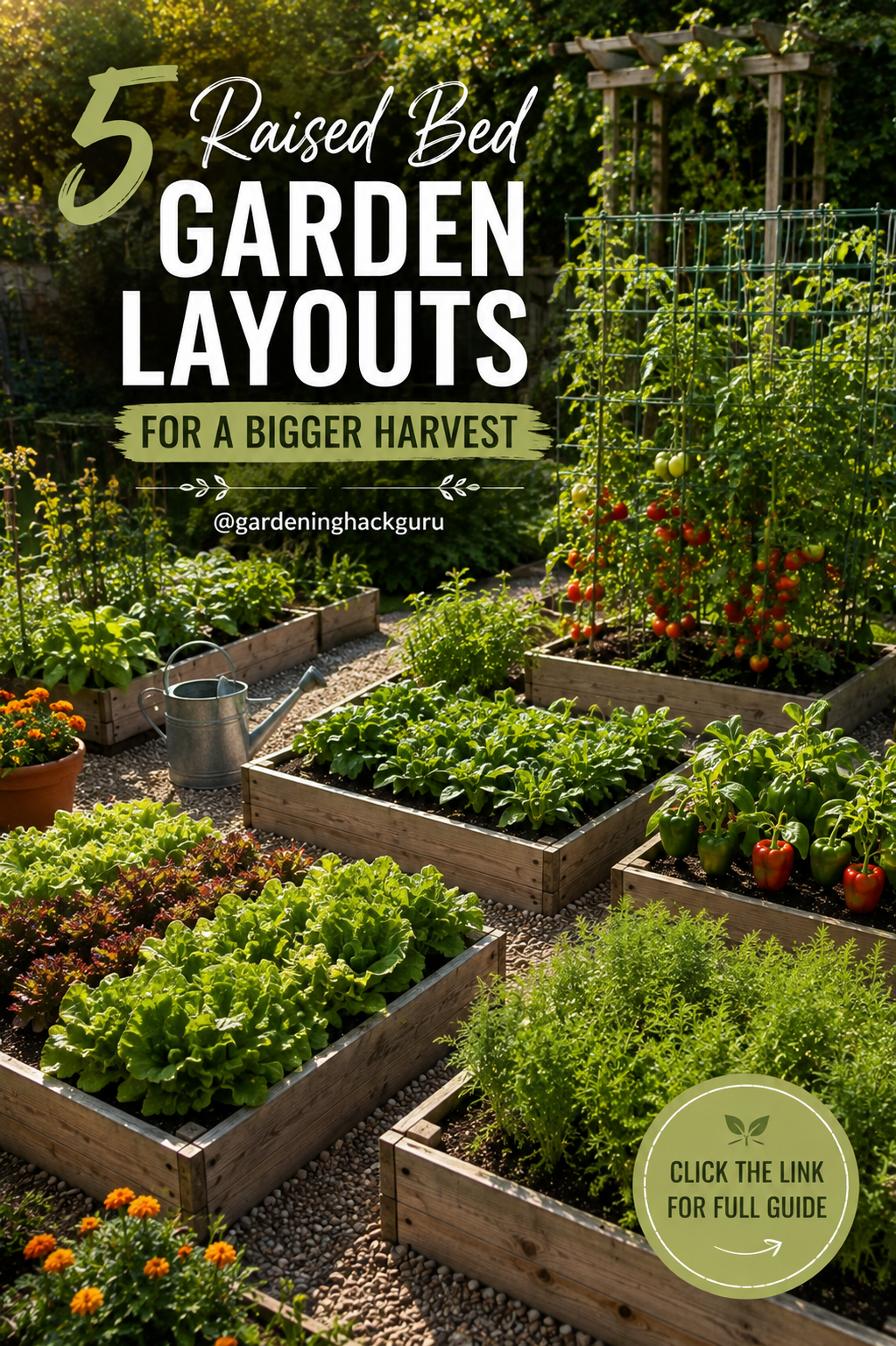
Raised bed gardening is one of the easiest ways to turn a backyard into a productive vegetable garden. Instead of planting vegetables wherever there happens to be space, raised beds allow you to organize crops carefully, improve soil conditions, simplify maintenance, and make better use of a relatively small growing area.
But simply having raised beds doesn’t guarantee a huge harvest. How you arrange your vegetables matters.
Tall tomato plants can shade lettuce. Sprawling cucumbers can consume valuable growing space. Closely planted vegetables can compete for sunlight and airflow. With a thoughtful layout, however, you can use vertical space, combine crops with different growth habits, and keep productive plants growing throughout the season.
Here are 5 raised bed garden layouts for a bigger harvest that can work beautifully in an everyday backyard.
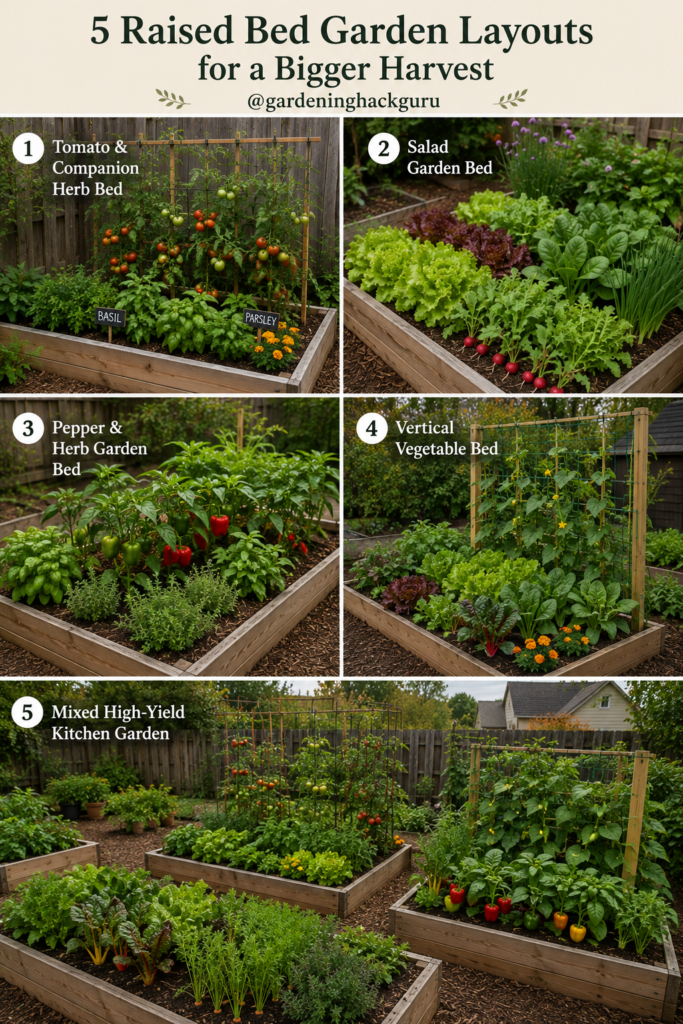
1. 🍅 Tomato & Companion Herb Bed
Tomatoes are often the stars of the summer vegetable garden, so giving them a dedicated raised bed can make management much easier.
Suggested layout
Back of the bed:
Tomatoes supported by sturdy cages or a trellis
Middle:
Basil and parsley
Front/edges:
Low-growing herbs or compact seasonal vegetables
Position the tomatoes where their mature height is least likely to shade shorter crops. In much of the Northern Hemisphere, that often means putting taller crops toward the north side of the bed, although your actual sun exposure should determine the final placement.
Give tomatoes adequate spacing based on the variety you’re growing rather than trying to squeeze as many plants as possible into one bed.
Good airflow can help reduce disease problems.
Why this layout works
Tomatoes use the vertical space above the garden while smaller plants make use of some of the lower-growing area.
Basil is also convenient to grow nearby because both crops are frequently harvested together in the kitchen.
Don’t expect companion planting alone to prevent pests or dramatically increase tomato production. The bigger benefits come from efficient spacing, good soil, adequate sunlight, and proper plant care.
2. 🥬 Salad Garden Bed
A salad bed is perfect for gardeners who want frequent harvests rather than waiting months for one large crop.
Fill the bed with fast-growing leafy vegetables and compact root crops.
Suggested layout
Try combining:
- Lettuce
- Spinach
- Arugula
- Radishes
- Green onions
Instead of planting one huge section of lettuce at the same time, sow smaller areas every couple of weeks when weather conditions are suitable.
This technique, known as succession planting, can help extend your harvest.
Why this layout works
Many salad crops mature relatively quickly.
Radishes may be harvested while slower crops are still developing, freeing up space for another planting.
Leaf lettuce can often be harvested gradually by taking outer leaves while allowing the center to continue growing.
During hot summer weather, many cool-season greens become less productive or bolt. You can then transition the bed to warm-season crops before planting greens again when temperatures cool.
3. 🫑 Pepper & Herb Garden Bed
Peppers are excellent candidates for raised beds because they appreciate warm conditions and well-draining soil.
Both sweet bell peppers and hot peppers can be incorporated into this layout.
Suggested layout
Main planting area:
Bell peppers and chili peppers
Between or around peppers:
Compact herbs where spacing allows
Bed edges:
Low-growing herbs such as thyme
Avoid crowding herbs directly against pepper stems.
Your pepper plants will become significantly larger than the seedlings you purchase in spring, so plan according to their mature size.
Why this layout works
Pepper plants generally grow upright rather than sprawling across huge sections of the bed.
That leaves opportunities to use some surrounding space for smaller plants without creating a chaotic garden.
The combination also creates a beautiful edible bed filled with different foliage textures and colorful peppers.
4. 🥒 Vertical Vegetable Bed
One of the smartest ways to increase productivity in a small raised bed is to stop thinking only horizontally.
Grow upward.
Install a strong trellis along one side of the raised bed and use it for climbing crops.
Excellent possibilities include:
- Pole beans
- Peas
- Trellised cucumbers
Choose crops appropriate for your growing season.
Suggested layout
Along the trellis:
Climbing vegetables
Middle:
Medium-height vegetables or herbs
Front:
Short vegetables and leafy greens
Growing cucumbers vertically can prevent vines from sprawling across the entire raised bed.
Pole beans can similarly produce vertically rather than requiring large amounts of ground space.
Why this layout works
Vertical gardening effectively creates another dimension of growing space.
Instead of cucumber vines covering several square feet of soil, the plants climb upward while the ground below remains more accessible.
Position the trellis carefully so it doesn’t cast excessive shade over the rest of the bed.
And build it before vigorous climbing plants need support. Trying to install a trellis through mature vines is much more difficult.
5. 🥕 Mixed High-Yield Kitchen Garden
If you want a backyard garden that produces a little bit of everything, create several raised beds and organize them according to plant height and growth habit.
This is the layout closest to a traditional kitchen garden.
Imagine stepping outside and harvesting tomatoes, peppers, lettuce, carrots, herbs, and cucumbers for dinner.
Example arrangement
Bed 1:
Tomatoes + basil + parsley
Bed 2:
Peppers + compact herbs
Bed 3:
Lettuce + spinach + radishes + green onions
Bed 4:
Carrots + other compatible compact vegetables
Bed 5:
Trellised cucumbers, beans, or peas depending on the season
This arrangement makes crop management easier because vegetables with similar requirements can be grouped together.
Why this layout works
You’re combining three important strategies:
Vertical growing + succession planting + efficient spacing.
Instead of asking one crop to occupy a raised bed for the entire year, you can replace finished crops with something appropriate for the next part of your growing season.
That keeps valuable garden space productive for longer.
☀️ Put Tall Vegetables Where They Won’t Block the Sun
One of the most important raised-bed layout rules is considering plant height.
Tomatoes, pole beans, peas, and trellised cucumbers can become much taller than lettuce, radishes, carrots, and many herbs.
If you put tall plants on the wrong side of a bed, they may shade shorter crops for much of the day.
Before planting, observe how sunlight moves across your backyard.
Then position tall crops and trellises where they’ll cause the least problematic shading.
A few minutes of planning can prevent months of frustration.
📏 Don’t Confuse High-Yield With Overcrowded
When gardeners want bigger harvests, there’s a temptation to put another plant into every empty inch of soil.
More plants don’t automatically equal more food.
Overcrowded plants can compete for:
- Sunlight
- Water
- Nutrients
- Root space
- Airflow
Follow appropriate spacing recommendations for the particular variety you’re growing.
A garden with fewer healthy, productive plants can outperform one packed with struggling plants.
🌱 Start With Great Raised Bed Soil
Even the smartest layout can’t compensate for poor growing conditions.
Raised beds should contain a fertile, well-draining growing medium with sufficient organic matter.
Adding finished compost can improve soil structure and provide nutrients, but don’t assume that adding enormous amounts of compost is always better.
Your vegetables’ nutrient requirements will change throughout the season.
If you’re gardening seriously, a soil test can help you understand what your soil actually needs rather than guessing.
💧 Make Watering Easier
Raised beds can drain and dry faster than in-ground gardens, especially during hot weather.
Water deeply enough to reach the root zone rather than repeatedly wetting only the surface.
Adding an appropriate layer of organic mulch around established plants can help reduce evaporation and suppress weeds.
For multiple raised beds, consider drip irrigation or soaker hoses.
These systems can deliver water directly to the soil while keeping much of the foliage dry.
🌿 Use Succession Planting for More Harvests
One of the biggest opportunities for increasing garden productivity isn’t squeezing in more plants.
It’s using the same space more than once.
For example, depending on your climate, you might grow a quick spring crop of radishes or lettuce.
After harvesting it, replace that crop with a warm-season vegetable.
Later, when summer crops finish, you may be able to plant cool-season greens again.
Your exact schedule will depend heavily on your climate and first and last frost dates.
🐝 Don’t Forget Pollinators
Vegetables such as tomatoes can self-pollinate, while crops such as cucumbers and squash benefit greatly from insect pollination.
Growing appropriate flowers near your vegetable beds can help make your backyard attractive to pollinating insects.
Instead of filling valuable vegetable-bed space with large ornamental plants, you can establish flowers around the garden perimeter or nearby.
Choose species suited to your region, preferably including locally appropriate native flowering plants.
🪵 Leave Comfortable Paths Between Beds
The garden in your inspiration photo works partly because every raised bed is accessible.
Don’t build a garden where you have to step into the beds to harvest vegetables.
Leave enough pathway space to comfortably:
- Walk between beds
- Carry baskets
- Use a watering can
- Pull weeds
- Harvest vegetables
- Move a wheelbarrow where necessary
Keeping your feet out of the growing beds also helps avoid unnecessary soil compaction.
🌿 Which Layout Is Best for Beginners?
If you’re building your first raised bed, don’t try to grow twenty vegetables at once.
Start with crops you actually enjoy eating.
A simple beginner garden might include:
2 tomato plants + several peppers + lettuce + radishes + basil + one trellised cucumber.
You’ll learn how sunlight, watering, pests, soil, and seasonal temperatures affect your particular backyard.
Next year, you can expand based on what performed best.
🍅 Final Thoughts
A productive raised bed garden isn’t necessarily the one containing the most plants. It’s the one where every plant has a purpose and enough room to perform well.
Use tall crops vertically. Put shorter vegetables where they’ll receive enough sunlight. Grow fast crops between longer-season plantings when appropriate. Replant empty spaces after harvest, and choose vegetables suited to your climate and season.
Whether you build a dedicated tomato bed, a colorful pepper garden, a quick-growing salad bed, a vertical cucumber garden, or an entire kitchen garden, thoughtful planning can help you harvest considerably more from the space you already have.
And that’s the real advantage of raised beds: you don’t necessarily need a bigger backyard—you need a smarter layout.