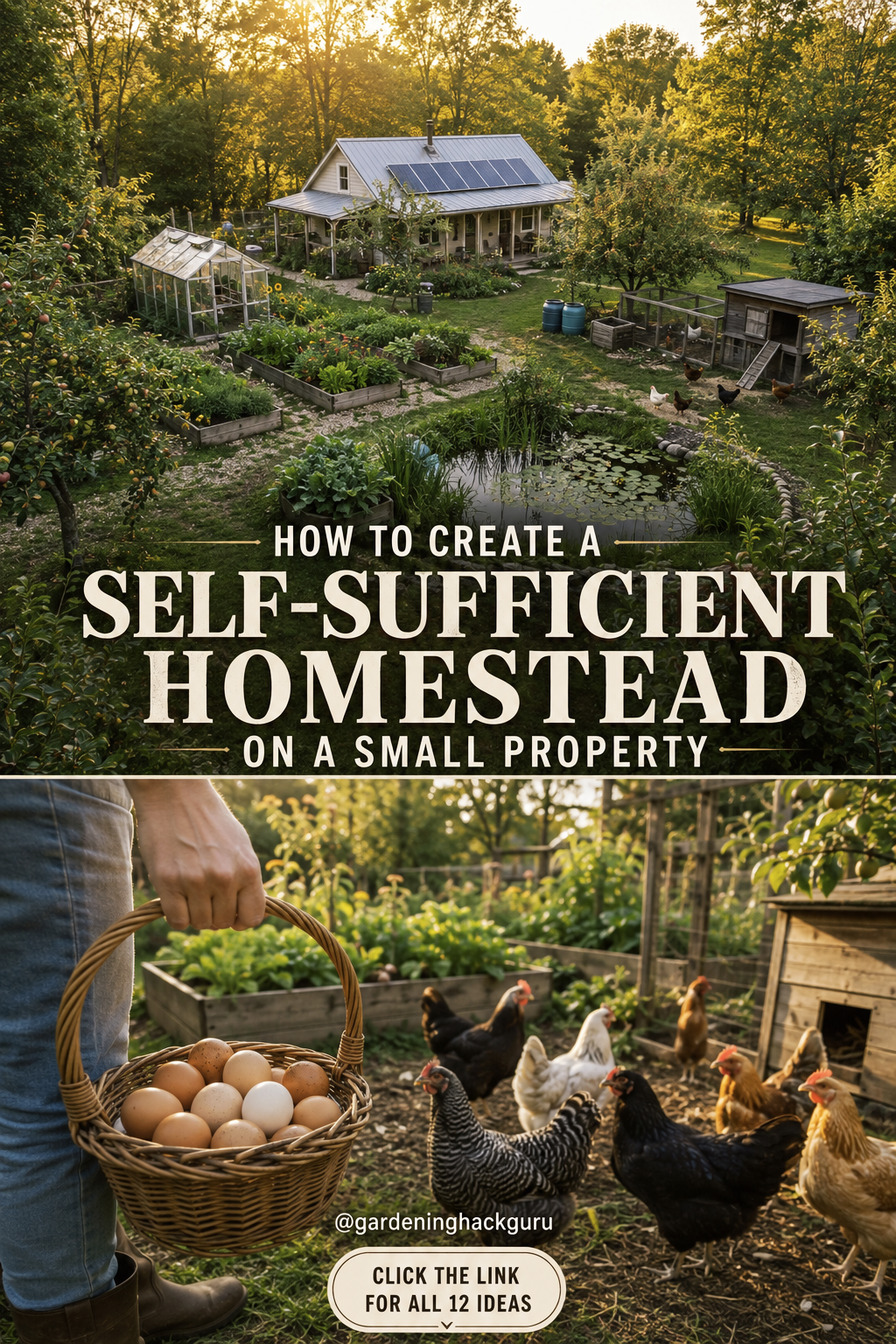
When most people picture a self-sufficient homestead, they imagine acres of countryside, a big farmhouse, barns, animals, and endless rows of crops. It sounds wonderful—but it can also make homesteading feel completely out of reach.
The good news is that you don’t need a huge piece of land to become more self-sufficient.
A surprisingly productive little homestead can fit onto a modest property when every area has a purpose. A sunny corner can become a vegetable garden, a few fruit trees can provide food for years, and even a small chicken coop can put fresh eggs on the breakfast table.
The goal doesn’t have to be living completely off-grid, either. For most of us, self-sufficiency simply means producing a little more ourselves and depending a little less on the store.
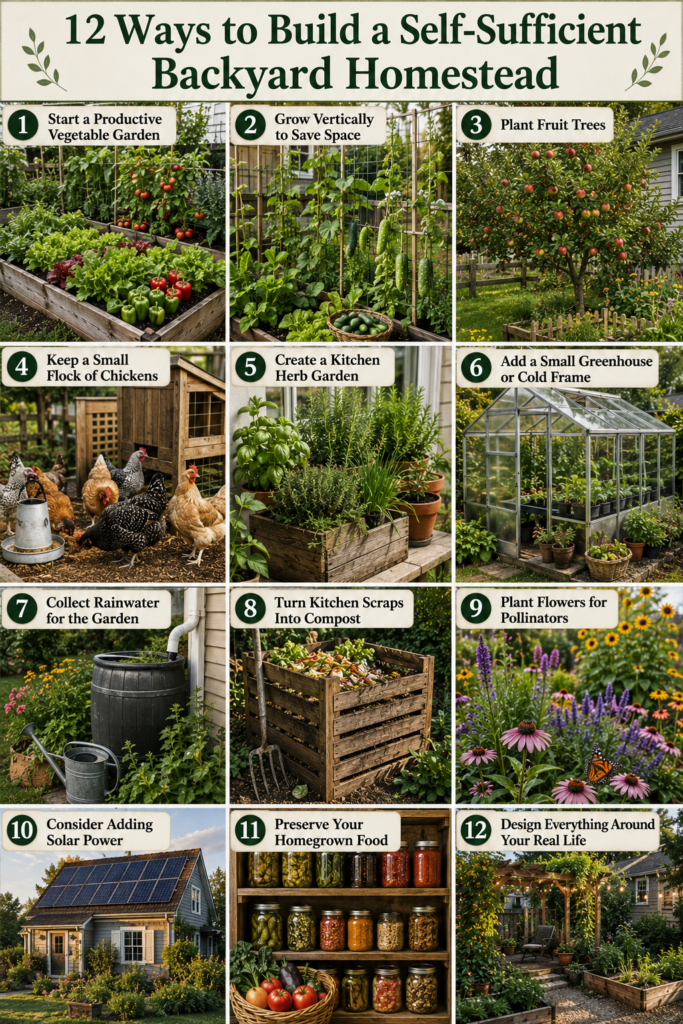
Here are 12 practical ways to get started.
1. Start With a Small Vegetable Garden
If you’re new to growing food, resist the temptation to plant everything at once.
A few well-planned raised beds can produce an impressive amount of food without taking over the entire yard. Start with vegetables your family actually eats regularly.
Tomatoes, lettuce, cucumbers, peppers, beans, carrots, zucchini, and leafy greens are all great choices.
Raised beds are especially useful on smaller properties because they keep the garden organized and make it easier to improve the soil exactly where you’re growing.
Once you get comfortable with a few beds, you can always expand.
2. Grow Up Instead of Out
When space is limited, vertical gardening becomes incredibly useful.
Beans and peas can climb trellises. Cucumbers can be trained upward instead of sprawling across the ground. Tomatoes can grow on tall supports, and strawberries or herbs can even be grown in vertical planters.
A fence that once did nothing more than mark the edge of the property can suddenly become another growing area.
It’s one of the easiest ways to squeeze more food out of a small backyard.
3. Plant Fruit Trees
Fruit trees are one of my favorite additions to a small homestead because they provide food without requiring much ground space once established.
You don’t necessarily need full-sized trees, either.
Dwarf and semi-dwarf varieties of apples, pears, peaches, plums, and cherries are much easier to fit into an ordinary yard.
If you’re really short on space, some fruit trees can even be trained flat against a fence or wall.
They may take a few years to become productive, but planting them early is worth it. Years from now, you’ll be glad you did.
4. Keep a Small Flock of Chickens
There’s something incredibly satisfying about walking outside in the morning and collecting fresh eggs.
For many small homesteads, chickens are one of the most practical animals to keep.
A modest flock doesn’t require an enormous amount of room, and besides providing eggs, chickens produce manure that can eventually become valuable compost for the garden.
Give them a secure, weatherproof coop, enough outdoor space, fresh water, appropriate feed, shade, and protection from predators.
Before bringing chickens home, check your local rules because backyard poultry regulations vary considerably from one area to another.
5. Grow Herbs Close to the Kitchen
Not everything on a homestead needs its own big garden bed.
Herbs are perfect for squeezing into smaller spaces.
Grow basil, parsley, rosemary, thyme, mint, oregano, chives, and cilantro in containers, along paths, or in a little garden near the kitchen.
Having fresh herbs just a few steps from the door means you’ll actually use them.
And once you start snipping fresh herbs for dinner instead of buying those tiny plastic packages at the grocery store, it’s difficult to go back.
6. Add a Small Greenhouse or Cold Frame
A greenhouse doesn’t have to be enormous.
Even a compact greenhouse can help you start seedlings earlier, protect tender plants, and extend your growing season.
If you don’t have enough room or budget for one, consider building a cold frame instead.
These simple structures can give young plants protection from cold temperatures and allow you to get more from the same small growing area throughout the year.
7. Collect Rainwater
Water is easy to overlook when planning a homestead, but a productive garden can use quite a lot of it.
Connecting rain barrels to suitable roof gutters can provide stored water for garden plants during dry periods.
Place barrels somewhere convenient rather than hiding them so far away that watering becomes a chore.
Just remember that rules surrounding rainwater collection differ by location, and stored water should be managed carefully to prevent mosquitoes and contamination.
8. Turn Kitchen Scraps Into Compost
One of the nicest parts of homesteading is seeing things that used to be considered waste become useful.
Vegetable peelings, coffee grounds, fallen leaves, garden trimmings, and other suitable organic materials can gradually become rich compost.
You don’t need an enormous compost pile.
A simple enclosed bin tucked into a corner of the yard is enough for many households.
Over time, you’ll have homemade organic matter to add back into your garden beds instead of constantly buying bags from the garden center.
9. Make Room for Pollinators
A productive homestead shouldn’t contain vegetables alone.
Flowers are important too.
Planting lavender, coneflowers, sunflowers, calendula, cosmos, native wildflowers, and other pollinator-friendly plants can attract bees, butterflies, and beneficial insects.
I love planting flowers around the edges of vegetable beds rather than separating the pretty garden from the practical one.
It makes the entire property feel softer and more natural while supporting the little creatures your garden depends on.
10. Consider Solar Power Gradually
You don’t have to cover your entire roof in solar panels on day one.
If solar power makes sense for your property, budget, climate, and local regulations, it can be something you introduce gradually.
The important thing is not to think of self-sufficiency as an all-or-nothing project.
Growing some of your vegetables counts.
Collecting rainwater counts.
Producing some of your electricity counts.
Every useful system makes your household a little more resilient.
11. Learn to Preserve What You Grow
Growing twenty tomatoes feels wonderful until they’re all ripe at exactly the same time.
That’s when food preservation becomes an essential homesteading skill.
Depending on the food, you might freeze, dry, ferment, pickle, or safely can part of your harvest.
Fresh herbs can be dried or frozen. Berries freeze beautifully. Tomatoes can become sauces, and extra vegetables can often be preserved for later.
For canning in particular, always follow current tested food-safety recipes rather than improvising processing times.
The goal is to enjoy your garden long after summer has disappeared.
12. Design the Homestead Around Your Real Life
This might be the most important tip of all.
Don’t build the homestead you saw someone else create online. Build the one that fits your life.
If you hate caring for chickens, don’t get chickens just because they look charming in photographs.
If your family eats mountains of tomatoes but hardly touches zucchini, give the tomatoes more space.
And don’t feel like every corner needs to become productive immediately.
Leave somewhere to sit under a tree. Keep some grass for children or pets. Create a little table where you can drink coffee in the morning and enjoy everything you’ve grown.
A homestead should make your life better—not become another endless list of chores.
Start With One Corner
The easiest way to become overwhelmed is to look at a beautiful established homestead and try to recreate everything in a single season.
Instead, choose one project.
Build two raised beds this spring.
Plant two fruit trees in the fall.
Start composting.
Add chickens next year if you’re ready.
Then keep building from there.
After a few seasons, that ordinary backyard can look completely different. You’ll know where some of your food came from, you’ll understand your soil better, and you’ll probably start measuring the seasons by what’s growing outside.
And that’s really what small-property homesteading is about.
It isn’t about proving that you can live without ever visiting a grocery store again. It’s about making better use of the space you already have, learning practical skills, and slowly creating a home that can provide a little more for you every year.
You may have less land than the homesteads you see online, but that doesn’t mean you can’t grow an incredible amount of life on it.