The weeks before the holidays always seem to have the same effect on my house. Suddenly, I notice every crowded cabinet, every random pile of mail, and every closet I’ve been avoiding all year.
And then the holiday stuff starts coming out.
There are decorations to unpack, groceries to stock up on, gifts to hide, guests to prepare for, and eventually new things coming into the house. If the home already feels full, all of that can quickly turn cozy holiday excitement into clutter.
That’s why I love doing a pre-holiday declutter before decorating begins.
This isn’t a whole-house minimalist makeover. You don’t need to spend an entire weekend emptying every drawer onto the floor. The goal is simply to clear the things you no longer need so there’s a little more breathing room for the season ahead.
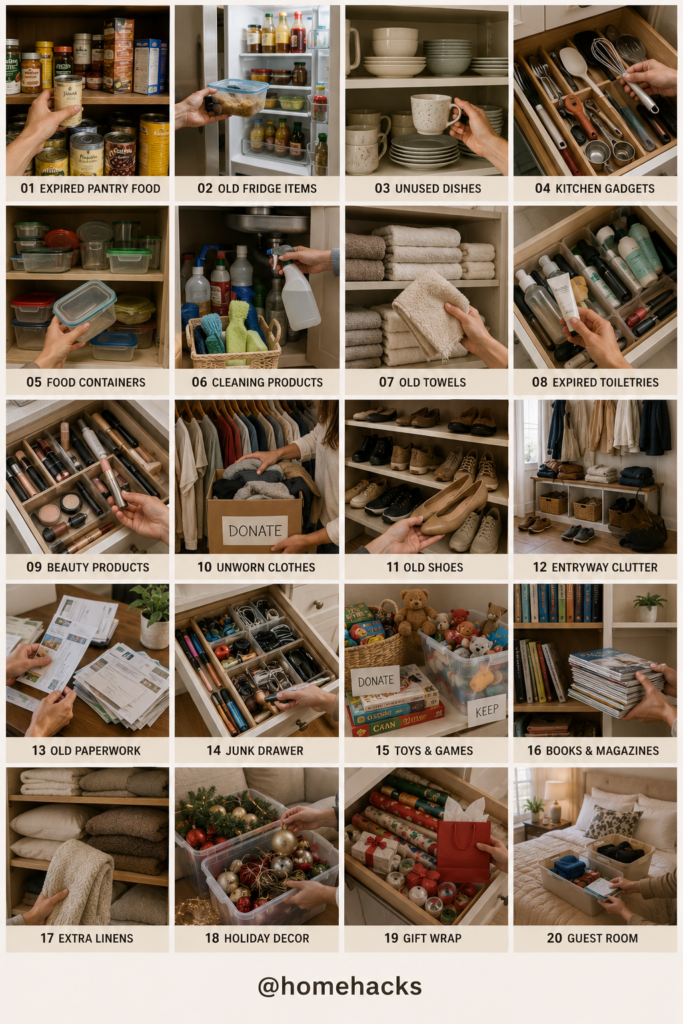
If you don’t know where to begin, start with these 20 surprisingly easy places.
1. Expired Pantry Food
The pantry is one of the best places to start because you may actually need the extra space soon.
Holiday baking ingredients, snacks for guests, canned goods, and extra groceries can fill shelves surprisingly quickly.
Take everything shelf by shelf rather than emptying the entire pantry at once.
Check expiration or best-quality dates as appropriate, look for damaged packaging, and get rid of anything that is unsafe to eat.
Then look at what’s still perfectly usable but realistically isn’t going to be eaten.
If you have unopened, in-date food your household doesn’t want, consider whether a local food bank or community organization can accept it.
Once you’re finished, group similar foods together so you can actually see what you have before holiday grocery shopping begins.
2. Old Fridge Items
Next comes the refrigerator.
This is especially worth doing before the holidays because the fridge is about to become prime real estate.
Go through leftovers, sauces, condiments, produce drawers, and those mysterious containers pushed all the way to the back.
Dispose of spoiled or unsafe food appropriately.
Then wipe up spills and sticky shelves while the fridge is less crowded.
You’ll make space for holiday ingredients and, more importantly, stop buying a second jar of something that’s been hiding behind the milk the entire time.
3. Unused Dishes
Holiday hosting tends to make us think we need more dishes.
Sometimes the opposite is true.
Open your kitchen cabinets and look at what’s taking up space.
Do you have chipped mugs you always skip over? Plates you haven’t used in years? Serving dishes that seemed like a good idea but never leave the cabinet?
Keep what you actually use and love.
Donate usable extras where appropriate and safely dispose of badly chipped or broken pieces.
The goal isn’t to get rid of every mismatched mug. If you love it and use it, keep it.
You’re just making room for the dishes that actually belong in your everyday life.
4. Duplicate Kitchen Gadgets
Somehow, kitchen gadgets multiply when nobody is looking.
You might discover three vegetable peelers, four bottle openers, several spatulas that all do the same thing, and one mysterious gadget you can’t even remember buying.
Pull out your most crowded utensil drawer.
Keep your favorites—the things you naturally reach for while cooking.
Then question the duplicates and rarely used tools.
With holiday cooking coming up, having a drawer that actually opens without getting stuck on a whisk is a small luxury worth creating.
5. Food Storage Containers
I think almost every kitchen has that cabinet.
You open the door carefully because there’s a reasonable chance a plastic lid will fall on your head.
Take out your food-storage containers and match every container with its lid.
Anything badly damaged, cracked, warped, or no longer appropriate for food storage can go according to local disposal or recycling guidance.
Then decide how many containers your household realistically needs.
Stacking containers by size and storing lids together can turn one of the most frustrating kitchen cabinets into something surprisingly manageable.
And you’ll be glad you did when holiday leftovers arrive.
6. Old Cleaning Products
Before holiday guests and entertaining begin, you’ll probably be cleaning more than usual.
So now is a good time to look under the sink.
Remove empty bottles, dried-out wipes, worn sponges, broken brushes, and products you no longer use.
Be careful with household chemicals. Don’t pour random cleaning products together or combine leftovers to save space. Follow product labels and your local hazardous-waste guidance when something requires special disposal.
Once you’ve cleared the unnecessary stuff, keep your everyday cleaning supplies somewhere easy to reach.
You’ll appreciate that when someone spills something ten minutes before guests arrive.
7. Worn-Out Towels
Open the linen closet and be realistic.
There are usually the towels everyone loves—and then there are the towels nobody chooses unless absolutely everything else is in the laundry.
Keep enough good bath towels, hand towels, and washcloths for your household and expected guests.
Then sort through the badly frayed, stained, or worn ones.
Some old towels can be cut down and reused as cleaning cloths. Animal shelters may also accept certain clean textile donations, depending on their policies.
You don’t necessarily need to throw everything away.
You just don’t need fifteen old towels occupying half the closet either.
8. Expired Toiletries
Bathroom drawers can hide an impressive amount of forgotten stuff.
Take a look at sunscreen, skincare, medications, personal-care products, travel-size toiletries, and anything else that’s been sitting there for a long time.
Check expiration dates where applicable.
Dispose of expired medications through an appropriate take-back or disposal program rather than casually throwing or flushing them away when local guidance advises otherwise.
Throw away empty containers and products that have clearly deteriorated.
Then group the things you actually use.
It makes the bathroom feel cleaner without changing a single piece of décor.
9. Unused Beauty Products
This category deserves its own pass because makeup and beauty products are incredibly easy to accumulate.
That lipstick that wasn’t quite the right shade.
The foundation you stopped using.
The nearly empty moisturizer you’re keeping for some unknown reason.
The samples you’ve been “saving for travel” since forever.
Keep what you genuinely use and enjoy.
Check product guidance for how long cosmetics remain suitable after opening, especially products used around the eyes.
Once the forgotten products are gone, your morning routine becomes much easier because you can actually find your favorites.
10. Unworn Clothes
You don’t need to completely reinvent your wardrobe before Christmas.
Just make some room.
Start with obvious decisions: clothing that no longer fits your life, things you consistently avoid wearing, damaged pieces you’re never going to repair, and duplicates you don’t need.
Put clean, wearable clothing into a donation box if you know you won’t wear it again.
One question helps me here:
If I saw this in a store today, would I actually want to bring it home?
If the answer is an immediate no, that’s useful information.
11. Old Shoes
Shoes take up a surprising amount of space, particularly around the entryway.
Pull out pairs you haven’t worn in a long time.
Check for worn-out soles, damaged shoes you’ve been meaning to repair, uncomfortable pairs, and shoes that simply don’t fit anymore.
Donate pairs that are still in suitable condition.
Then clean and organize the ones you actually wear.
Your entryway will immediately feel calmer—and you’ll have somewhere for guests to put their shoes when they arrive.
12. Entryway Clutter
Speaking of the entryway, this is one area I’d definitely tackle before holiday gatherings.
It’s the first part of your home people see.
Remove out-of-season shoes, random bags, old mail, broken umbrellas, jackets nobody is currently wearing, and all those little things that somehow migrate toward the front door.
Give everyday items a simple home.
Hooks for coats.
A basket for winter accessories.
A tray for keys.
A sensible place for shoes.
You don’t need a magazine-worthy entryway. You just need enough empty space that four guests arriving with coats doesn’t create instant chaos.
13. Old Paperwork
Paper clutter is sneaky because one sheet doesn’t look like much.
Then suddenly there’s an entire drawer of receipts, catalogs, instruction manuals, old statements, and unopened mail.
Sort through it carefully.
Recycle paperwork you genuinely don’t need, but shred documents containing sensitive personal or financial information where appropriate.
Keep important tax, legal, medical, warranty, and financial records according to the retention periods relevant to you rather than decluttering them simply because they’re old.
Once you’ve removed the obvious junk, create one small place for incoming paperwork so the pile doesn’t immediately return.
14. The Junk Drawer
Yes, we’re finally dealing with it.
Empty your junk drawer onto a table.
You’ll probably find batteries, pens, tape, keys, random screws, charging cables, receipts, rubber bands, and at least one object nobody in the household can identify.
Test pens.
Recycle batteries and electronics through appropriate programs.
Match chargers with devices.
Throw away obvious rubbish.
Then use a few small dividers or containers for what remains.
The drawer can still contain miscellaneous things—that’s its job.
It just shouldn’t require both hands and a prayer to close.
15. Unused Toys and Games
If children live in your home, doing a toy declutter before the holidays can be especially helpful.
New toys and games may be arriving soon, so make space beforehand.
Sort out broken toys, incomplete games, things that have been outgrown, and toys nobody chooses anymore.
Children can often help decide what they’re ready to pass along.
Donate clean, complete items where accepted.
For favorite toys, keep them accessible rather than buried underneath things nobody plays with.
The goal isn’t an empty playroom.
It’s a playroom where the things that remain actually get enjoyed.
16. Books and Magazines
I’m not going to tell you to get rid of books you love.
A home full of well-loved books isn’t clutter simply because there are a lot of them.
Instead, look for books you know you’ll never read again, outdated reference material, duplicate copies, old catalogs, and magazines you’ve already finished.
Donate suitable books to places that accept them.
Recycle magazines where local recycling rules allow.
Then give the books you’re keeping enough room to breathe.
A bookshelf doesn’t need to be perfectly styled. It’s much nicer when you can simply remove one book without causing an avalanche.
17. Extra Blankets and Pillows
Blankets seem particularly innocent until you realize they’ve taken over an entire closet.
Pull out your spare bedding, throws, blankets, and pillows.
Keep enough for your household, seasonal needs, and overnight guests.
Then look at what remains.
Do you have pillows that are no longer comfortable? Throws nobody uses? Bedding for a mattress size you don’t even own anymore?
Donate clean items if local organizations accept them.
This is one category where decluttering before the holidays makes immediate sense because you’ll probably want those extra linens for guests.
18. Holiday Decorations
Before you decorate, go through the decorations themselves.
It’s much easier than putting everything up and deciding what you dislike afterward.
Open the storage boxes and check for broken ornaments, damaged decorations, tangled or non-working lights, tired garlands, and pieces you haven’t displayed in several years.
Test electrical decorations safely before using them.
Keep sentimental items even if they aren’t fashionable. Holiday decorating should feel personal, not like you’re trying to recreate a showroom.
But if something is broken, unwanted, and has been traveling from storage box to storage box for a decade, this might be its year to leave.
19. Gift Wrap Supplies
Gift-wrap storage can get surprisingly ridiculous.
You save a nice gift bag.
Then another.
Then a box.
Then seventeen tiny pieces of wrapping paper because technically they could wrap something.
Before buying new holiday wrapping supplies, see what you already have.
Get rid of crushed bags, unusably small scraps, damaged bows, empty tape rolls, and boxes you don’t need.
Organize the good paper, ribbons, tags, tape, scissors, and reusable bags together.
You may discover you barely need to buy anything this year.
20. Guest Room Clutter
Finally, deal with the room that often becomes unofficial household storage: the guest bedroom.
If nobody stays there regularly, it’s incredibly easy to start putting things on the bed “just for now.”
And we all know how that ends.
Remove boxes, laundry, paperwork, seasonal storage, unwanted clothes, and anything else that doesn’t need to live there.
You don’t have to create a luxury hotel room.
Make the bed with fresh bedding, clear the nightstand, provide somewhere for luggage, leave some closet or drawer space, and make sure guests can easily access an outlet.
That’s enough to make someone feel genuinely welcome.
Don’t Try to Declutter Everything in One Day
Twenty categories sound like a lot because they are.
Don’t turn this into a punishment.
You could do four categories each weekend. Or choose one room every evening for a week. You could even set a 20-minute timer and stop when it rings.
The important thing is making progress before holiday activity starts piling on top of everyday life.
I’d prioritize the kitchen, entryway, living areas, and guest spaces first because those are the places likely to work hardest during holiday gatherings.
Use Four Simple Categories
When you’re stuck deciding what to do with something, keep the system simple:
KEEP — You use it, need it, or genuinely love it.
DONATE — It’s still useful and appropriate for donation, but you don’t need it.
RECYCLE — The material can be accepted through your local recycling system.
DISPOSE — It’s unusable and cannot appropriately be recycled or donated.
You may need a separate pile for things requiring special disposal, such as certain batteries, electronics, chemicals, or medications.
Avoid creating a giant “decide later” pile.
That’s usually just clutter wearing a new name.
Declutter Before You Buy Organizers
This is one of the biggest mistakes people make.
They see a crowded cabinet and immediately buy six matching baskets.
But organizing clutter doesn’t remove clutter.
Go through the space first.
Decide what actually deserves to stay.
Then—and only then—figure out whether you need containers.
Quite often, once the unnecessary things are gone, you’ll discover you already have enough storage.
Don’t Declutter Other People’s Belongings Without Them
Holiday motivation can be powerful.
One minute you’re sorting your own closet; the next you’re standing in front of someone else’s belongings with a donation bag.
Resist.
Shared spaces can absolutely be decluttered together, but personal belongings deserve input from the person who owns them.
It may take a little longer, but it’s much better than spending Christmas explaining where someone’s favorite sweatshirt went.
Make Space for What’s Coming
This is the part of pre-holiday decluttering that I find most useful.
You’re not clearing your house simply because clutter is “bad.”
You’re making space for the season you’re about to enjoy.
Space in the refrigerator for holiday food.
Space in the pantry for baking supplies.
Space in the entryway for visitors.
Space in the guest room for family.
Space under the tree for gifts.
Space in your home to decorate without everything feeling crowded.
And maybe even a little space in your schedule because you’re no longer searching through clutter for things you can’t find.
Final Thoughts
Your house doesn’t need to be perfectly organized before the holidays.
Nobody is going to inspect your junk drawer before accepting a cookie.
But clearing some of the things you no longer need can make the busiest part of the year feel noticeably easier.
Start small.
Throw away the expired pantry food. Clear the refrigerator. Match the food containers. Fill one donation box with clothes. Make the guest room usable again.
Then stop for the day if you’ve had enough.
By the time the decorations come out and guests start arriving, your home will already feel lighter, calmer, and more prepared.
And that’s really the point.
Not a perfect house.
Just more room for the people, traditions, food, and memories you actually want to bring into it.