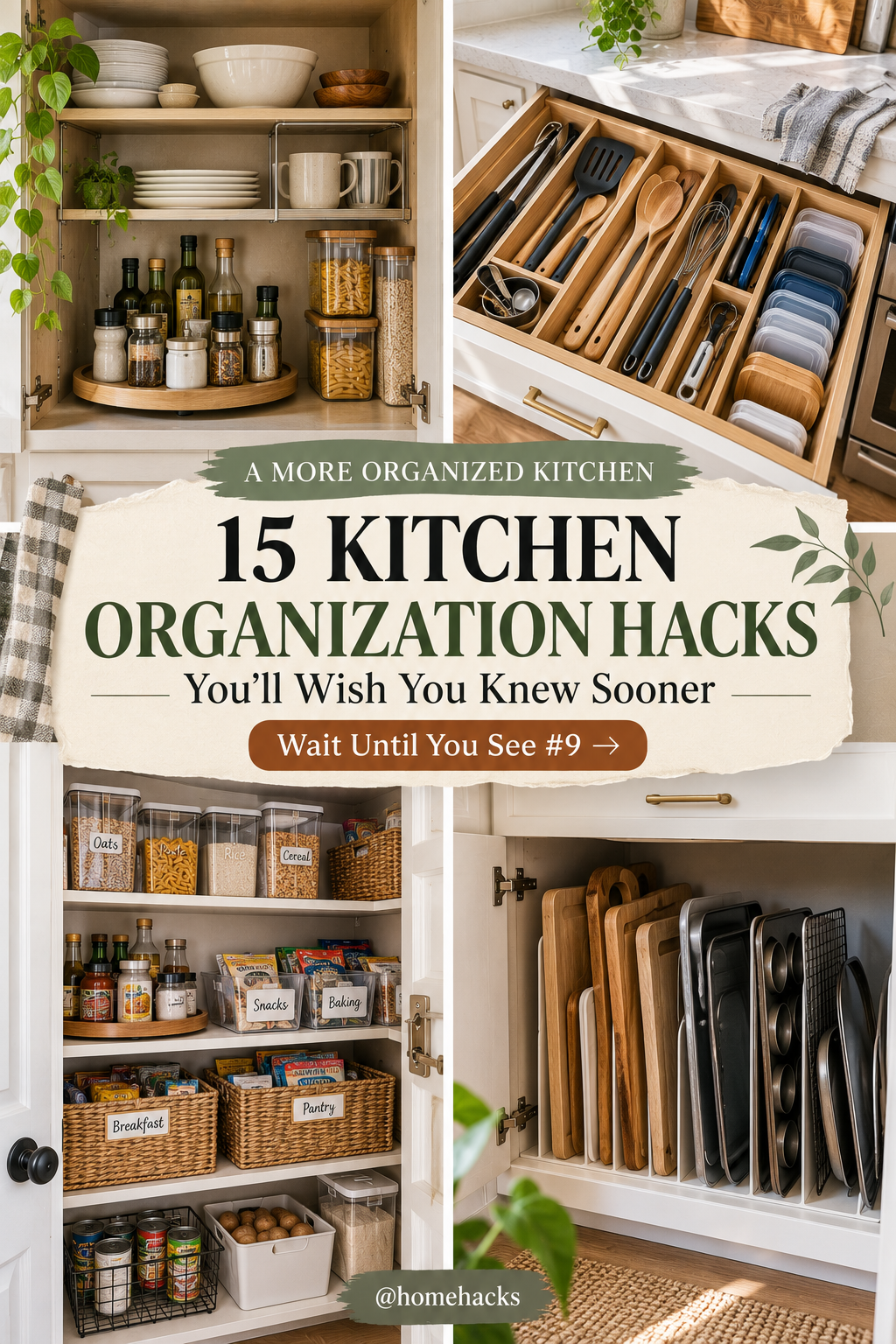
A kitchen can have plenty of cabinets and still somehow feel like it has no storage.
The problem isn’t always the amount of space. Often, it’s how that space is being used.
There are the baking sheets stacked underneath three frying pans. The container lids that seem to multiply overnight. The spice jar you know you bought but can’t find until you buy another one. And, of course, the mysterious collection of things slowly taking over the kitchen counter.
The good news is that organizing a kitchen doesn’t necessarily mean buying dozens of matching containers or installing expensive custom cabinetry.
Some of the best kitchen organization hacks are surprisingly simple. A shelf riser can double the useful space inside a cabinet. A turntable can make a deep corner accessible again. Even changing the way you store cutting boards can make everyday cooking easier.
Here are 15 smart kitchen organization hacks that can help you create a kitchen that’s easier to cook in, easier to clean, and much easier to keep organized.
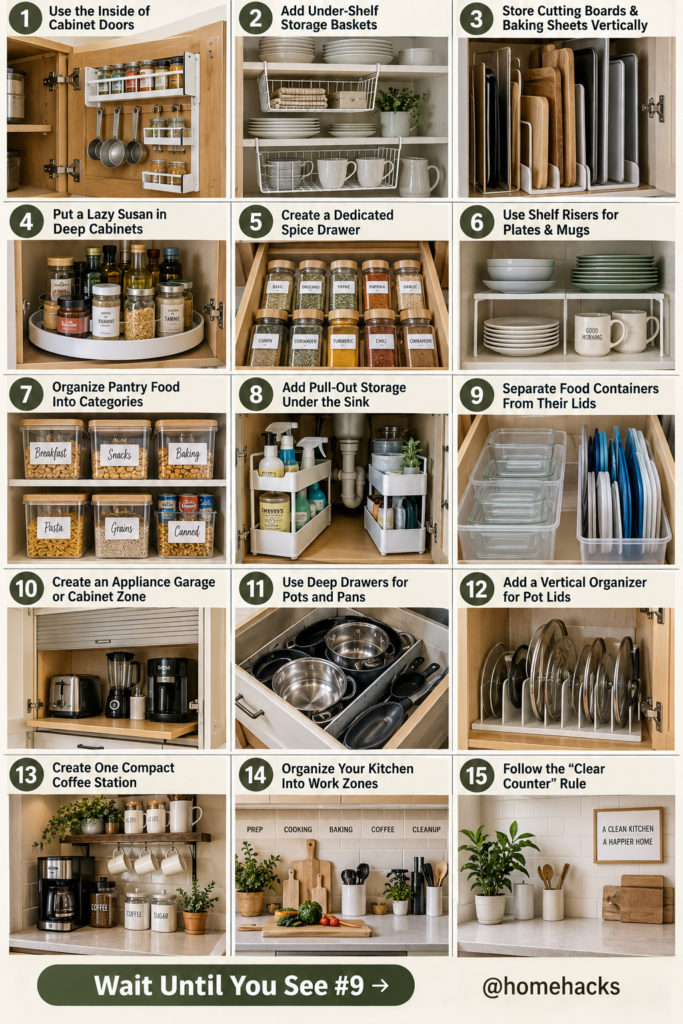
1. Use the Inside of Cabinet Doors
Open one of your kitchen cabinets and look at the back of the door.
Chances are, it’s completely empty.
That little area can become useful storage, particularly in a small kitchen where every inch matters.
Depending on the cabinet and door clearance, you might add slim racks or suitable hooks for lightweight kitchen items.
The important word here is slim.
Before installing anything, close the cabinet carefully and check where the shelves and contents sit. An organizer that’s too deep can hit whatever is stored inside and prevent the door from closing properly.
Used thoughtfully, though, cabinet doors can turn previously ignored vertical space into genuinely useful storage.
2. Add Under-Shelf Storage Baskets
Here’s another place most kitchens waste space: directly underneath shelves.
Imagine a tall cabinet shelf with a short stack of plates sitting on it. There’s often a large gap between the top plate and the next shelf.
An under-shelf basket can make use of some of that empty space without permanently changing the cabinet.
Depending on the basket’s weight rating and your cabinet setup, it can be useful for lightweight items such as kitchen linens or other small essentials.
It’s especially helpful in rental kitchens because many versions simply slide onto an existing shelf.
Just make sure the basket fits securely and doesn’t overload the shelf.
3. Store Cutting Boards and Baking Sheets Vertically
If you’ve ever pulled a baking sheet from the bottom of a giant stack, you already know why this works.
Instead of laying cutting boards, baking trays, cooling racks, and muffin tins flat on top of one another, store them vertically.
A sturdy divider or vertical organizer allows each item to have its own slot.
Then when you need the large cutting board, you simply pull it out.
You don’t have to remove six baking sheets first.
This is one of those small changes that doesn’t necessarily give you dramatically more storage space, but it makes the storage you already have far easier to use.
And that’s just as important.
4. Put a Lazy Susan in Deep Cabinets
Deep cabinets sound wonderful until something disappears into the back.
You reach past one bottle, knock over another, discover a jar that expired months ago, and eventually give up.
A rotating turntable—often called a Lazy Susan—can make certain deep storage areas much easier to access.
Instead of reaching behind everything, you rotate the organizer and bring items toward you.
They can work especially well for jars, bottles, condiments, and pantry staples that fit securely on the tray.
The trick is not to overcrowd it.
If bottles fall over every time you rotate the tray, you’ve defeated the purpose.
Keep similar items together and leave enough room for the organizer to turn smoothly.
5. Create a Dedicated Spice Drawer
Spices are surprisingly difficult to organize.
Put them in a deep cabinet and the small jars disappear behind larger ones. Put them on the counter and suddenly you have twenty bottles competing for space.
If you have a suitable drawer available, consider turning it into a dedicated spice drawer.
Arrange the jars so you can identify them quickly, using an organizer appropriate for the drawer if needed.
The goal isn’t to make your spices look like a store display.
The goal is to be able to find paprika without removing twelve other jars.
Before buying matching spice containers, try organizing the jars you already own. You may discover that you don’t need to transfer everything into new packaging at all.
6. Use Shelf Risers for Plates and Mugs
This might be one of the easiest ways to improve a crowded kitchen cabinet.
Let’s say you have bowls sitting on top of dinner plates because there’s only one shelf.
Every time you need a plate, the bowls have to move.
A simple shelf riser creates another level.
Plates can stay underneath while bowls sit above. Or mugs can occupy one level while smaller dishes use another.
Suddenly, the vertical gap inside the cabinet becomes usable.
Measure your cabinet before buying a riser, and choose something sturdy enough for what you plan to store.
It’s a small upgrade, but in the right cabinet, the difference can be enormous.
7. Organize Pantry Food Into Categories
You don’t need a picture-perfect walk-in pantry filled with matching glass jars to have an organized pantry.
You need categories.
Keep breakfast foods together.
Create an area for snacks.
Group baking supplies.
Keep pasta, rice, and similar staples in another section.
When related things live together, you can quickly see what you have before making a grocery list.
You also don’t need to decant every ingredient into a new container.
Original packaging is perfectly fine if the system works for you.
Clear bins, baskets, or simple shelf zones can help contain smaller packages, but don’t buy containers simply because they look good.
Organize first. Buy organizers only when they solve an actual problem.
8. Add Pull-Out Storage Under the Sink
The cabinet underneath the kitchen sink is often one of the most awkward spaces in the entire kitchen.
Pipes occupy the middle.
The garbage disposal may take up additional room.
And somehow everything you need ends up at the very back.
A pull-out organizer can make the space easier to access because the contents come toward you instead of requiring you to reach around the plumbing.
Measure carefully before buying anything. Pipes, valves, and disposal units vary significantly between kitchens, and you’ll want to keep plumbing accessible.
Also be thoughtful about what you store here.
Follow product labels for household cleaners, keep incompatible products appropriately separated, and make sure potentially hazardous products are secured away from children and pets.
Pretty organization isn’t worth compromising safety.
9. Separate Food Containers From Their Lids
There’s a particular kind of kitchen frustration that comes from finding the perfect container and then spending five minutes looking for its lid.
Instead of storing every container with its lid attached, try separating them.
Nest compatible containers by size to reduce the amount of space they occupy.
Then store the lids vertically in a sturdy divider or bin.
You can arrange them roughly by size so the right lid is easier to identify.
This is also a perfect opportunity to declutter.
Match every container with a lid.
Anything without a partner should be evaluated.
And if you’ve accumulated far more takeaway containers than you could realistically use, keep a reasonable number and recycle or dispose of the rest according to local guidelines.
10. Create an Appliance Garage or Cabinet Zone
Kitchen counters can look cluttered surprisingly quickly.
The toaster is out.
The blender is out.
The stand mixer is out.
The air fryer is out.
Suddenly, there’s barely enough room to prepare dinner.
You don’t necessarily need to hide every appliance. If you make toast every morning, keeping the toaster accessible may make sense.
But an appliance you use twice a month probably doesn’t deserve prime countertop real estate.
Give less frequently used appliances a designated cabinet or pantry area.
If you’re considering an enclosed appliance garage, remember that heat-producing appliances need to be used according to their manufacturer instructions. Don’t simply operate an appliance inside an enclosed cabinet unless the setup is specifically designed and approved for that use.
11. Use Deep Drawers for Pots and Pans
If your kitchen has deep drawers, they can be excellent for cookware.
Instead of building a precarious tower of pots inside a lower cabinet, arrange frequently used cookware so it’s easier to reach.
Nest compatible pots when necessary, but avoid creating such a complicated stack that getting the bottom pan requires dismantling everything.
You can also keep frequently used cookware toward the front and less-used pieces farther back.
If your current kitchen doesn’t have deep drawers, don’t worry. You can apply the same principle to a lower cabinet using suitable pull-out organizers.
The objective is simple: make individual pieces easier to retrieve.
12. Store Pot Lids Vertically
Pot lids cause almost as much trouble as food-container lids.
They’re awkward.
They’re different sizes.
And stacking them often results in a miniature kitchen avalanche.
A vertical lid organizer can solve much of that frustration.
Depending on your kitchen, it might live inside a deep drawer or cabinet.
Arrange lids so you can see their sizes and pull out one without disturbing everything else.
Before buying a dedicated organizer, count your lids.
You may discover that you have lids belonging to cookware you no longer own—which is a surprisingly satisfying problem to fix.
13. Create a Compact Coffee Station
If you drink coffee every day, it makes sense to keep everything you use together.
Instead of storing mugs in one cabinet, coffee somewhere else, and accessories across the kitchen, create one small coffee zone.
Your coffee maker can sit on the counter if appropriate, while mugs and supplies stay nearby.
Keep the setup simple.
You don’t need to turn your kitchen into a miniature café.
In fact, the best coffee stations often contain very little: the machine, coffee, mugs, and whatever you genuinely use every morning.
Grouping these items together also keeps other parts of the kitchen clearer.
14. Organize the Kitchen Into Work Zones
This is less of a storage product and more of an organizational mindset.
Think about where you use things.
Cooking utensils should be convenient to the cooking and prep area.
Everyday dishes should be somewhere easy to access.
Coffee supplies should be near the coffee maker.
Baking equipment can live together if you regularly bake.
Cleaning supplies belong near the cleanup zone when safe and practical.
When you organize around activities rather than simply putting things wherever there’s an empty shelf, the kitchen becomes easier to move through.
You stop crossing the room every thirty seconds because everything you need for one task is scattered across four cabinets.
15. Follow the Clear-Counter Rule
Finally, one of the cheapest kitchen organization tricks requires buying absolutely nothing.
Keep your counters mostly clear.
That doesn’t mean your kitchen has to look empty.
It means countertop space should be reserved primarily for things that are useful enough to deserve it.
If you use the coffee maker every morning, leave it out.
If you use the blender once every three weeks, consider putting it away.
The same goes for piles of mail, reusable bottles, random grocery bags, and objects that don’t really belong in the kitchen.
Clear counters don’t just make a kitchen look more organized.
They also give you more room to prepare food and generally make surfaces easier to clean.
Before You Buy More Kitchen Organizers
Here’s something that can save you money:
Declutter first. Organize second. Shop third.
It’s tempting to see a beautiful pantry online and immediately order ten storage bins.
But containers don’t create space.
Sometimes they simply organize things you didn’t need to keep in the first place.
Go through one cabinet at a time.
Check expired food and dispose of it appropriately.
Match containers with lids.
Look for duplicate utensils.
Ask yourself whether you genuinely use that appliance occupying half a shelf.
Once you’ve removed what you don’t need, you’ll have a much clearer idea of what kind of organizer—if any—would actually help.
Measure Everything
Kitchen storage spaces can be deceptive.
A basket might technically fit inside your cabinet but prevent the door from closing.
A drawer divider might be half an inch too long.
A turntable might fit on the shelf but not rotate once bottles are added.
Before buying organizers, measure:
- cabinet width, depth, and height
- drawer dimensions
- shelf clearance
- door hinges and frames
- plumbing underneath the sink
- the objects you actually intend to store
Five minutes with a measuring tape can prevent a lot of returns.
The Best Kitchen Organization System Is the One You Can Maintain
An organized kitchen shouldn’t require thirty minutes of tidying every evening.
If putting something away is complicated, there’s a good chance you’ll eventually stop doing it.
That’s why simple systems often work better than elaborate ones.
A basket labeled “snacks” is easy.
A vertical divider for baking sheets is easy.
A drawer where all your spices live is easy.
The easier it is to put something back where it belongs, the more likely your kitchen will stay organized after the initial Pinterest-worthy makeover wears off.
And don’t feel pressured to make everything match.
Your pantry doesn’t need twenty identical containers.
Your dishes don’t need to be arranged by color.
Your kitchen doesn’t need to look like nobody cooks there.
A genuinely organized kitchen can still look lived in.
Start With the Spot That Annoys You Most
You don’t need to reorganize your entire kitchen this weekend.
Pick one problem.
If you’re constantly fighting with food-container lids, fix that drawer.
If the pantry is driving you crazy, create categories.
If baking sheets fall over every time you open the cabinet, store them vertically.
If your counters feel crowded, put away three things you rarely use.
Small changes tend to stick because you immediately notice the improvement.
Then tackle another area.
Eventually, those little fixes begin working together.
Final Thoughts
The smartest kitchen organization ideas aren’t necessarily the most expensive or the prettiest.
They’re the ones that make everyday life easier.
A shelf riser means you don’t have to move bowls every time you need a plate.
A rotating organizer means you can actually reach what’s hiding in the back of a deep cabinet.
Vertical dividers stop baking sheets from becoming an avalanche.
A pull-out organizer makes an awkward cabinet easier to access.
And a mostly clear countertop gives you something every kitchen needs more of: room to actually cook.
So before deciding that your kitchen simply doesn’t have enough storage, take another look inside your cabinets, drawers, pantry, and under-sink area.
There may be more usable space hiding there than you realize.
Sometimes the best kitchen makeover isn’t adding more storage.
It’s simply making the storage you already have work harder.