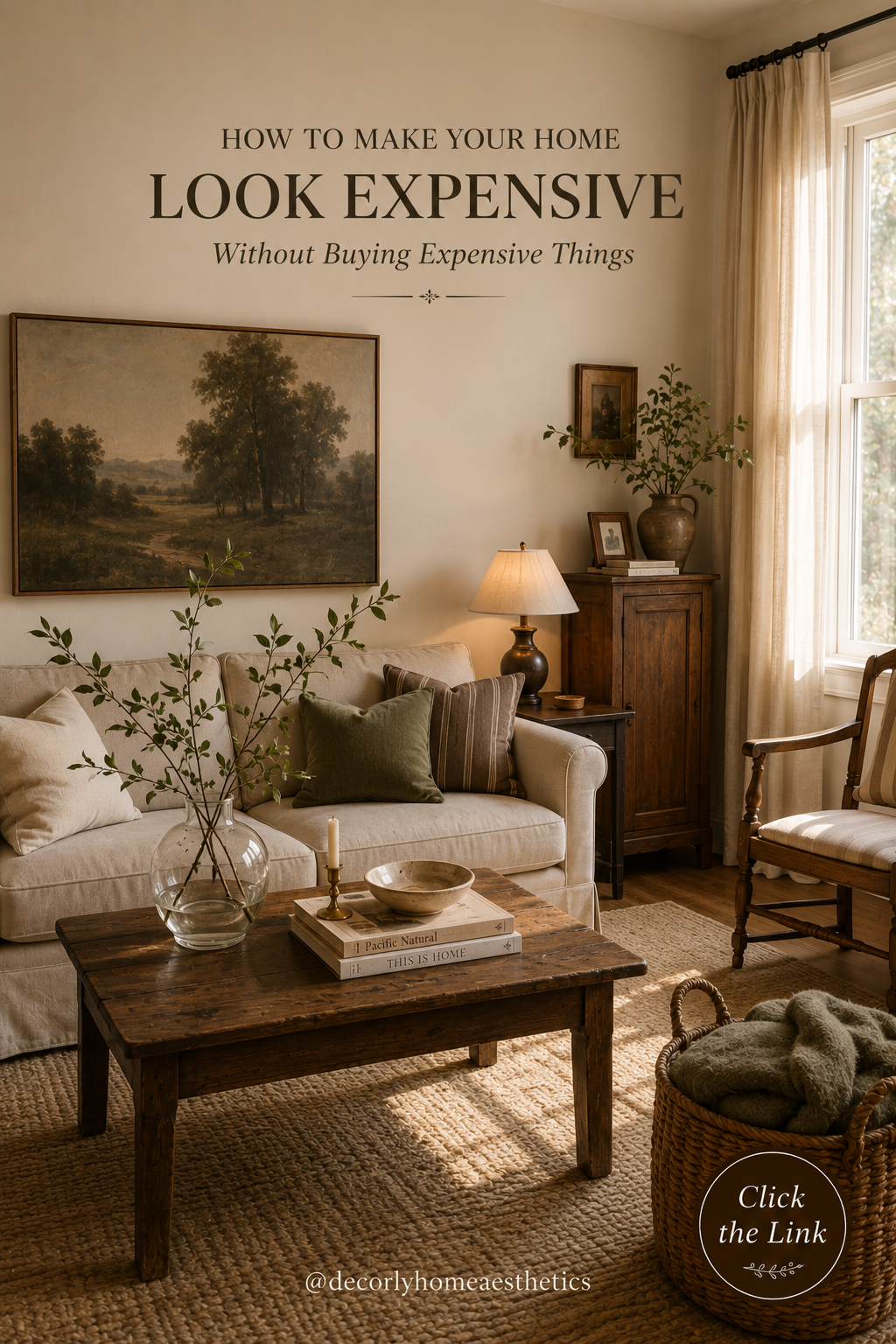
There’s a funny thing about homes that look expensive: it’s often not the expensive things that make them feel that way.
You can walk into a room filled with costly furniture and still feel like something is off. Then you can visit another home where the sofa is years old, the coffee table came from a thrift store, and the branches in the vase were cut from the backyard—and somehow everything feels beautiful.
The difference is usually how the room has been put together.
Good proportions, warm lighting, thoughtful colors, a little breathing room, and objects that feel collected over time can do far more for a home than constantly buying new decor.
So if you’ve been looking around your house thinking it needs an expensive makeover, don’t reach for your credit card just yet.
Start with what you already have.
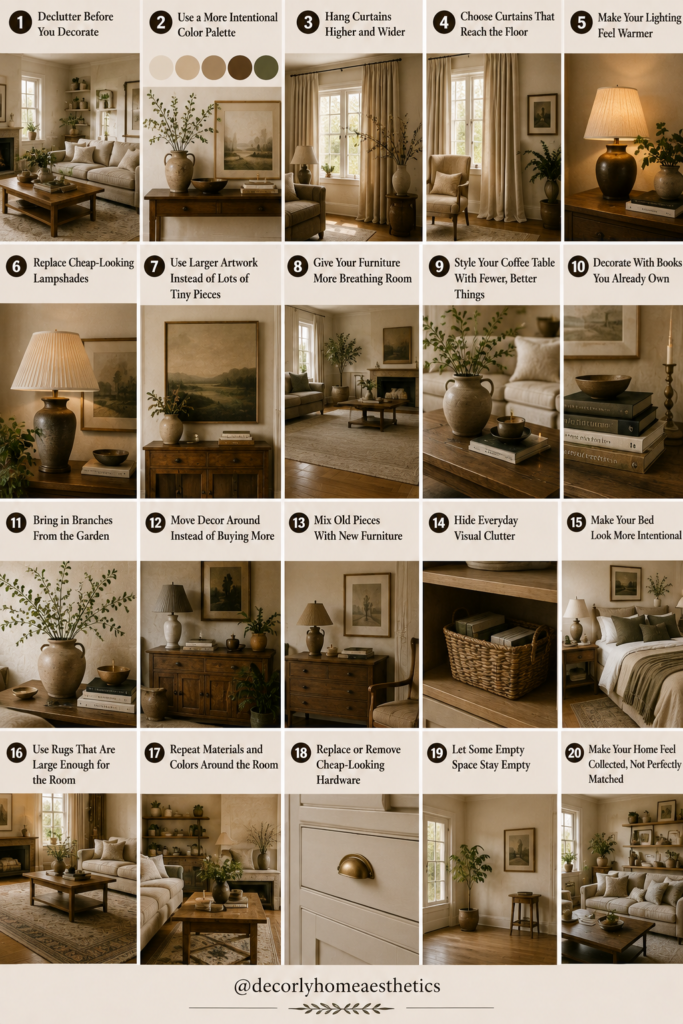
Here are 20 ways to make your home look more expensive without buying expensive things.
1. Declutter Before You Decorate
Before buying another vase, basket, candle, or cushion, remove things.
This might be the least exciting decorating advice, but it can make one of the biggest differences.
Expensive-looking rooms tend to have visual breathing room. You can actually notice the furniture, artwork, and architecture because every surface isn’t covered.
Start with one room.
Clear the coffee table, side tables, windowsills, and any open shelving. Then put back only the things you genuinely like or regularly use.
You may be surprised by how different the room feels without spending anything.
And decluttering doesn’t mean creating a cold, empty home. Books, photographs, ceramics, blankets, and everyday objects can absolutely stay.
The goal is simply to let the good things be visible.
2. Use a More Intentional Color Palette
Sometimes a room feels inexpensive because there are too many unrelated colors competing with each other.
Instead of trying to match everything, choose a small palette and repeat those colors naturally throughout the room.
For example:
warm ivory + oatmeal + walnut + chocolate brown + muted olive + aged brass
Your walls might be ivory.
Your sofa could be oatmeal.
Wood furniture introduces walnut.
A cushion or throw adds olive.
Picture frames, lamps, and smaller accessories bring in brown and brass.
Nothing needs to match exactly.
In fact, slight variations usually make the room feel more sophisticated.
The important thing is repetition. When the same few colors appear in different parts of a room, even inexpensive pieces start feeling connected.
3. Hang Curtains Higher and Wider
This is one of those decorating tricks that can make a surprisingly large difference.
If your curtain rod sits directly above the window frame, try positioning it closer to the ceiling when your wall and hardware allow it.
Then extend the rod beyond the sides of the window.
It makes the window appear larger and the ceiling feel taller.
It also allows more of the window to remain uncovered when the curtains are open, which means more natural light.
You don’t need expensive custom curtains to create the effect.
Simple linen-look or cotton curtains can look beautiful when they’re hung properly.
4. Choose Curtains That Reach the Floor
Curtains that stop awkwardly halfway between the window and floor can make a room feel unfinished.
For most living rooms and bedrooms, floor-length curtains tend to create a much more polished appearance.
Ideally, they should either lightly touch the floor or have a very subtle break.
Avoid having several inches of fabric floating above the floor unless that’s an intentional part of the design.
And don’t assume expensive fabric is necessary.
The length, fullness, and way curtains hang often matter more than the price tag.
A simple oatmeal curtain that falls beautifully can look far more luxurious than an expensive curtain that’s the wrong size.
5. Make Your Lighting Feel Warmer
Lighting can make beautiful furniture look terrible.
A harsh overhead light tends to flatten everything. Textures disappear, corners become overly bright, and the entire room can start feeling clinical.
Instead, create several smaller pools of light.
Use your table lamps.
Turn on a floor lamp.
Light a candle in the evening.
If appropriate for your fixtures, choose warm-toned bulbs rather than extremely cool white light.
You don’t need five designer lamps.
Even two well-positioned lamps can completely change how a living room feels after sunset.
6. Replace Cheap-Looking Lampshades
Sometimes you don’t need a new lamp.
You just need a better shade.
An old lamp base can look completely different with a simple linen, pleated, or softly tapered shade.
This is particularly useful with thrifted lamps.
You might find a beautiful ceramic, brass, or wooden base secondhand while the existing shade looks dated. Ignore the shade and look at the shape underneath.
With the right replacement, an inexpensive lamp can suddenly look custom.
Just make sure the proportions work with the base and that any replacement is compatible with the lamp fitting.
7. Use Larger Artwork Instead of Lots of Tiny Pieces
Tiny artwork isn’t inherently bad.
The problem happens when a large empty wall has several little pictures floating randomly in the middle of it.
Try using fewer, larger pieces.
One oversized landscape above a sofa can make the entire living room feel calmer and more intentional.
And large artwork doesn’t have to be expensive.
Look for vintage prints, public-domain artwork you can legally print, old paintings at thrift stores, photographs you’ve taken yourself, textile pieces, or inexpensive prints placed inside secondhand frames.
A good frame can transform inexpensive artwork.
8. Give Your Furniture More Breathing Room
When we’re trying to make a room feel cozy, it’s tempting to keep adding furniture.
Another chair.
Another side table.
Another basket.
Another little cabinet.
Eventually, the individual pieces disappear into the clutter.
Try removing one thing.
Pull furniture slightly away from the walls if the room allows it. Make sure there’s enough space to comfortably walk between pieces.
You don’t need a huge room to create breathing room.
Sometimes eliminating one unnecessary side table is enough.
The empty floor space around furniture helps each piece feel more important.
9. Style Your Coffee Table With Fewer, Better Things
Coffee tables are magnets for decor.
Before long, you’ve got candles, coasters, books, trays, bowls, flowers, decorative chains and five objects whose purpose nobody really understands.
Try simplifying it.
A beautiful coffee table might need only:
two books + a ceramic bowl + a vase of branches
That’s it.
You can add a candle or another small object if the table is large, but resist the urge to fill every corner.
The surface itself should remain visible.
A slightly worn wooden coffee table with three thoughtful objects can feel much more sophisticated than a fancy table covered with accessories.
10. Decorate With Books You Already Own
Books are some of my favorite decorating objects because they’re personal.
They also solve dozens of little styling problems.
Stack two beneath a small bowl.
Place several vertically on a shelf.
Put one beautiful hardcover on the coffee table.
Use a stack to add height underneath a lamp or decorative object when it’s safe and stable to do so.
Don’t worry about buying matching decorative books purely because their covers fit your color palette.
Use books you’ve actually read or want to read.
Homes feel more interesting when the objects inside them reveal something about the people who live there.
11. Bring in Branches From the Garden
Before buying artificial greenery, look outside.
A few branches can look incredible in a large vase.
The irregular shapes are actually part of what makes them beautiful.
Depending on where you live and what you’re allowed to cut, you could use leafy garden branches, olive-like foliage, eucalyptus, flowering branches, or even bare sculptural branches during colder months.
Keep the arrangement loose.
Don’t try to make both sides identical.
A slightly wild branch arrangement gives a room movement and height while costing almost nothing.
12. Move Decor Around Instead of Buying More
When you’re tired of a room, your first instinct might be to shop.
Try shopping your own house instead.
Take the lamp from the bedroom and try it in the living room.
Move the ceramic bowl from the dining table onto the console.
Bring an old framed picture out of storage.
Switch cushions between rooms.
Move the armchair to another corner.
You already own more decorating possibilities than you probably realize.
I find that even moving one familiar object somewhere unexpected can make it feel new again.
13. Mix Old Pieces With New Furniture
A room where everything was purchased from the same store at the same time can feel flat.
Introduce something older.
It could be a small wooden table, vintage mirror, old landscape painting, brass candleholder, ceramic pot, stool, or chest.
Older pieces often bring texture and patina that mass-produced furniture can’t easily imitate.
They don’t have to be valuable antiques either.
A scratched wooden table from a secondhand shop can be exactly what a room filled with newer upholstered furniture needs.
Those imperfections give the home history.
14. Hide Everyday Visual Clutter
There are certain objects we all need but don’t necessarily want to decorate around.
Chargers.
Remote controls.
Mail.
Cables.
Cleaning products.
Pet supplies.
Random receipts.
Give these things proper homes.
A beautiful box can hide remotes.
A drawer can become the charging station.
A basket can hold blankets.
A tray can contain everyday keys and sunglasses.
The goal isn’t to make your home look like nobody lives there.
It’s simply to prevent twenty small practical objects from visually dominating the room.
15. Make Your Bed Look More Intentional
You don’t need twelve pillows to create an expensive-looking bed.
In fact, simpler can look better.
Start by making sure your bedding fits properly.
Then layer rather than pile.
You might use crisp or softly rumpled sheets, a duvet, one folded quilt or blanket at the bottom, and two or three decorative pillows.
Mix textures rather than buying an entire matching bedding set.
Cotton, linen, wool, and a subtle stripe can look beautiful together.
And don’t obsess over perfection.
A slightly relaxed linen bed often feels far more inviting than something styled like a furniture showroom.
16. Use Rugs That Are Large Enough for the Room
A beautiful rug that’s too small can make the entire room feel disconnected.
In a living room, the rug should usually be large enough to visually connect the main seating pieces. Often that means having at least the front legs of the sofa and chairs resting on it.
In a bedroom, you want enough rug extending beyond the bed that it feels intentional rather than like a small mat underneath it.
Before replacing a rug, though, experiment with what you have.
Try moving it.
Rotate it.
Use it in another room where the proportions work better.
Sometimes the problem isn’t the rug itself—it’s where we’ve put it.
17. Repeat Materials and Colors Around the Room
One of the easiest ways to make unrelated furniture feel intentional is repetition.
If you have a walnut coffee table, repeat a similar wood tone somewhere else.
If there’s aged brass on the lamp, bring a small amount into a picture frame or candleholder.
If you’ve introduced muted olive through a cushion, perhaps repeat it in artwork or greenery.
These repetitions don’t need to be obvious.
Actually, it’s better when they’re subtle.
Your eye notices the relationship even when you aren’t consciously thinking about it.
That’s how a room full of different pieces starts feeling like one complete space.
18. Replace or Remove Cheap-Looking Hardware
Small hardware can have an outsized effect on furniture.
If you have an otherwise nice cabinet with flimsy-looking handles, changing them can completely alter its appearance.
Look at knobs and pulls you already own first. You may even be able to swap hardware between furniture pieces.
When replacing hardware, aged brass, dark bronze, simple black, wood, and ceramic can all work beautifully depending on the style of your home.
But there’s another option people forget:
remove unnecessary decorative hardware.
Sometimes simplifying an overly ornate piece makes it look much better.
Just make sure any changes fit the existing holes or can be installed without damaging the furniture.
19. Let Some Empty Space Stay Empty
This might be the cheapest decorating trick in the entire article.
Don’t decorate everything.
You don’t need something in every corner.
You don’t need artwork on every wall.
You don’t need a plant beside every chair.
You don’t need to fill the entire bookshelf.
Empty space gives your eyes somewhere to rest.
It also makes the objects you do display feel more important.
If you have a beautiful vintage vase sitting alone on part of a console, you notice it.
Put fifteen objects around it and suddenly it’s just another thing.
Luxury often feels restrained.
20. Make Your Home Feel Collected, Not Perfectly Matched
This is probably the most important idea of all.
Don’t try to make your home look as though everything came from one furniture collection.
Let different periods, materials, and stories live together.
A newer linen sofa can sit beside an old wooden table.
A contemporary lamp can stand underneath a vintage painting.
An inexpensive woven basket can sit beside an antique chair.
A handmade ceramic bowl can rest on a mass-market coffee table.
That’s what gives a home depth.
The goal isn’t for someone to walk in and think, Everything here must have been expensive.
It’s for them to feel that everything seems to belong.
The Expensive-Looking Color Palette I Keep Coming Back To
If you’re struggling to pull everything together, start with a warm, natural palette:
Warm ivory for walls and larger backgrounds
Oatmeal for upholstery and curtains
Walnut for furniture
Chocolate brown for depth
Aged brass for warmth
Muted olive for a little color
It’s neutral without becoming a sea of beige.
And because these colors work beautifully with wood, linen, pottery, books, greenery, and vintage pieces, you can create much of the look using things you already have.
Things That Can Accidentally Make a Home Feel Cheaper
It’s usually not inexpensive furniture that’s the problem.
More often, it’s too much of everything.
Too many tiny decorative objects. Too many unrelated colors. Curtains that don’t fit the windows. Rugs floating in the middle of rooms. Harsh lighting. Furniture pushed awkwardly against every wall. Matching sets everywhere.
Another common mistake is trying too hard to create a “luxury” look.
You don’t need faux marble on everything, gold accessories in every corner, mirrored furniture, or decor covered in designer logos.
Real elegance is usually quieter.
Natural wood.
Good lighting.
Proper proportions.
A beautiful textile.
An old painting.
A handmade-looking bowl.
A room where you can actually see the furniture.
Where I Would Spend a Little Money
Making your home look expensive doesn’t mean you should never buy anything.
It means spending more intentionally.
If you do have a small decorating budget, prioritize things that affect the entire room rather than another decorative accessory.
Properly sized curtains can make a bigger difference than five new cushions.
A better lampshade can improve a lamp you already own.
One appropriately sized rug may do more than several small ones.
A good secondhand frame can make an inexpensive print look beautiful.
And sometimes a tin of paint transforms an existing cabinet enough that you no longer want to replace it.
Spend where it changes the overall feeling of the room.
Stop Trying to Make Your Home Look Perfect
Some of the most beautiful homes I’ve seen don’t look perfect.
The wooden table has scratches.
The linen curtains aren’t perfectly pressed.
The books have worn covers.
The pottery doesn’t match.
The branches in the vase lean strangely to one side.
And there’s probably a blanket someone actually uses tossed over the sofa.
Those imperfections are what stop a home from feeling like a showroom.
There’s a difference between messy and lived-in.
A lived-in home still feels intentional, but it doesn’t hide every sign of human life.
Final Thoughts
Making your home look expensive isn’t really about making people believe you spent more money than you did.
It’s about creating a home that feels considered.
Start by removing unnecessary clutter.
Work with a smaller color palette.
Hang your curtains properly.
Use warmer, layered lighting.
Choose fewer, larger pieces of artwork.
Give furniture room to breathe.
Bring in natural materials, books, garden branches, vintage finds, and things that have some history.
Then stop before you feel the need to fill every empty space.
You may already own most of what your home needs.
Sometimes the biggest transformation doesn’t come from bringing something new into a room.
It comes from removing something, moving something, or finally seeing something you already own in a completely different way.