There are certain cleaning products that somehow stay in the back of the laundry cupboard for years because we only know one thing to do with them.
Borax is definitely one of those.
Most people associate it with laundry, and that’s understandable. But borax—also known as sodium borate—has traditionally been used for several household cleaning jobs, from tackling grimy utility sinks to freshening washable trash cans.
That doesn’t mean it belongs on every surface or that every viral borax hack online is a good idea. Some of them aren’t.
Used according to the product label, however, borax can be a useful addition to a regular cleaning routine.
So, if you’ve got a box sitting in your laundry room and you’re wondering what else you can actually do with it, here are 15 practical borax cleaning hacks worth knowing.
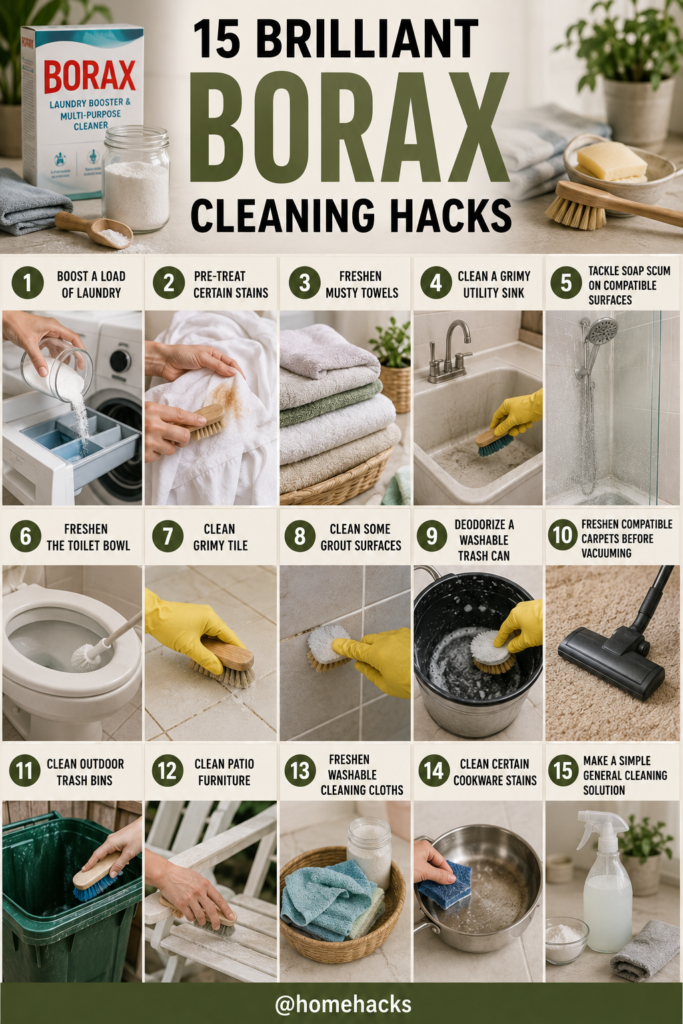
1. Give Your Laundry a Boost
Let’s start with the classic.
Borax is commonly used as a laundry booster alongside regular detergent. It can be particularly useful when you’re dealing with loads that come out looking or smelling less fresh than you’d like.
The important thing is not to start throwing random amounts into the washing machine.
Check the directions on your specific borax product and make sure its use is compatible with your washer.
You also don’t necessarily need it in every load. Save it for those times when ordinary detergent could use a little help.
2. Use It as Part of a Stain-Treatment Routine
That mystery mark on your favorite shirt doesn’t always need to mean goodbye.
Depending on the fabric and stain, borax can sometimes be incorporated into a pre-treatment routine for washable laundry.
Before treating anything, read the garment’s care label and the borax package directions.
And if you’re working with something delicate, brightly colored, or expensive, test your chosen treatment somewhere inconspicuous first.
One cleaning lesson worth learning early: more aggressive doesn’t automatically mean more effective.
3. Freshen Musty Towels
Have you ever pulled a supposedly clean towel out of the closet only to discover it has that slightly stale smell?
It’s surprisingly common.
Towels can accumulate detergent residue, body oils, and other buildup over time, particularly if they’re frequently left damp.
Borax can be used according to its label as a laundry booster when washing compatible towels.
But there’s another half to this trick: dry your towels properly.
No laundry additive can completely compensate for towels that are repeatedly left damp in a heap.
4. Tackle a Grimy Utility Sink
Utility and laundry sinks aren’t exactly treated gently.
Dirty mop water, gardening messes, muddy hands, cleaning cloths—eventually the sink itself needs some attention.
If the sink material is compatible with borax, use the product according to its cleaning directions to tackle ordinary grime.
Scrub gently rather than attacking the surface.
Then rinse thoroughly.
This is also a good reminder to check the sink manufacturer’s care instructions. Some specialty surfaces don’t appreciate abrasive or strongly alkaline products.
5. Loosen Bathroom Soap Scum
Soap scum has an annoying ability to make a freshly cleaned bathroom look dirty again almost immediately.
Borax may help with certain types of bathroom grime on compatible surfaces.
Follow the product directions, work on a small area, and rinse thoroughly afterward.
Don’t assume it’s suitable for every bathtub, shower surround, natural stone surface, or specialty finish.
If you’re unsure, check the manufacturer’s cleaning recommendations before experimenting.
A Pinterest cleaning hack isn’t worth damaging an expensive bathroom finish.
6. Freshen the Toilet Bowl
Here’s another straightforward use.
Depending on your product’s directions, borax may be used as part of routine toilet-bowl cleaning.
Follow the label instructions, scrub using a toilet brush, and flush thoroughly.
And this is where an important rule comes in:
Don’t start combining cleaners.
If you’ve recently used another toilet cleaner, especially something containing bleach or acids, don’t casually add borax—or anything else—on top.
Use one cleaning product at a time according to its instructions.
7. Clean Grimy Tile
Kitchen and bathroom tile can gradually collect dirt, splashes, and everyday buildup.
On compatible washable tile, a borax cleaning solution prepared according to label directions can be useful for ordinary grime.
Start with a small inconspicuous area if you’ve never used it on that surface before.
And be particularly cautious with natural stone.
What works beautifully on one tile material can damage another.
Knowing the surface you’re cleaning is just as important as choosing the cleaner.
8. Give Certain Grout Areas Some Attention
Grout can make an otherwise clean bathroom look tired.
On compatible grout, borax may help loosen ordinary dirt and buildup.
Use an appropriate brush and gentle pressure rather than scrubbing so aggressively that you damage the grout itself.
After cleaning, rinse the area as directed.
Also remember that dark discoloration isn’t always ordinary dirt. Persistent mold, moisture problems, or deteriorating grout may need more than a cleaning hack.
Sometimes the correct solution is fixing the moisture problem rather than repeatedly scrubbing the symptom.
9. Wash Out a Smelly Trash Can
This may be one of the most satisfying uses on the list.
You take the garbage out, put in a brand-new liner…and somehow the trash can still smells.
That’s because small leaks and food residue often collect underneath the bag, around the rim, and inside the lid.
Empty the bin completely.
For a compatible washable trash can, use borax according to its label instructions to clean the interior.
Pay attention to the bottom and lid where residue tends to hide.
Rinse thoroughly and let the bin dry completely before adding a new liner.
Sometimes the easiest way to make your kitchen smell better isn’t adding fragrance.
It’s washing the trash can.
10. Be Careful Using Borax on Carpets
You’ll see plenty of internet posts recommending sprinkling borax all over carpets.
I wouldn’t make that an automatic cleaning routine.
Carpet materials vary, and powder can be difficult to remove completely from some carpets. That’s especially relevant in homes with young children or pets who spend time directly on the floor.
If you’re considering using borax on carpet, first check whether your carpet manufacturer permits it and follow the borax product directions.
Keep children and animals away during use and remove the product thoroughly as directed.
For many carpet odors, ordinary thorough vacuuming and addressing the actual source of the smell may be all you need.
11. Clean Outdoor Trash Bins
Outdoor garbage cans deserve cleaning too—even though it’s tempting to pretend they don’t exist once they’re outside.
Food leaks, dirt, and moisture can turn them unpleasant surprisingly quickly, especially during warm weather.
For compatible bins, borax can be used according to label directions as part of a normal wash.
Work somewhere appropriate, scrub the dirty areas, rinse thoroughly, and allow the container to dry before replacing the bag.
Doing this periodically is much easier than waiting until opening the lid becomes an experience you regret.
12. Clean Compatible Patio Furniture
Outdoor furniture deals with dust, pollen, bird mess, dirty hands, rain, and whatever else the backyard throws at it.
Borax may be useful for cleaning some washable outdoor surfaces.
But “patio furniture” can mean plastic, painted metal, powder-coated finishes, wood, composite materials, or fabric.
Those aren’t interchangeable.
Check the furniture manufacturer’s care recommendations first. If borax is suitable, use it according to the product directions and rinse appropriately.
For delicate or specialty finishes, stick with the cleaner recommended by the manufacturer.
13. Freshen Reusable Cleaning Cloths
There’s something slightly ironic about cleaning your house with a cloth that smells terrible.
Reusable cleaning cloths and compatible washable mop pads can accumulate grease and grime surprisingly quickly.
Wash them regularly instead of leaving them damp in a bucket or laundry basket.
For compatible washable fabrics, borax can be added according to package directions as part of the laundry routine.
Afterward, dry the cloths thoroughly before storing them.
And consider separating heavily soiled cleaning cloths from everyday laundry when appropriate.
14. Approach Cookware With Caution
Borax is sometimes suggested online for tackling stubborn cookware residue, but this is an area where I’d be conservative.
Cookware materials and coatings vary enormously.
Something suitable for one non-reactive surface may be completely wrong for another, particularly nonstick coatings or specialty finishes.
Before using borax, check both the cookware manufacturer’s cleaning instructions and your borax product label.
If either doesn’t support that use, choose another cleaning method.
Anything used on a food-contact surface also needs to be rinsed extremely thoroughly according to the relevant instructions.
Sometimes hot water, dish soap, soaking, and patience remain the best “hack.”
15. Keep a Simple Borax Cleaning Solution in Your Toolkit
Borax can also be useful for general cleaning on surfaces specifically compatible with it.
But here’s where I’d ignore those DIY recipes telling you that stronger is always better.
It isn’t.
Prepare a cleaning solution according to the directions on the actual product you’re using rather than creating an extremely concentrated homemade mixture.
Use it only on compatible washable surfaces, ventilate the room appropriately, wear gloves when the label recommends them, and rinse when directed.
Simple and correctly diluted is better than turning cleaning day into a chemistry experiment.
What You Should Never Do With Borax
Borax is useful, but it deserves the same basic respect as other household cleaning products.
First, don’t eat it and don’t use it in homemade food-related remedies. Keep the product stored securely away from children and pets.
Avoid breathing dust while handling powdered products and follow the label’s guidance regarding skin and eye contact.
Most importantly, don’t casually mix borax with other household cleaning products.
The internet is full of DIY recipes combining multiple cleaners because the mixture looks powerful or creates an interesting reaction.
You don’t need to do that.
Using one appropriate product correctly is usually simpler and safer.
Don’t Confuse Borax With Baking Soda
The names sometimes get thrown around together in cleaning articles, but they’re not the same substance.
Borax is generally sodium borate, while baking soda is sodium bicarbonate.
They have different chemical properties and shouldn’t be treated as interchangeable simply because both are white powders commonly found in homes.
Whenever you’re following cleaning instructions, make sure you’re using the product the instructions actually call for.
Surfaces Where You Should Be Extra Careful
Before using borax on an unfamiliar surface, check its care instructions.
Be especially cautious around:
- Natural stone
- Specialty metal finishes
- Delicate fabrics
- Upholstery
- Certain carpets
- Painted or sealed surfaces
- Nonstick cookware
- Specialty countertops
A five-minute spot test can be much cheaper than repairing a damaged finish.
When you’re uncertain, use the cleaning method recommended by the surface manufacturer.
Why Borax Still Has a Place in the Cleaning Cabinet
I think the appeal of borax is actually pretty simple.
It’s not that it magically replaces every cleaning product in your house.
It doesn’t.
It’s that one relatively inexpensive household product can be useful for several ordinary cleaning jobs.
Laundry is probably where many people will get the most use from it. But depending on the product instructions and surfaces in your home, it can also have a place in bathroom cleaning, trash-can maintenance, utility-room cleaning, and a handful of other jobs.
That’s much more useful than buying a separate bottle for every tiny cleaning problem.
A Better Way to Use Cleaning Hacks
Whenever you see a viral cleaning trick, ask three questions before trying it.
What exactly is the surface?
A trick that works on ceramic tile may be completely inappropriate for marble.
What does the product label say?
If an internet recipe contradicts the manufacturer’s directions, I’d trust the manufacturer.
Am I actually cleaning—or just creating a dramatic video?
Cleaning doesn’t need to foam violently, change color, or involve five different products to work.
Often, the boring method is the good method.
Warm water.
The right cleaner.
A little dwell time when directed.
Gentle scrubbing.
A thorough rinse.
Done.
Final Thoughts
Borax may be an old-school cleaning product, but that doesn’t mean it’s useless—or that every old cleaning trick involving it should automatically be repeated.
Used properly, it can be a handy addition to your household cleaning routine.
Start with the jobs where it makes the most sense: laundry, washable trash cans, compatible utility sinks, certain tile and grout surfaces, and other uses specifically supported by the product directions.
Don’t try all 15 hacks in one afternoon.
Pick one problem you already have and see whether borax is appropriate for it.
And remember the golden rule of home cleaning: you don’t need to mix a cabinet full of chemicals to get something clean.
Sometimes a simple product, used correctly, is all you need.