There’s something exciting about camper life. You have your bed, kitchen, bathroom, clothes, food, outdoor gear, and travel essentials packed into one tiny home on wheels.
The problem? It doesn’t take much for that tiny home to become a complete mess.
One pair of shoes left by the door, a few groceries sitting on the counter, chargers scattered around the bed, and suddenly your peaceful camper feels half its actual size.
The good news is that you probably don’t need a bigger RV.
You just need to use the space you already have a little differently.
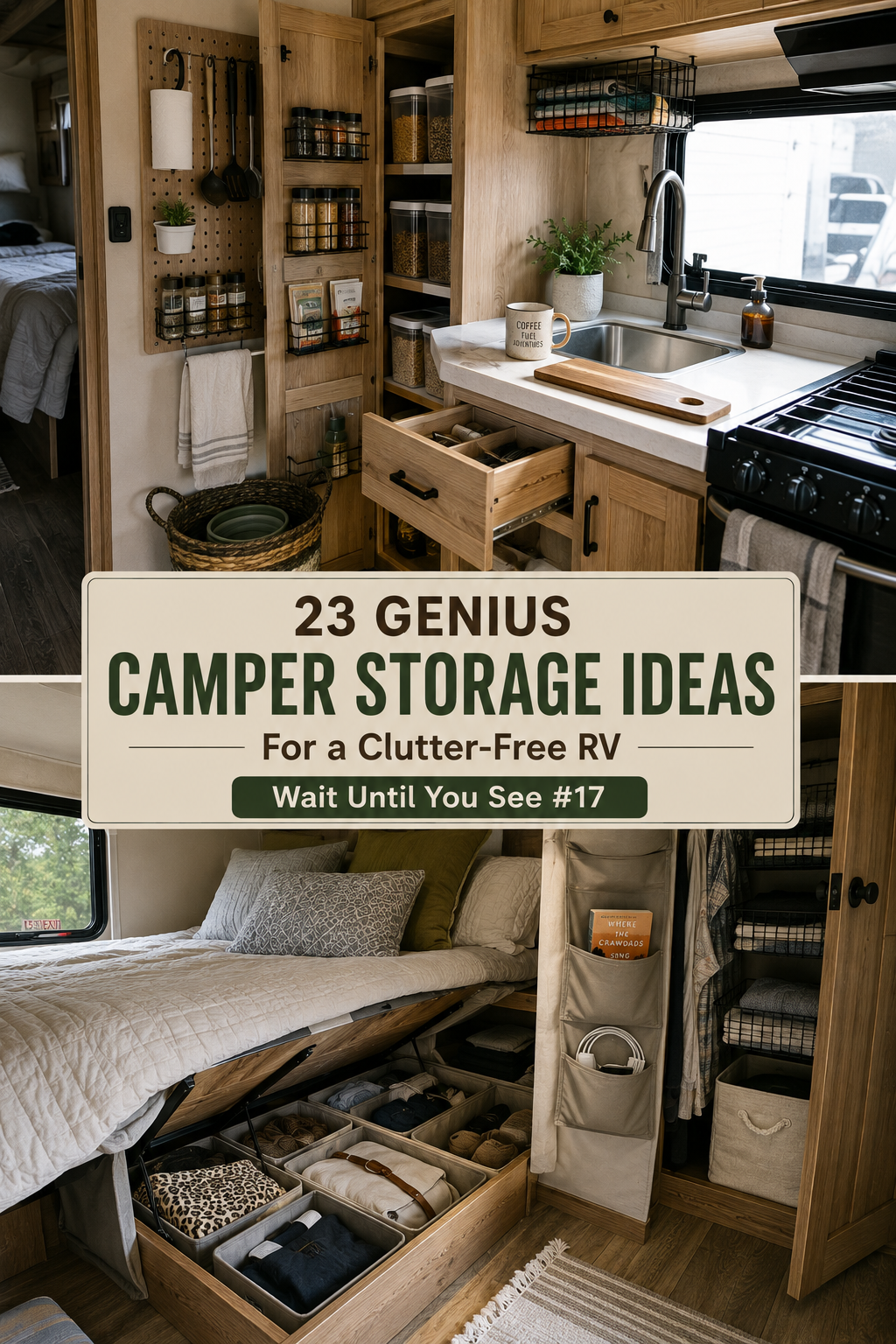
The best camper storage ideas aren’t complicated renovations. They’re simple solutions that make forgotten corners, empty walls, cabinet doors, and awkward gaps actually useful.
Whether you live in your RV full-time or only take it out for weekend adventures, these 23 camper organization ideas can help you create a space that feels calmer, cleaner, and surprisingly roomy.
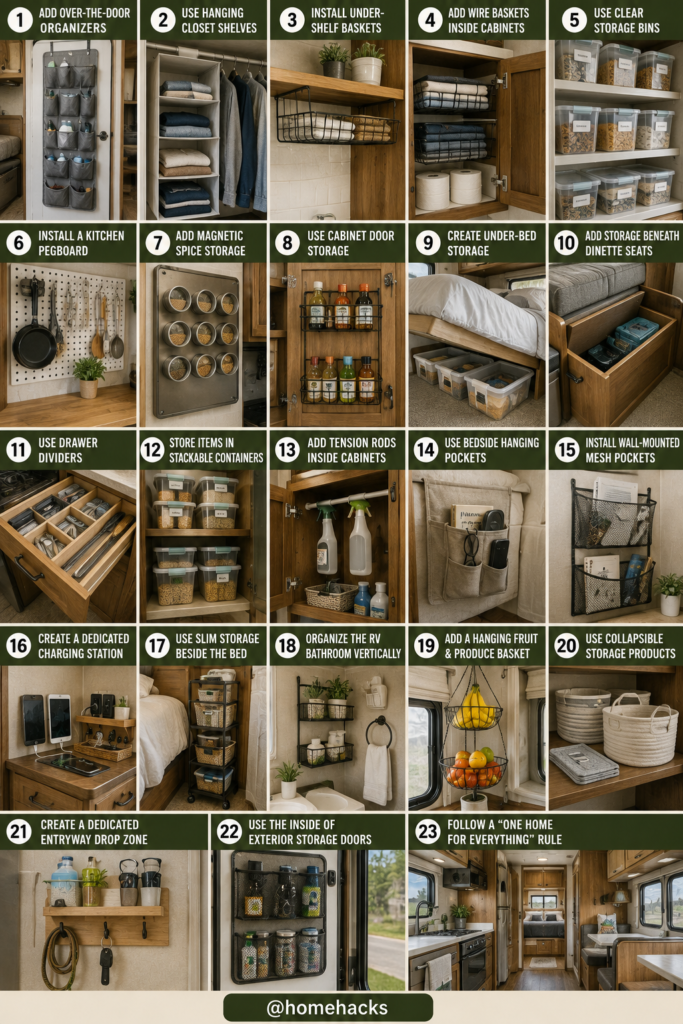
1. Add Over-the-Door Organizers
Camper doors offer valuable vertical space that often goes completely unused.
A lightweight over-the-door organizer can hold shoes, toiletries, sunscreen, cleaning cloths, pet supplies, or other small items that usually end up scattered around.
The trick is not stuffing every pocket.
Use it for things you reach for regularly and keep heavier objects elsewhere. Also make sure any organizer you add doesn’t interfere with the door’s safe operation.
2. Use Hanging Closet Shelves
RV closets can be frustrating because they’re often tall but surprisingly narrow.
If you don’t have many clothes that need to hang, a fabric hanging-shelf organizer can turn some of that vertical space into compartments.
Use the sections for T-shirts, shorts, pajamas, towels, or packing cubes.
Suddenly, one narrow closet can hold much more without becoming a giant pile of clothes.
3. Install Under-Shelf Baskets
Look underneath your camper shelves.
See that empty space?
An appropriately secured under-shelf basket can turn it into useful storage.
These are especially handy inside pantry cabinets for lightweight things such as napkins, wraps, reusable bags, or small packaged foods.
It’s one of those tiny RV storage hacks that doesn’t look dramatic until you realize you’ve created an entirely new storage level.
4. Add Wire Baskets Inside Cabinets
Deep camper cabinets sound wonderful until everything disappears into the back.
Baskets help create smaller zones.
Instead of stacking ten things on top of each other, group similar items together: breakfast foods in one basket, snacks in another, bathroom supplies in another.
Pull out the basket and you can see what you have without unloading the whole cabinet.
In a moving vehicle, choose storage that’s appropriately secured for travel.
5. Use Clear Storage Bins
Clear containers aren’t the most exciting organization purchase, but they’re incredibly practical in a camper.
You can immediately see what’s inside.
That’s useful when supplies are stored above your head, underneath the bed, or inside deep cabinets.
Use them for lightweight pantry supplies, toiletries, craft items, cables, or other small belongings.
Don’t buy twenty containers first and then figure out what to put inside them.
Declutter first. Measure your cabinet. Then buy containers that actually fit.
6. Install a Kitchen Pegboard
A small pegboard can be fantastic in an RV kitchen when it’s installed appropriately.
Use it for a few lightweight, frequently used items rather than covering the entire wall with equipment.
A spatula, measuring spoons, oven mitt, or small kitchen accessory can move off the countertop and onto the wall.
Before mounting anything, consider the camper wall construction and follow the RV manufacturer’s guidance. Camper walls aren’t necessarily built like residential walls.
And remember: anything displayed while parked needs to be secure before driving.
7. Add Magnetic Spice Storage
Spice containers can consume an absurd amount of cabinet space.
A compact magnetic system can help, provided it’s installed on a suitable surface and the containers are securely stored for travel.
Keep only the spices you actually use.
That’s the important part.
Twenty beautiful matching containers aren’t saving space if fifteen contain spices you never cook with.
A small collection of everyday seasonings is usually enough for camper cooking.
8. Use the Inside of Cabinet Doors
Open your kitchen or bathroom cabinets and look at the backs of the doors.
That’s potential storage.
Slim organizers can hold lightweight items without taking up shelf space.
In the bathroom, you might use one for small grooming essentials. In the kitchen, it could hold lightweight wraps, cloths, or frequently used supplies.
Check clearance before installing anything. You need to make sure the organizer doesn’t hit shelves or prevent the cabinet from closing properly.
9. Turn the Space Under the Bed Into Storage
If your camper has storage beneath the bed, don’t treat it like a place where random things go to disappear.
Divide it into categories.
One container for extra bedding.
One for seasonal clothing.
One for shoes.
One for travel supplies.
If the space is large, labeled bins or soft-sided organizers can prevent everything from migrating into one giant pile.
Keep weight distribution in mind as well. In an RV, storage isn’t only an organization question—vehicle weight and balance matter too.
10. Use the Storage Under Dinette Seats
Those benches around your camper table may be hiding some of the best storage in the entire RV.
Under-seat compartments are ideal for items you need occasionally but not every hour.
Think spare linens, games, outdoor accessories, backup supplies, or other appropriate belongings.
Keep everyday essentials somewhere easier to access so you’re not dismantling the dining area every morning.
11. Add Drawer Dividers
Camper drawers experience something your kitchen drawers at home generally don’t:
They travel down the highway.
Without dividers, everything can shift around.
Simple drawer organizers help keep cutlery, kitchen tools, toiletries, office supplies, and small accessories separated.
Measure first, especially in older campers where drawers may be unusual sizes.
And don’t overload them just because you’ve managed to create more compartments.
12. Choose Stackable Containers
When floor space is limited, go upward.
Stackable containers can help you use tall cabinets more efficiently.
The best versions for camper storage are appropriately sized, lightweight, easy to open, and stable.
Use matching sizes when possible so they stack neatly instead of creating a plastic-container version of Jenga.
Again, secure stored items appropriately before traveling.
13. Use Tension Rods Carefully
A tension rod can sometimes help organize lightweight items or create simple divisions inside suitable cabinets.
For example, a carefully positioned rod may help keep certain lightweight items separated or reduce shifting.
But don’t assume a tension rod is strong enough to restrain heavy objects while your RV is moving.
Anything that could fall, become damaged, or create a hazard needs a proper travel-safe storage solution.
Use tension rods for organization—not as a substitute for secure cargo restraint.
14. Add Bedside Hanging Pockets
Tiny camper bedrooms rarely have space for two traditional nightstands.
A bedside pocket organizer solves that beautifully.
Use it for your glasses, a paperback, sleep mask, charging cable, or other small nighttime necessities.
It keeps things within reach without covering the bed.
This is especially useful in bunks, where there’s often almost no surface space at all.
15. Install Wall-Mounted Mesh Pockets
Mesh pockets work well for the awkward little items that never seem to have a home.
Depending on placement, they can organize lightweight maps, small accessories, children’s items, or everyday travel supplies.
Because you can see through them, you don’t have to open five containers looking for one thing.
Keep them away from areas where they could interfere with doors, windows, controls, appliances, or emergency exits.
16. Create One Charging Station
Nothing makes a small camper feel cluttered faster than cables everywhere.
Choose one sensible location for charging electronics.
Keep charging cables, adapters, and power banks together instead of spreading them across every available outlet.
A small cable organizer can make a huge difference.
Electrical safety matters in an RV, so use appropriate equipment, avoid overloaded outlets, and follow the manufacturer’s electrical guidance for your camper.
A neat charging station should be convenient and safe.
17. Use Those Tiny Gaps Beside the Bed
Camper designers seem to love leaving mysterious six-inch gaps beside beds.
Don’t ignore them.
A narrow basket, slim organizer, or custom-sized storage container may fit perfectly.
Use the space for books, slippers, lightweight clothing, or other small necessities.
Before buying anything, measure the gap carefully.
In small-space organization, an inch can be the difference between “perfect fit” and “why did I order this?”
18. Organize the Bathroom Vertically
RV bathroom counters are tiny, so keeping five bottles on one can make the entire room look messy.
Move appropriate storage upward.
A small wall organizer, hanging shower caddy, or lightweight basket can keep toiletries organized without taking over the counter.
Choose products suitable for humid environments and install them appropriately.
Also keep travel in mind. Shampoo bottles that look beautiful lined up on a shelf while parked may not remain there after a bumpy road.
19. Add Hanging Produce Storage
Produce can take up precious kitchen counter space.
A compact hanging basket can be useful for suitable fruits and vegetables while you’re parked.
Just be selective about what you store there and where you hang it.
Don’t place produce where heat, direct sun, or cooking conditions will cause it to spoil quickly.
And before driving, secure anything that could swing, fall, or become a projectile.
20. Choose Collapsible Storage
Collapsible items are practically made for camper life.
Laundry baskets, buckets, storage cubes, and certain kitchen accessories can fold down when they’re not being used.
That’s a huge advantage in a small RV.
A traditional laundry basket takes up the same amount of room whether it’s full or empty.
A collapsible one can disappear into a narrow cabinet when laundry day is over.
Whenever you’re buying something new for your camper, ask yourself:
Can I get a version that folds?
Often, the answer is yes.
21. Create a Small Entryway Drop Zone
Every home needs somewhere to put the things that arrive through the door.
Campers are no different.
Create one tiny drop zone near the entrance for things like keys, sunglasses, dog leashes, or other everyday items.
A couple of appropriate hooks and a small basket may be enough.
The goal isn’t to build a full mudroom inside your travel trailer.
It’s simply to stop keys, hats, and outdoor accessories from ending up on the kitchen counter.
22. Use Exterior Storage More Intentionally
Exterior compartments can quickly become another version of the junk drawer.
Instead of tossing everything inside, divide the compartment into logical zones.
Appropriately secured lightweight organizers may help you make better use of certain door or wall surfaces where the RV design permits it.
Group similar gear together and keep frequently needed equipment accessible.
Be particularly thoughtful about heavy items. Follow your RV’s storage, payload, and weight-distribution requirements rather than filling every available compartment simply because there’s space.
23. Give Everything a Permanent Home
This may be the least exciting idea on this list.
It’s also probably the most effective.
Every item in your camper should have somewhere it belongs.
Not “somewhere around the kitchen.”
Not “probably under the bed.”
One actual place.
When everyone knows where the flashlight, chargers, towels, dog leash, cooking utensils, and games belong, cleaning up becomes incredibly fast.
If something doesn’t have a home, either create one or ask whether you really need to carry it.
That’s the real secret to a clutter-free RV.
Don’t Organize Things You Don’t Need
Before buying bins, baskets, hooks, and drawer dividers, take everything out and declutter.
Camper organization gets much easier when you’re carrying less.
How many mugs do two people really need?
Are you traveling with clothes you haven’t worn on the last four trips?
Do you need seven pans?
Why are there twelve reusable shopping bags underneath the sink?
Small spaces make excess belongings obvious.
Be realistic about how you actually camp rather than how you imagine you might camp someday.
The easiest item to organize is the one you decided you didn’t need.
Think About Weight, Not Just Space
This is one of the biggest differences between organizing an apartment and organizing an RV.
Finding an empty cabinet doesn’t automatically mean you should fill it.
Every RV has weight limits, and how weight is distributed matters.
Pay attention to your vehicle’s ratings and manufacturer’s guidance, and don’t overload storage compartments.
Heavy items generally require particularly thoughtful placement and secure storage.
If you’re unsure about your camper’s payload or loading requirements, check the documentation for your specific RV rather than relying on a generic organization hack.
A clutter-free camper is nice.
A safely loaded camper is much more important.
Make Everything Travel-Safe
Pinterest photographs usually show campers sitting perfectly still.
Your camper doesn’t.
Before driving, walk through the RV and imagine everything experiencing a sudden stop or sharp turn.
Could that basket fall?
Could the spice containers come loose?
Could something swing?
Could a cabinet open?
Could an item become a projectile?
Secure belongings appropriately for travel and follow your RV manufacturer’s recommendations.
Decorative storage can still be beautiful—it simply needs to work when your home starts moving.
Keep the Countertops Almost Empty
If you want one change that immediately makes a camper look bigger, clear the counters.
In a small space, visual clutter feels amplified.
Try to leave only the things you use constantly.
Perhaps that’s a coffee maker while you’re parked, a small tray, or one decorative item.
Everything else should have a cabinet, drawer, basket, or designated storage location.
An empty section of countertop isn’t wasted space.
It’s breathing room.
And in a tiny camper, breathing room is valuable.
Create Zones Inside Your RV
Another trick that makes camper organization easier is thinking in zones.
Create a cooking zone for food preparation tools.
A coffee zone for morning essentials.
A bathroom zone for toiletries.
A charging zone for electronics.
An outdoor zone for camping equipment.
A sleeping zone for nighttime essentials.
When related things live together, you spend less time searching.
It also makes packing for the next trip much easier because you can immediately see what’s missing.
Do a Five-Minute Camper Reset Every Evening
Tiny homes get messy quickly.
Fortunately, they also clean up quickly.
Before bed, spend five minutes putting everything back in its designated home.
Clear the counter.
Put shoes away.
Return chargers to the charging station.
Hang jackets.
Put dishes away.
Reset the dinette.
It doesn’t need to be perfect.
The goal is simply to wake up to a camper that feels calm rather than cramped.
Five minutes at night can save you twenty frustrating minutes the next morning.
Common Camper Storage Mistakes
One of the biggest mistakes is buying organizers without measuring.
Camper cabinets aren’t standard kitchen cabinets. Measure height, width, depth, door clearance, and any unusual angles before ordering anything.
Another mistake is using every wall.
Yes, vertical storage is valuable, but covering every surface with baskets and pockets can make a tiny camper feel even smaller.
Leave some visual space.
Also avoid making frequently used things difficult to reach. If you use something three times every day, don’t store it underneath four bins and behind the spare bedding.
Finally, don’t confuse more storage with better organization.
Sometimes you don’t need another basket.
You need fewer things.
Final Thoughts
The smartest camper storage ideas aren’t necessarily the expensive custom-built ones.
Often, they’re incredibly simple.
A basket under a shelf.
A divided drawer.
A pocket beside the bed.
A better-organized under-seat compartment.
A collapsible laundry basket.
One dedicated place for chargers.
The goal isn’t to cram as much stuff as physically possible into your RV.
It’s to create enough organization that you can actually enjoy being there.
Start with one messy area instead of trying to reorganize the entire camper in one afternoon.
Declutter it.
Measure it.
Think vertically.
Use the awkward spaces.
Choose storage that makes sense for how you actually travel.
And most importantly, give everything a permanent home.
Because when you’re parked somewhere beautiful, the last thing you want to spend your evening doing is searching through three cabinets for the bottle opener you know you packed.
A little organization means less time dealing with clutter—and more time actually enjoying the road.