The entryway is such a strange little part of the house.
We walk through it every single day, drop our keys there, kick off our shoes, hang up a jacket—and yet it’s often one of the last spaces we think about decorating.
For years, entryways seemed to follow the same formula: a neutral console, a round mirror, a basket underneath, maybe a lamp, and you’re done.
There’s nothing wrong with that. But sometimes it feels a little too safe.
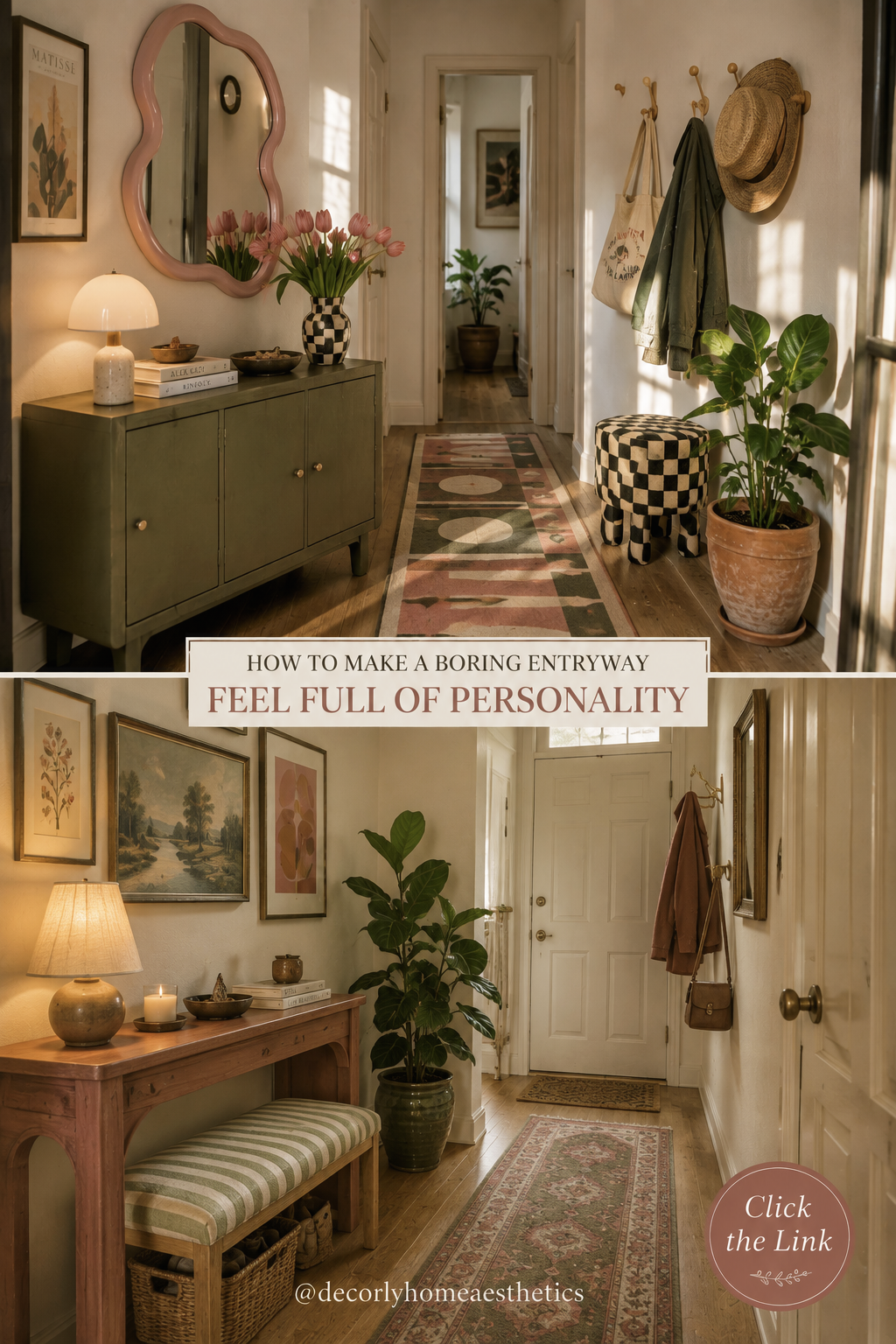
I love an entryway that tells you something about the home before you’ve even reached the living room. Maybe there’s a wavy mirror you wouldn’t expect. A colorful cabinet. A slightly quirky lamp. A rug with enough pattern to wake up a narrow hallway. A piece of art that actually means something to the person who lives there.
The good news is that adding personality doesn’t require a complete entryway makeover.
You can keep the walls. Keep the flooring. Keep the front door. Sometimes all it takes is changing the things around them.
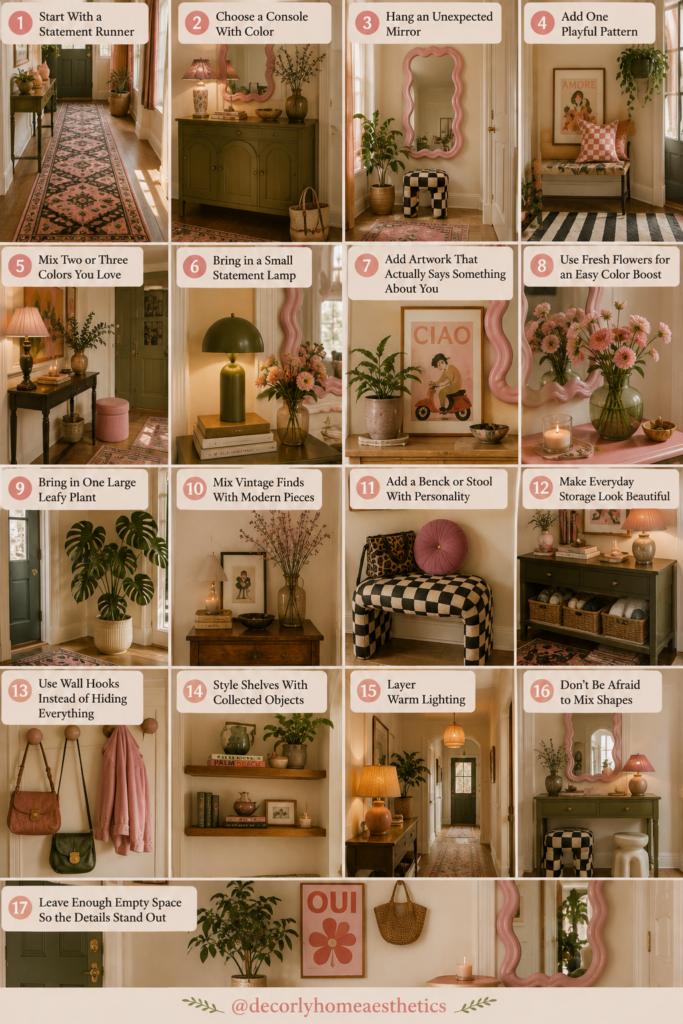
Here are 17 ways to make a boring entryway feel colorful, collected, welcoming, and much more like you.
1. Start With a Statement Runner
If your entryway feels flat, look down first.
A runner covers a surprisingly large amount of visual space, especially in a narrow hallway, which means changing it can completely change the mood of the room.
Instead of automatically choosing beige or gray, consider something with personality.
Maybe that’s a faded vintage-style rug with rust and olive tones. Maybe it’s a soft checkerboard. Maybe you love stripes or a slightly unexpected geometric pattern.
The rug doesn’t have to shout.
Even a subtle combination of dusty pink, cream, olive, and warm brown can give a plain hallway far more character.
Just remember that an entryway rug has a hard life. Choose something durable and easy to clean, and use a suitable non-slip pad underneath where needed.
2. Choose a Console With Color
The console is often the biggest piece of furniture in an entryway, so why does it always have to be white or wood?
A painted console can become the anchor for the entire space.
I especially love olive green, muted blue, dusty terracotta, burgundy, or warm mustard in an entryway because these colors feel interesting without being difficult to live with.
You don’t necessarily need to buy something new.
If you already have a basic wooden cabinet or console that feels uninspiring, paint may be enough to give it a completely different personality.
Keep the rest of the styling fairly simple and let the furniture do some of the decorating for you.
3. Hang an Unexpected Mirror
Entryways and mirrors naturally work together.
You get somewhere to check yourself before leaving, and the reflection helps bounce light around a smaller space.
But the mirror itself can also be fun.
Instead of another perfectly round black-framed mirror, try something with an unusual shape.
A wavy frame, scalloped edge, vintage carved mirror, softly irregular shape, or colored frame can instantly make the wall more interesting.
The mirror in the inspiration for this article is a perfect example. The soft pink frame isn’t overwhelming, but its shape gives the whole hallway a playful quality.
It’s one small decision that changes everything around it.
4. Add One Playful Pattern
You don’t need to cover the walls in wallpaper to bring pattern into an entryway.
One patterned piece can be enough.
A checkerboard stool.
A striped lampshade.
A geometric runner.
A floral cushion.
The secret is choosing where you want the pattern to happen.
If the rug is already bold, keep the bench or stool relatively simple. If the floor is quiet, that’s when you can have more fun with upholstery.
And if you’re mixing patterns, change the scale.
Large checks beside narrow stripes usually feel much calmer than two equally busy patterns fighting for attention.
5. Mix Two or Three Colors You Actually Love
There’s no rule saying an entryway has to match the rest of the house perfectly.
It should feel connected, of course, but it can also be a place where you’re slightly more adventurous.
Try choosing two or three colors and repeating them loosely.
For example:
dusty pink + olive green + warm cream
Then add black, wood, or brass as grounding neutrals.
Maybe the console is olive.
The mirror is pink.
The rug contains both.
Then a small lamp or artwork quietly repeats one of those colors somewhere else.
That’s usually enough to make different pieces feel related without buying a matching set.
6. Bring in a Small Statement Lamp
A lamp does more than provide light.
It makes an entryway feel like part of the home rather than simply a passage between the front door and another room.
And because the lamp is small, it’s a great place to try something unusual.
A mushroom lamp.
A pleated shade.
A ceramic base in a surprising color.
A vintage brass lamp found secondhand.
In the evening, that small pool of warm light can completely change the atmosphere.
If you normally rely on one bright ceiling fixture, try turning it off and using a table lamp instead.
You’ll immediately understand why layered lighting matters.
7. Add Artwork That Actually Says Something About You
Entryway artwork doesn’t have to be generic.
You don’t need a sign telling guests that they’re standing in an entryway.
Instead, hang something you genuinely like.
Maybe it’s an old travel print from somewhere meaningful.
A vintage landscape.
An abstract piece in colors you love.
A photograph you took yourself.
A funny print that makes you smile every time you leave the house.
Art is one of the easiest ways to make a room feel personal because it doesn’t need to serve any practical purpose.
It can simply be there because you enjoy looking at it.
8. Use Fresh Flowers for an Easy Color Boost
A vase of flowers can change an entryway in about thirty seconds.
Tulips are beautiful in spring. Branches can work wonderfully in autumn and winter. In summer, garden flowers or even a few leafy stems can be enough.
Don’t worry about creating a professional-looking arrangement.
Actually, I prefer it when the flowers lean slightly to one side and aren’t all exactly the same height.
Put them in an interesting vase—a checkerboard ceramic vessel, vintage glass pitcher, old stoneware jug, or simple terracotta container.
Suddenly the console feels alive.
9. Bring in One Large Leafy Plant
If you have enough natural light, a plant is one of the best ways to soften an entryway.
And I would rather have one healthy, substantial plant than seven tiny plants squeezed onto every shelf.
A larger Monstera, rubber plant, palm, or another species suited to your home’s light conditions can fill an awkward corner beautifully.
The leaves introduce shape and movement into a room filled with straight walls, cabinets, doors, and frames.
Choose the plant based on the actual conditions in your entryway, though.
If the space receives very little natural light, don’t force a sun-loving plant to live there simply because it looks good in a photograph.
10. Mix Vintage Finds With Modern Pieces
This is where an entryway starts looking collected rather than decorated.
Put a contemporary lamp on an old cabinet.
Hang a modern print beside a vintage landscape.
Place an antique brass dish beside a colorful ceramic vase.
Use a thrifted stool with a newer rug.
The contrast makes each piece more interesting.
You also don’t need expensive antiques.
Flea markets, thrift stores, estate sales, and secondhand marketplaces are perfect for finding small entryway pieces because you’re often looking for character rather than perfect condition.
A little age can actually make the room better.
11. Add a Bench or Stool With Personality
If you have room, somewhere to sit while putting on shoes is genuinely useful.
But practical furniture doesn’t have to be boring.
Try a small upholstered stool in checkerboard fabric, a vintage wooden bench, a striped ottoman, or something with a sculptural shape.
In a narrow hallway, pay close attention to depth.
You don’t want a beautiful bench that everyone has to walk sideways around.
Sometimes a small stool tucked against the wall is all you need.
12. Make Everyday Storage Look Beautiful
Entryways have to store things.
There’s no way around it.
Keys, shoes, umbrellas, bags, sunglasses, dog leads, mail—the front door seems to attract objects.
The goal isn’t pretending those things don’t exist.
It’s giving them somewhere sensible to go.
Use a beautiful ceramic dish for keys.
Keep shoes inside a closed cabinet or woven basket.
Use a tray for mail.
Give umbrellas one container.
If the storage itself looks good, you don’t have to hide absolutely everything.
13. Use Wall Hooks Instead of Hiding Everything
A few wall hooks can make an entryway much more practical.
And everyday objects can actually become part of the room.
A canvas tote.
A straw hat.
A favorite jacket.
A patterned scarf.
When only a few pieces are displayed, they give the entryway that relaxed, lived-in quality that’s difficult to create with purely decorative objects.
The important part is only a few.
If twelve coats, six bags, two umbrellas, and a backpack are hanging from the wall, the charming lived-in look disappears fairly quickly.
Keep the everyday essentials accessible and move everything else somewhere else.
14. Style Shelves With Collected Objects
If your entryway has shelves, don’t feel pressure to fill every inch.
Choose a handful of things that look interesting together.
You might have:
- a small ceramic vase
- two or three books
- a framed photograph
- a vintage bowl
- one trailing plant
- a candle
- a small object brought home from a trip
Vary the heights and shapes rather than arranging everything in a perfectly straight line.
And leave some shelf visible.
Empty space makes the objects you do display feel more intentional.
15. Layer Warm Lighting
Entryways are often darker than the rest of the house, especially if they don’t have large windows.
Instead of solving that problem with one extremely bright bulb overhead, try layering your light.
Use the ceiling fixture when you need it.
Then add a small console lamp for evenings.
If you have artwork, a picture light can be beautiful.
Wall sconces can also work if you’re renovating or already have electrical points available.
Aim for a warm, comfortable glow rather than cold, overly bright light.
An entryway should feel welcoming the moment you open the door.
16. Don’t Be Afraid to Mix Shapes
Look around most hallways and you’ll notice a lot of rectangles.
Rectangular doors.
Rectangular consoles.
Rectangular rugs.
Rectangular artwork.
Adding curves immediately makes the space feel softer.
That’s why a wavy mirror works so well.
You can also introduce curves through a mushroom lamp, round ceramic bowl, scalloped shelf, rounded vase, arched artwork, or curved stool.
You don’t need every object to have an unusual shape.
One or two unexpected silhouettes are enough to break up all those straight lines.
17. Leave Enough Empty Space So the Details Stand Out
Personality and clutter are not the same thing.
In fact, interesting objects usually look better when there’s some empty space around them.
You don’t have to put artwork on every wall.
The console doesn’t need twelve decorative objects.
Every corner doesn’t need a plant.
Every hook doesn’t need something hanging from it.
Choose the pieces that make the biggest difference and give them room.
A colorful cabinet looks more special when you can actually see it.
A beautiful lamp deserves a little empty surface around it.
And an unusual mirror doesn’t need an entire gallery wall competing for attention.
A Color Palette That Feels Playful but Grown-Up
If you love the warm retro look from the inspiration image, try:
Dusty pink + olive green + warm cream + terracotta + black + aged brass
Let cream be your background.
Use olive for a larger piece such as a cabinet or bench.
Introduce pink through a mirror, rug, flowers, or artwork.
Black adds contrast, especially through checkerboard patterns or frames.
Then use terracotta and brass in smaller amounts to warm everything up.
The palette has personality without feeling childish or overly colorful.
How to Add Personality Without Making the Entryway Cluttered
Before adding another decorative object, ask yourself whether you could make something you already need more interesting instead.
You need a mirror—choose a fun mirror.
You need a rug—choose a patterned rug.
You need storage—paint the cabinet olive.
You need somewhere to sit—choose a checkerboard stool.
You need light—find a sculptural lamp.
Now five practical objects are also doing the decorating.
That means you don’t need twenty extra accessories sitting around purely to make the room interesting.
This is especially useful in a small entryway.
What If Your Entryway Is Really Small?
Don’t try to recreate a large foyer in a narrow hallway.
Scale everything down.
Use a shallow wall-mounted console instead of a deep cabinet.
Hang a mirror rather than leaning one on the floor.
Use hooks instead of a coat rack.
Choose one narrow runner.
Add one small lamp or wall sconce.
And use vertical space for artwork or a small shelf.
A tiny entryway can actually handle quite a bit of personality because you’re decorating a small area.
One interesting mirror and colorful runner might be enough to transform the whole thing.
Give Yourself a Drop Zone
Beautiful entryways become messy very quickly if there’s nowhere for everyday things to land.
Create one small drop zone near the door.
A shallow tray can hold keys and sunglasses.
A drawer can hide mail and chargers.
A basket can contain scarves or reusable shopping bags.
Shoes can go beneath a bench or inside a cabinet.
When those everyday objects have an obvious home, keeping the rest of the entryway looking good becomes much easier.
Don’t Buy Everything at Once
The most personal rooms rarely come from one shopping trip.
Start with the pieces you actually need.
Then wait.
You might find the perfect mirror at a flea market next month.
Maybe you’ll discover a strange little ceramic bowl while traveling.
Perhaps an old family photograph ends up being exactly what the wall needed.
Let the room develop.
A slightly mismatched collection of things you genuinely love will almost always have more personality than a perfectly coordinated set bought because everything happened to be in the same collection.
Make It Feel Like Your Home
Pinterest is wonderful for inspiration, but your entryway doesn’t have to look exactly like anyone else’s.
If you hate pink, don’t add pink because it’s trending.
If checkerboard isn’t your thing, skip it.
If you love deep blue, use deep blue.
If your favorite artwork is weird, hang the weird artwork.
The whole point of adding personality is allowing the room to reveal something about you.
Otherwise, you’re simply replacing one generic entryway with another fashionable one.
Final Thoughts
A boring entryway doesn’t necessarily need new flooring, built-in cabinetry, wallpaper, or an expensive renovation.
Often, it just needs a few stronger decisions.
Choose a runner with pattern instead of the safest option.
Paint the console a color you love.
Hang an unusual mirror.
Add a lamp that makes you smile.
Bring in one healthy plant, a vase of fresh flowers, a useful stool, and a couple of objects that actually mean something to you.
Then leave some space around everything.
Your entryway is the first part of your home you see when you walk through the door—and the first glimpse visitors get of the rooms beyond it.
It doesn’t need to be perfect.
It just shouldn’t feel like it could belong to absolutely anyone.
A little color, a little pattern, something old, something unexpected, and a few everyday signs of life are usually all it takes to make that first impression feel unmistakably yours.