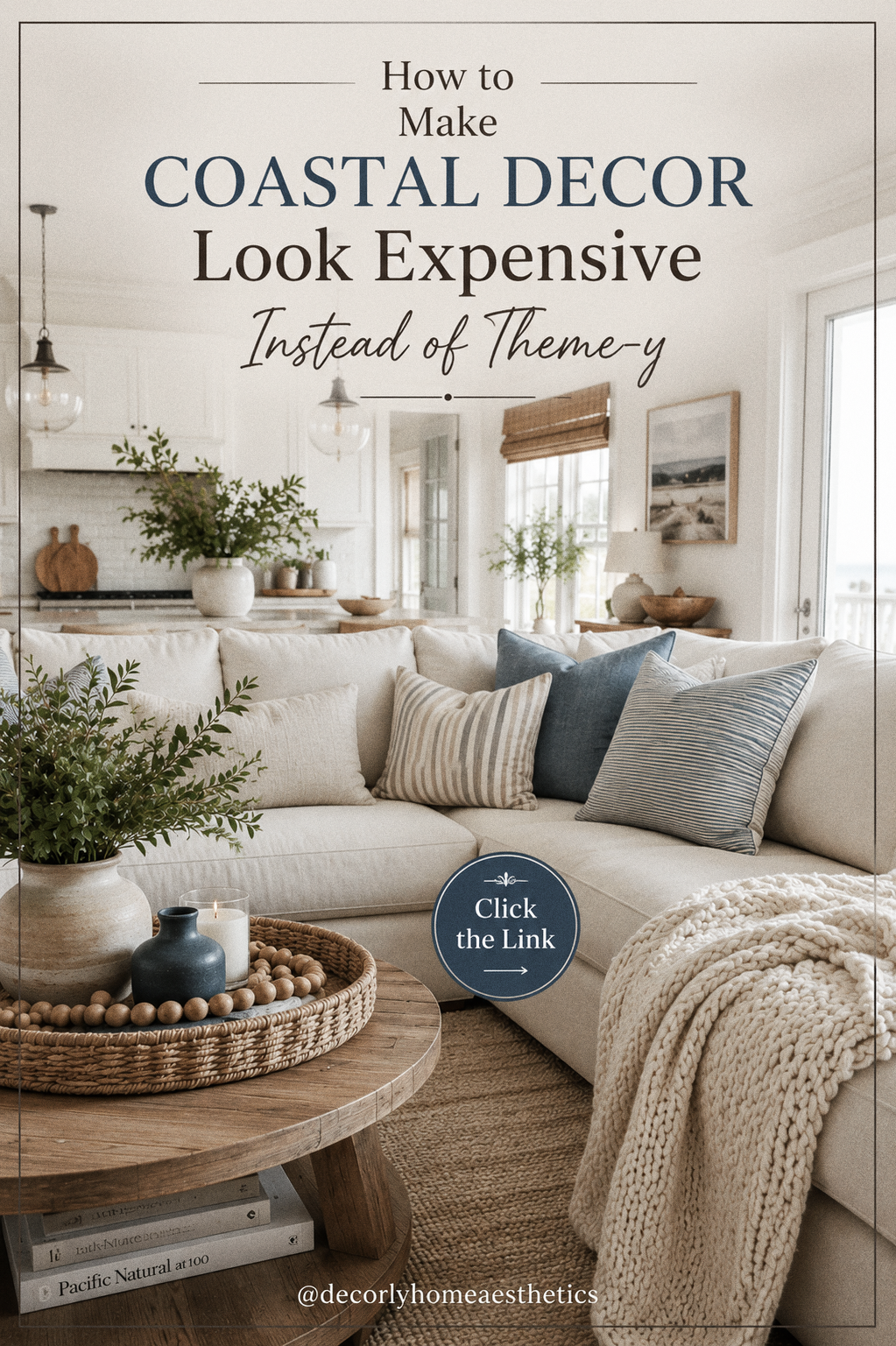
Coastal decor can go wrong surprisingly quickly.
You start with a beautiful blue cushion, add a woven basket, maybe bring home a shell from vacation—and suddenly you’re looking at anchor signs, rope accessories, turquoise everything, and a room that feels more like a beach-themed rental than the relaxed coastal home you imagined.
The coastal interiors I love most don’t actually have much “beach decor” in them.
Instead, they have soft linen, warm whites, weathered wood, faded blues, beautiful pottery, woven textures, comfortable furniture, and plenty of natural light. You get the feeling of being near the coast without needing a sign that says Beach House to explain it.
If you’re trying to create an elegant coastal home that feels expensive, timeless, and relaxed, these are the decorating ideas I’d focus on.
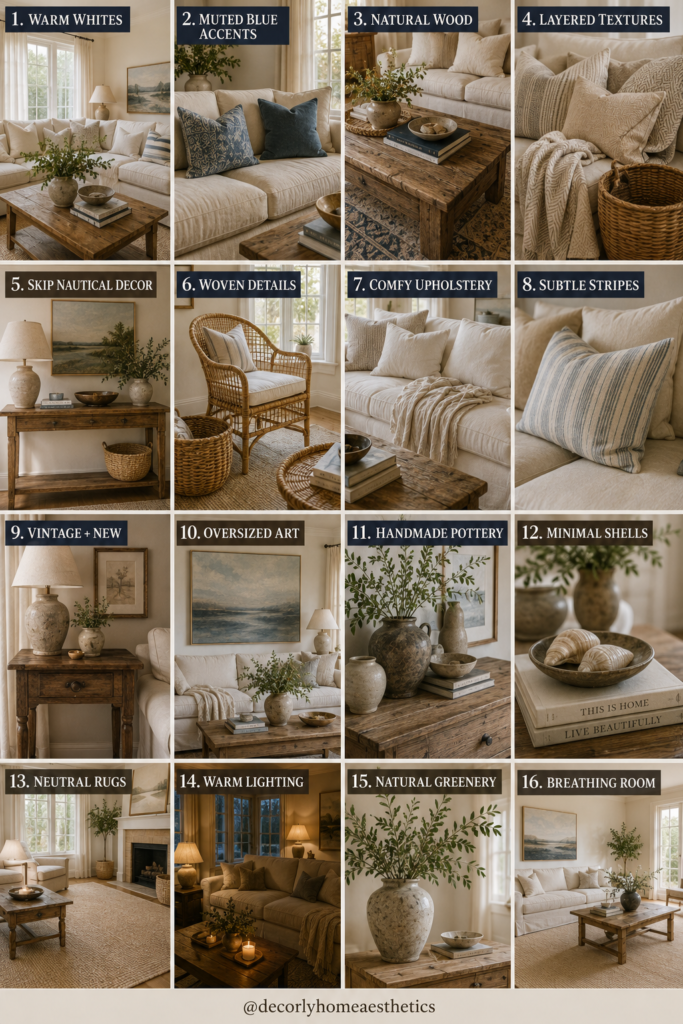
1. Start With Warm Whites, Not Stark White
White is an obvious choice for coastal interiors, but the shade matters more than you might think.
Very bright, cool white can make a room feel sterile. Instead, look for warmer whites with subtle cream, ivory, or sandy undertones.
They pair beautifully with natural wood and soften the entire room.
You don’t have to make everything white either. A warm white wall can sit beside an oatmeal sofa, sandy rug, and weathered oak table without the room losing its airy feeling.
The slight variations are what make it interesting.
2. Treat Blue as an Accent
You don’t need blue walls, a blue rug, blue curtains, and blue accessories just because you’re decorating a coastal home.
A little blue goes a long way.
Try two faded blue cushions on a cream sofa. Add a blue-gray landscape painting. Perhaps bring in a softly striped throw.
That’s often enough.
I particularly like dusty blue, slate blue, faded denim, and muted navy because they feel sophisticated and work beautifully with warmer neutrals.
Bright turquoise can certainly work in certain homes, but if you’re after a quieter, more expensive-looking coastal style, muted shades are much easier to live with.
3. Bring in Plenty of Natural Wood
Wood keeps a pale coastal room from feeling cold.
Weathered oak is beautiful, but you don’t have to buy furniture specifically labeled “coastal.”
An old pine table, walnut console, vintage wooden stool, or slightly worn oak coffee table can work just as well.
And don’t worry about matching every wood tone.
A room with several slightly different woods often feels more collected and natural than one where every piece came from the same furniture collection.
Look for visible grain, knots, variation, and finishes that aren’t overly glossy.
4. Layer Linen, Cotton and Woven Textures
When your color palette is restrained, texture becomes incredibly important.
Imagine a cream sofa with smooth cream cushions sitting on a plain cream rug. Everything may coordinate beautifully, but there’s very little depth.
Now add a rumpled linen cushion, a chunky cotton throw, a woven basket, a wool rug, and a weathered wooden table.
The palette hasn’t changed much, but the room suddenly feels layered.
That’s one of the secrets behind beautiful neutral coastal decor.
Use texture instead of relying on lots of color.
5. Skip the Obvious Nautical Decor
This is probably the biggest difference between coastal decor and beach-themed decor.
You don’t need anchors.
You don’t need ship wheels.
You don’t need rope wrapped around every lamp.
And you definitely don’t need a sign reminding everyone that they’re at the beach.
Instead, decorate with things you would happily use in a non-coastal home: beautiful ceramics, old books, landscape paintings, wooden bowls, linen lampshades, baskets, and greenery.
The coastal feeling should come from the palette, materials, light, and atmosphere, not a collection of themed accessories.
6. Use Wicker and Rattan Sparingly
Natural woven materials belong beautifully in coastal homes.
A rattan chair beside a cream sofa can look gorgeous. So can a woven pendant over a breakfast table or a large basket beside the fireplace.
But you don’t need all three plus a rattan coffee table, wicker console, woven mirror, and six baskets.
Too much of any one material starts to look themed.
Instead, scatter woven pieces around the room.
One or two noticeable elements are usually enough to add that relaxed coastal texture.
7. Choose Furniture That Looks Comfortable
Coastal interiors should make you want to sit down.
That means avoiding furniture that looks beautiful but uncomfortable.
A deep cream sofa with slightly relaxed cushions immediately gives a room that effortless beach-house feeling.
Slipcovered furniture works particularly well because it doesn’t look too precious.
Add an oversized armchair, soft cushions, and a casually draped throw.
The result should feel polished, but never as though you’re afraid to touch anything.
That’s part of what makes coastal living room decor so appealing.
8. Use Stripes Without Going Full Nautical
Stripes and coastal decorating naturally work together, but restraint makes them much more sophisticated.
Instead of bold navy-and-white stripes everywhere, use one faded striped cushion.
Or perhaps a subtle ticking stripe on an armchair.
Soft blue, gray, oatmeal, and cream stripes give you that coastal reference without turning the room into a nautical theme.
Patterns that look slightly washed or worn tend to work particularly well.
9. Mix Vintage Pieces With New Furniture
One of the easiest ways to make coastal decor look more expensive is to stop buying everything new.
Put an old wooden side table beside your newer sofa.
Hang a vintage landscape in an otherwise modern room.
Place an aged ceramic pot on a clean contemporary console.
Bring home an old brass lamp from a thrift store.
Those slightly worn pieces keep the room from looking as though you ordered an entire “coastal collection” from one store.
They also add something money can’t easily buy: character.
10. Choose One Large Piece of Artwork
A wall covered with tiny beach prints can quickly push a room toward theme-y territory.
Instead, try one substantial piece of artwork.
It doesn’t even need to depict the ocean.
An atmospheric landscape, abstract painting, faded botanical piece, or moody blue-gray artwork can give you the same peaceful feeling.
Choose colors that connect naturally with the rest of the room.
A large piece also makes a stronger visual statement, which can make the entire space feel more intentional.
11. Add Stone and Handmade Pottery
Not everything in a coastal home needs to be soft.
Stone, ceramic, and pottery bring in earthy texture that works beautifully alongside linen and wood.
Try a large irregular ceramic vase filled with branches.
Place a small stone bowl on the coffee table.
Use handmade-looking mugs and pottery in the kitchen.
The little imperfections matter.
A vase that’s slightly irregular often feels much more interesting than something perfectly smooth and mass-produced.
12. Keep Shells and Coral to a Minimum
You can absolutely decorate with shells.
The trick is making them look collected rather than purchased specifically to create a beach theme.
One beautiful shell sitting on top of an old book can be lovely.
A small bowl containing shells collected during family trips can feel personal.
A single piece of coral-style decor might work on a bookshelf.
But when shells appear on the coffee table, mantel, console, walls, lamps, and cushions, you’ve crossed from coastal into themed.
Give special objects room to stand on their own.
13. Anchor the Room With a Neutral Rug
A good rug quietly pulls everything together.
For coastal interiors, I love wool, jute, sisal-style textures, and softly faded rugs in oatmeal, sand, cream, or muted gray-blue.
Don’t choose something purely because it looks coastal.
Think about comfort and practicality too.
If the living room is somewhere everyone actually uses, a rug that can cope with everyday life is going to make you much happier than one that’s beautiful but impossible to maintain.
The best coastal homes are designed to be lived in.
14. Make the Lighting Warm
Natural daylight is a huge part of the coastal look, but eventually the sun goes down.
That’s when your lamps matter.
Use table lamps and floor lamps around the room rather than relying solely on one bright ceiling fixture.
Ceramic lamp bases and linen shades work especially well.
At night, you want the room to shift from bright and breezy to warm and cozy.
That’s also why I wouldn’t use extremely cool-toned bulbs in a warm coastal interior. They can make cream and natural wood suddenly look much colder.
15. Bring in Greenery
A few branches can completely wake up a neutral room.
You don’t need tropical plants everywhere.
Try loose leafy branches in an oversized ceramic vase, an olive-style tree in a corner, or simple seasonal greenery on the kitchen counter.
Green naturally works with cream, sand, wood, and muted blue, so it doesn’t disturb the coastal palette.
It also prevents a heavily neutral room from feeling lifeless.
Sometimes one large arrangement is more effective than lots of tiny plants scattered everywhere.
16. Leave Some Breathing Room
This might be the most important one.
Expensive-looking rooms rarely feel as though someone was desperately trying to decorate every available inch.
Leave part of the coffee table empty.
Don’t fill every shelf.
You don’t need artwork on every wall.
And that empty corner may actually be fine without another basket or plant.
Negative space lets your best furniture and accessories stand out.
It’s also what gives coastal interiors that light, effortless feeling in the first place.
The Coastal Color Palette That Always Works
If you’re unsure where to begin, keep the foundation simple:
Warm white + sand + oatmeal + weathered oak + muted blue + soft gray + natural green + a little navy
Let warm white and sand dominate.
Use natural wood to create warmth.
Introduce blue through a few textiles or artwork rather than covering the room in it.
Then use greenery and small darker accents to create contrast.
This palette works particularly well for a coastal living room, bedroom, kitchen, entryway, or relaxed beach house interior.
What Makes Coastal Decor Look Cheap?
Usually, it’s not the budget.
It’s trying too hard to communicate the theme.
A beautiful $20 thrifted wooden table can look far more sophisticated than an expensive console covered with nautical decorations.
The things I’d be careful with are:
Beach signs, anchor motifs, ship wheels, excessive rope, turquoise overload, shell-covered accessories, matching coastal furniture sets, and too many blue-and-white stripes.
You don’t necessarily have to ban all of them.
Just don’t use them all at once.
If you have an old nautical object with personal meaning, that can actually be wonderful. Surround it with ordinary decor and let it tell its own story.
How to Get the Expensive Coastal Look on a Budget
You don’t need an oceanfront-house budget to create this look.
Spend your money where it makes the biggest visual difference.
A large rug can transform a room. So can properly sized curtains or a substantial piece of artwork.
Then thrift the character pieces.
Look for wooden stools, landscape paintings, pottery, baskets, brass frames, side tables, and old books.
Replace inexpensive cushion covers rather than the entire sofa.
Bring in branches from the garden instead of constantly buying decorative stems.
And before purchasing new decor, try removing a few things.
Sometimes the cheapest way to make a room look more expensive is simply to edit it.
Coastal Decor vs. Nautical Decor
They’re related, but they’re not quite the same thing.
Nautical decor tends to reference the sea directly—anchors, boats, rope, navy stripes, lighthouses, and marine objects.
Modern coastal decor is much more about how a space feels.
It’s breezy.
Natural.
Comfortable.
Light but not sterile.
Relaxed but still polished.
You should be able to remove every shell from the room and still recognize the coastal influence.
That’s when you know you’ve got the balance right.
Final Thoughts
The best coastal homes don’t look as though someone went shopping for “coastal decor.”
They look as though they’ve evolved naturally.
There’s a comfortable linen sofa that’s been sat on a thousand times. An old wooden table has a few scratches. A faded blue cushion sits beside something cream. Branches lean slightly awkwardly from a handmade vase. A painting reminds you of the sea without necessarily showing it.
Nothing screams beach.
But somehow, the whole room makes you want to open the windows and stay awhile.
If you want your coastal decor to look more expensive, don’t add more beach-themed accessories.
Use better textures. Mix old with new. Bring in natural materials. Soften your colors. And give everything a little room to breathe.
That’s what creates the relaxed, timeless coastal look that’s so much harder to get tired of.