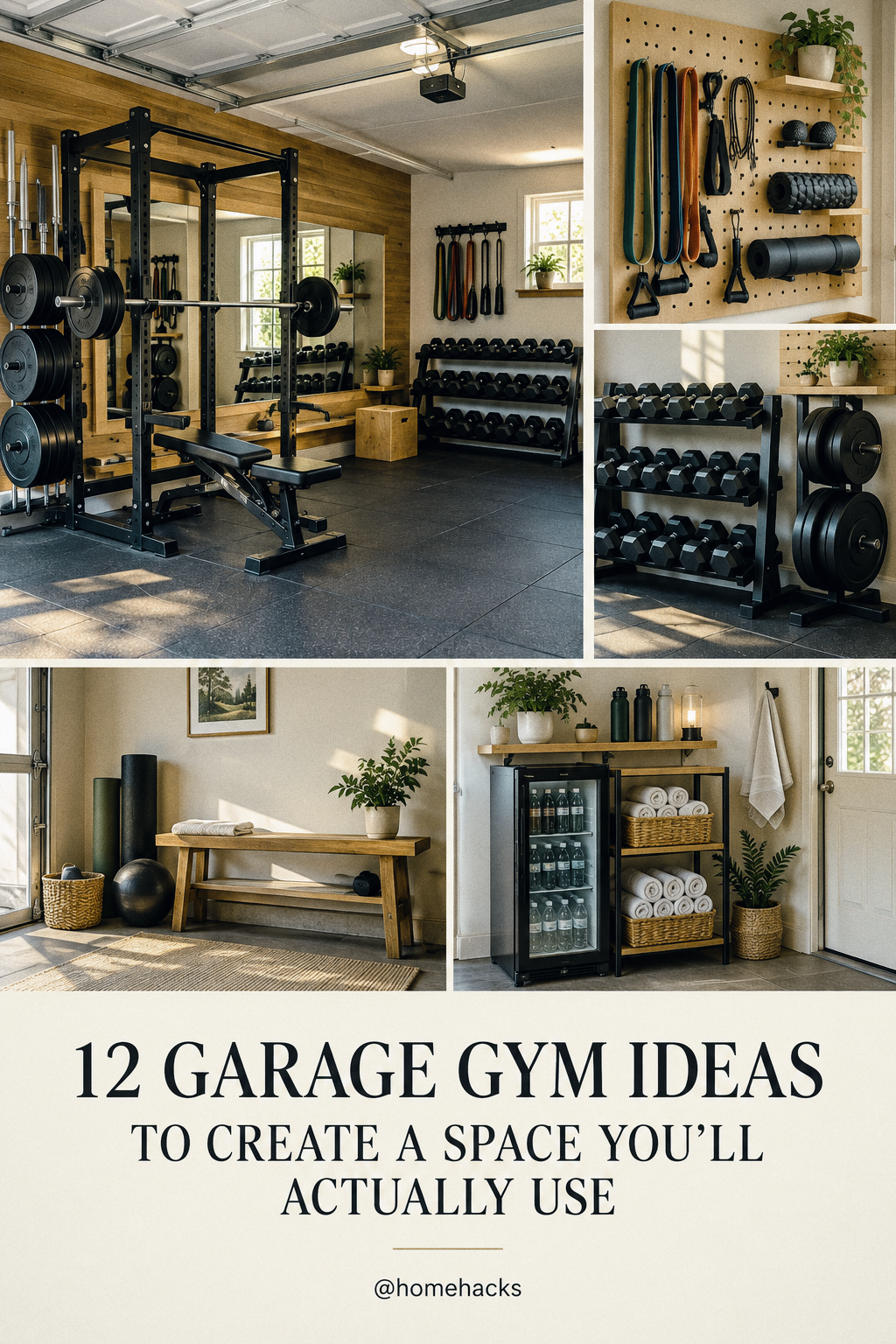
There’s something appealing about having a gym just a few steps from your living room.
No driving across town. No waiting for equipment. No wondering whether the gym will be packed after work. You open the garage door, put on some music, and start your workout.
At least, that’s the dream.
The reality is that a garage gym can easily become a power rack squeezed between storage boxes, bicycles, tools, and everything else that never found a proper home.
The good news is that you don’t need a huge garage—or a commercial gym budget—to create a workout space that feels good to use. What matters most is planning around how you actually exercise, keeping equipment organized, and making the room comfortable enough that you want to spend time there.
If you’re planning a garage gym makeover, these 12 ideas can help you turn an ordinary garage into a practical home workout space.
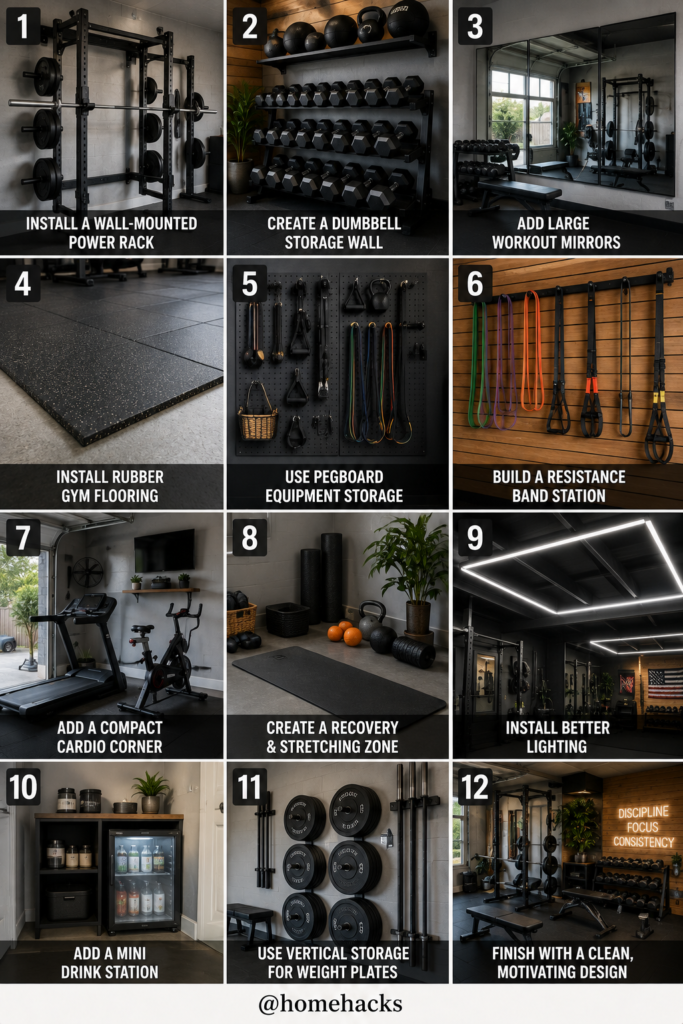
1. Install a Wall-Mounted Power Rack
If strength training is a big part of your routine, a power rack can become the center of your garage gym.
The problem is that traditional racks can occupy a lot of valuable floor space.
A properly installed wall-mounted or folding rack can be a useful alternative in smaller garages. Some designs fold toward the wall when they’re not being used, leaving more room for stretching, conditioning, or even parking when necessary.
Before installing one, make sure the wall and mounting method are suitable for the equipment and loads involved. Follow the manufacturer’s installation requirements rather than treating heavy gym equipment like ordinary wall shelving.
Once it’s installed correctly, build the rest of the gym around it.
2. Create a Dumbbell Storage Zone
Dumbbells scattered across the floor make even a beautiful home gym feel messy.
They’re also something you don’t want to trip over.
Give your dumbbells a dedicated rack or storage area where every weight has a predictable place.
If you have several pairs, a compact multi-tier rack can use vertical space rather than spreading everything across the floor.
Keep frequently used weights at a comfortable height when possible.
It’s a small organizational change, but there’s something satisfying about finishing a workout and putting everything back where it belongs.
More importantly, an uncluttered floor gives you more usable workout space.
3. Add Large Workout Mirrors
Mirrors can completely change the feeling of a garage gym.
They reflect light, make a small garage appear more open, and can help you visually check exercise form.
You don’t necessarily need an entire mirrored wall.
One appropriately sized mirror near your main strength-training area may be enough.
If you’re installing large or heavy mirrors, make sure they’re securely mounted using appropriate hardware and installation methods. Avoid simply leaning large mirrors against a wall in an active workout area where they could be knocked over.
For a softer look, combine mirrors with warm wood or neutral wall finishes rather than trying to recreate a commercial fitness center.
4. Install Proper Gym Flooring
If I were prioritizing a garage gym budget, flooring would be near the top of the list.
Bare concrete isn’t particularly forgiving, and gym equipment can be hard on the floor too.
Quality rubber gym flooring or suitable heavy-duty mats can create a more comfortable workout surface while helping protect the concrete underneath.
You may not need to cover the entire garage.
If only half the room is used for exercise, create a clearly defined workout zone and leave the remaining floor accessible.
Before installation, address moisture or drainage problems rather than simply covering them. Garages can have very different conditions from indoor living spaces, so choose flooring appropriate for the environment and your type of training.
5. Build a Pegboard Equipment Wall
Small workout accessories somehow manage to create a surprising amount of clutter.
Resistance bands, lifting straps, jump ropes, handles, belts, and similar equipment can quickly end up piled on a bench.
A pegboard or suitable wall-storage system fixes much of that.
Give each type of accessory its own hook or section.
You can immediately see what you have, and putting everything away after a workout takes seconds.
It also gives your garage gym that satisfying organized look without requiring expensive cabinetry.
Use hardware designed to safely support whatever you’re hanging, particularly heavier items.
6. Create a Resistance Band Station
If you use resistance bands regularly, give them their own little workout station.
Bands are useful precisely because they don’t require much space, but they become annoying when they’re tangled together in a drawer.
Hang them neatly by resistance level or type.
If you use wall anchors or suspension equipment for exercise, make sure they’re specifically designed, positioned, and installed for the forces involved. A decorative wall hook isn’t automatically a safe exercise anchor.
Having everything ready to use removes one more tiny excuse for skipping the workout.
7. Add a Compact Cardio Corner
You don’t need three treadmills and a row of exercise bikes to have a cardio area.
Choose the equipment you genuinely enjoy.
Maybe that’s a stationary bike.
Maybe it’s a rowing machine.
Perhaps you’d rather have open floor space for jump-rope sessions or bodyweight circuits.
The important thing is designing the gym around your workouts, not around what you think a home gym is supposed to contain.
If you’re buying new equipment, measure the space first—including the room required to safely get on, off, and use the machine.
Remember to consider ventilation and electrical requirements for powered equipment too.
8. Make Room for Stretching and Recovery
One of the easiest garage gym mistakes is filling every available inch with equipment.
Leave some empty floor.
Seriously.
A small recovery corner with a yoga or exercise mat, foam roller, mobility tools, and enough room to comfortably stretch can make the gym far more versatile.
You don’t need much.
A narrow wall shelf or basket can keep smaller recovery tools together.
When you’re finished, roll the mat up and store it vertically.
The result is a space that works for warm-ups and cooldowns just as well as heavy training.
9. Improve the Lighting
A dark garage doesn’t exactly make you excited about a 6 a.m. workout.
Lighting can have a surprisingly large effect on whether the space feels like a forgotten storage room or an intentional home gym.
Start by maximizing any natural daylight the garage already receives.
Then make sure your artificial lighting provides clear, even illumination across workout areas without creating distracting glare.
If electrical changes or new hardwired fixtures are required, use appropriately qualified help rather than improvising electrical work.
You don’t need colorful nightclub lighting.
For most home gyms, bright, comfortable, practical lighting is far more useful.
10. Add a Mini Drink Station
This one isn’t essential.
But once you’ve sorted out the basics, a small drink station is a fun addition.
A compact refrigerator can keep cold water or workout drinks nearby. Alternatively, skip the appliance and create a simple shelf for reusable water bottles, clean towels, and other workout essentials.
If you use a mini fridge, make sure it’s appropriate for the location, has adequate ventilation, and is connected according to its electrical requirements.
Keep this area small.
You’re creating a convenient hydration station, not building a smoothie bar in the garage.
11. Store Weight Plates Vertically
Weight plates can consume a lot of floor space when they don’t have a proper home.
Dedicated plate storage makes a big difference.
Depending on your setup, that might mean a suitable vertical plate tree, rack-mounted storage designed for your equipment, or properly rated wall storage.
The important part is stability and load capacity.
Weight plates are heavy, so this isn’t an area where I’d improvise with lightweight shelving.
Keep the plates you use most frequently easy to access, and don’t position heavy equipment where it could fall into a walkway.
Once everything has a designated place, cleaning and resetting the gym becomes much easier.
12. Make the Garage Feel Like a Room You Want to Use
Function comes first, but appearance matters too.
You don’t need expensive finishes.
Sometimes a few simple changes are enough: coordinated storage, a clean wall, warm wood accents, good lighting, a large mirror, and equipment arranged intentionally rather than randomly.
Try sticking with a simple palette.
Black equipment looks great against natural wood, warm white, gray, or muted neutral walls.
If the garage still needs to serve other purposes, visually divide it into zones. Keep household storage on one side and workout equipment on the other.
Your garage doesn’t need to look like a boutique fitness studio.
It just needs to feel like your gym rather than a storage room that happens to contain dumbbells.
Start With the Workouts You Actually Do
Before buying anything, write down what a normal week of exercise looks like for you.
If you primarily lift weights, prioritize the rack, bench, weights, flooring, and storage.
If you prefer cardio, don’t spend half your budget creating a complicated weightlifting setup you’ll barely touch.
If you love functional workouts, open floor space might be more valuable than another machine.
This sounds obvious, but home gyms have a strange way of becoming collections of equipment people hope they’ll use.
Build around your existing habits first.
You can always add equipment later.
How to Organize a Small Garage Gym
When space is tight, think vertically.
Walls are incredibly valuable in a small home gym.
Use appropriate wall storage for lightweight accessories, mats, bands, and other suitable equipment. Keep bulky items consolidated instead of spreading them around the room.
Foldable equipment can also be useful when the garage serves multiple purposes.
Most importantly, protect open floor space.
A smaller gym with enough room to move is usually more enjoyable than a garage packed with every machine imaginable.
Don’t Forget About the Garage Itself
Before making the room beautiful, check whether the garage is actually comfortable and suitable for exercise.
Garages can experience heat, cold, moisture, poor ventilation, uneven floors, and other conditions that aren’t as noticeable inside the house.
Consider airflow and temperature for your climate.
Don’t block required exits, doors, electrical panels, ventilation, or access to household equipment.
If you have vehicles, tools, chemicals, fuel-powered equipment, or other garage storage nearby, think carefully about how the workout zone is separated from them.
A Pinterest-worthy gym isn’t worth creating if basic safety and practicality have been ignored.
What Does a Garage Gym Really Need?
You can start surprisingly small.
For many people, the basics might be:
- Suitable gym flooring
- Adjustable bench
- Dumbbells or another preferred resistance setup
- Safe storage
- Exercise mat
- Resistance bands
- Good lighting
- Enough open space to move comfortably
A rack, barbell, cardio machine, mirrors, mini fridge, and other upgrades can come later if they match your training.
There’s no prize for having the most equipment.
The best garage gym is the one you consistently use.
Common Garage Gym Mistakes to Avoid
One of the biggest mistakes is buying everything before understanding the space.
Measure first.
Plan where you’ll move, where equipment will be stored, and how much clearance each exercise or machine requires.
Another mistake is ignoring storage until the end. If every new piece of equipment gets dropped onto the floor, the room will quickly feel cramped.
And don’t sacrifice safety for aesthetics. Heavy racks, mirrors, shelves, and wall-mounted exercise equipment need appropriate installation.
Finally, resist the urge to copy somebody else’s garage gym exactly.
Their workouts aren’t necessarily your workouts.
Take inspiration from the look, but build the room around your own routine.
Final Thoughts
A great garage gym doesn’t need to be huge, packed with equipment, or incredibly expensive.
It needs to remove friction.
Your weights should be easy to find. Your floor should have enough room to move. The lighting should make the space pleasant to use. Your equipment should suit the workouts you genuinely enjoy.
Start with the essentials.
Add smart vertical storage.
Create separate strength, cardio, and recovery areas if your space allows.
Then finish it with a few simple design choices that make walking into the garage feel good.
Because ultimately, the most impressive home gym isn’t the one that looks best in a photograph.
It’s the one that makes you want to come back tomorrow.