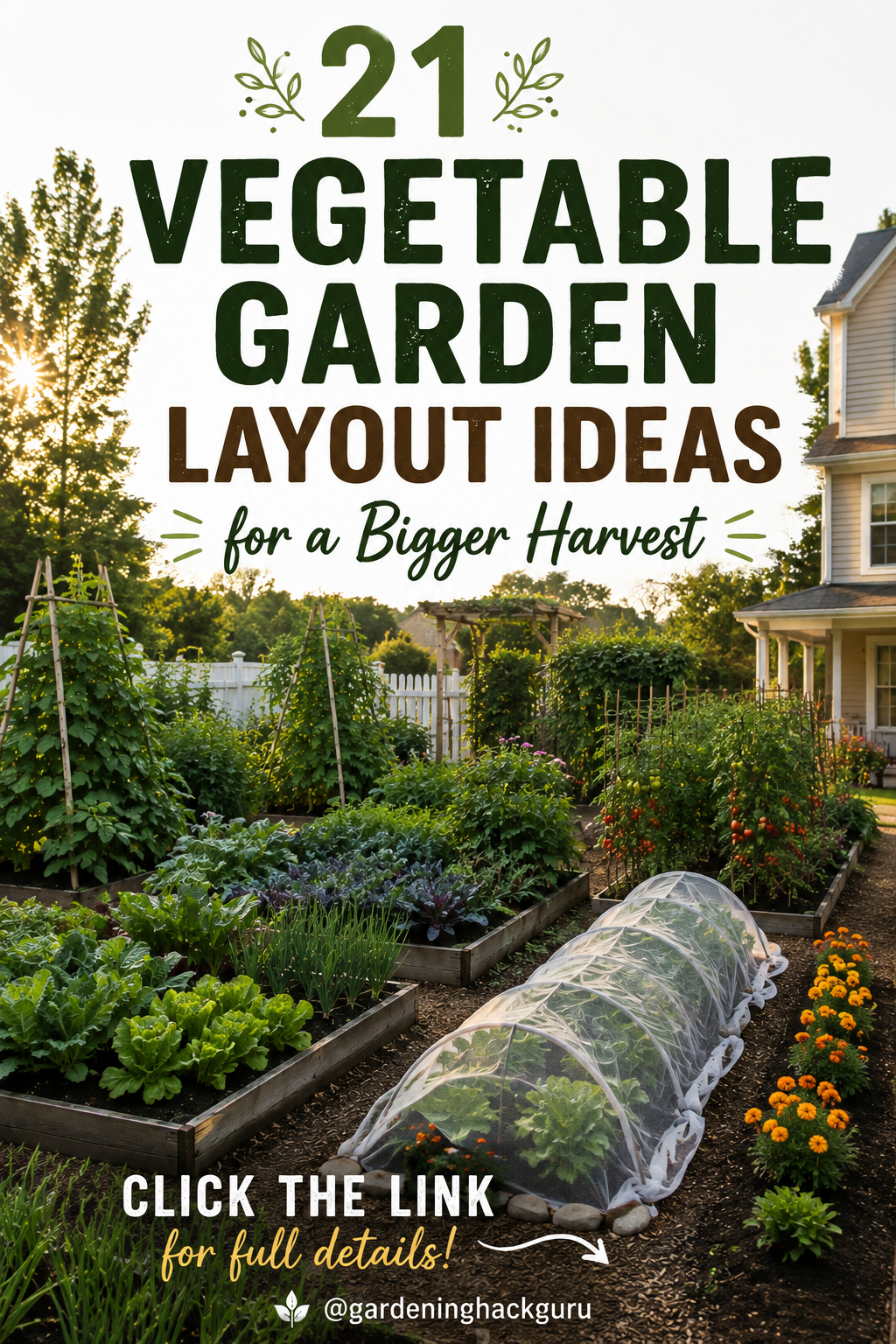
There’s a big difference between simply growing vegetables and planning a garden that actually makes good use of the space you have.
I learned quickly that adding more plants doesn’t necessarily mean getting more food. When vegetables are crowded together, paths are difficult to reach, or tall plants shade everything behind them, even a large garden can feel surprisingly unproductive.
A thoughtful vegetable garden layout changes that.
You start thinking about where the sun falls, which crops can grow vertically, how easily you can reach each bed, and what you’ll plant once an early crop has finished. Suddenly, the same backyard can produce much more without feeling overcrowded.
Whether you’re planning your first backyard vegetable garden or reorganizing an established one, here are 21 practical layout ideas that can help you create a beautiful, productive growing space.
1. Classic Raised Bed Layout
Raised beds are popular for a reason.
Instead of creating one enormous growing area, divide your vegetable garden into several manageable rectangular beds with pathways between them.
You can dedicate one bed to tomatoes and peppers, another to leafy greens, another to root vegetables, and another to herbs or flowers.
The biggest advantage is accessibility. You should be able to reach the center of each bed without stepping onto the growing soil.
It keeps the garden organized while making planting, weeding, watering, and harvesting much easier.
2. Four-Bed Garden Layout
If you’re starting from scratch, four raised beds are surprisingly versatile.
Arrange them in a simple square with a cross-shaped pathway through the middle.
Each bed can contain a different group of vegetables, or you can mix crops according to their growing requirements.
Place a small pot, birdbath, herb planter, or decorative feature where the pathways meet.
It’s simple, attractive, and easy to expand later.
3. Grow Tall Crops Along the Back
One of the easiest vegetable garden layout mistakes to avoid is putting tall plants where they’ll shade shorter ones.
If your garden orientation allows it, position tall crops such as pole beans, climbing cucumbers, trellised tomatoes, and other vertical plants where they won’t block important sunlight from lower-growing crops.
Then place medium-height vegetables in front and smaller plants such as lettuce toward the sunnier edges.
Watch the actual sunlight in your yard before deciding exactly where “back” should be.
4. Add Vertical Trellises
When you run out of ground space, grow upward.
Trellises can support crops such as pole beans, peas, cucumbers, and certain squash varieties where appropriate.
Vertical growing has another benefit: harvesting becomes much easier when produce isn’t hidden underneath sprawling foliage.
A simple wooden or metal trellis can also give an otherwise practical vegetable garden some beautiful height and structure.
5. Create a Central Garden Path
If you have a larger backyard garden, start with one clear central path.
Then arrange beds on either side.
It may sound overly simple, but having a proper pathway makes the whole garden easier to use. You can carry baskets, move tools, pull a small cart, and reach different growing areas without squeezing between plants.
Mulch, gravel, stepping stones, or grass can all work depending on your garden.
6. Try a U-Shaped Vegetable Garden
A U-shaped layout works beautifully in smaller backyards.
Place narrow raised beds along three sides while keeping the center open for movement.
You get plenty of growing area without losing easy access.
The back section can hold taller crops or trellises while shorter vegetables grow along the sides.
It’s especially useful when you’re creating a kitchen garden close to the house.
7. Create a Dedicated Salad Garden
Instead of scattering lettuce everywhere, dedicate one easily accessible bed to vegetables you frequently harvest for salads.
You might grow different lettuces, spinach, radishes, arugula and suitable herbs together.
Keep this bed near the kitchen if possible.
These are crops you’ll potentially visit frequently, so there’s little benefit in placing them at the farthest corner of the backyard.
8. Build a Kitchen Garden Near the House
A vegetable garden doesn’t need to sit at the end of the property.
If you have suitable sunlight near the house, create a compact kitchen garden filled with ingredients you use constantly.
Think herbs, lettuce, tomatoes, peppers, scallions, and other everyday favorites.
The closer these plants are to the kitchen, the more likely you are to actually harvest them.
There is something very satisfying about realizing dinner needs basil and simply walking outside for it.
9. Use an Arch Trellis Between Beds
An arch trellis can turn a practical garden feature into one of the prettiest parts of your backyard.
Place an arch across a pathway between two raised beds and grow suitable climbing vegetables up either side.
Pole beans and some cucumbers can work particularly well.
Eventually, the vines meet overhead and create a green tunnel you can walk beneath.
Just make sure the structure is strong enough to support the mature plants and their crop.
10. Mix Vegetables With Flowers
A productive vegetable garden doesn’t need to contain vegetables alone.
Flowers can bring color into the beds and, depending on the plants, may provide resources for pollinators and other beneficial insects.
Try adding suitable flowers around bed edges or at the ends of vegetable rows.
Marigolds, nasturtiums, calendula, zinnias, cosmos, and sunflowers are commonly seen in edible gardens, although the best choices depend on your climate and growing conditions.
The result is a vegetable garden that feels much less utilitarian.
11. Create a Tomato and Basil Bed
Tomatoes deserve room.
Instead of squeezing them randomly between other crops, consider giving several plants their own sunny bed.
Provide sturdy support early so you aren’t trying to wrestle cages or stakes around enormous plants later.
You can grow basil or other compatible smaller crops nearby where conditions allow.
Most importantly, leave enough airflow between tomato plants rather than trying to fit as many as possible into the bed.
More tomato plants don’t automatically equal more tomatoes.
12. Create a Root Vegetable Bed
Carrots, beets, radishes, turnips, and similar crops can work well together in a dedicated section of loose, well-prepared soil.
Keeping them in one area makes it easier to manage crops that spend most of their productive life underground.
You can also succession-sow quick-growing vegetables such as radishes rather than planting the entire packet on one afternoon.
That way, you don’t end up with dozens ready at exactly the same time.
13. Try Square-Foot-Style Gardening
If you have limited space, intensive bed planning can help you use it efficiently.
The basic idea is to divide a raised bed into smaller sections and plant each section according to the mature size and spacing requirements of a particular crop.
One section might contain lettuce, another carrots, another herbs, and another a larger vegetable.
The important part isn’t squeezing plants together.
It’s organizing spacing deliberately.
Always adapt recommendations to the actual variety you’re growing.
14. Add a Protected Growing Bed
A lightweight insect mesh or row cover can be incredibly useful for certain crops.
Create one bed where hoops can easily be installed and covered when necessary.
This is especially handy for vegetables that regularly face insect pressure in your area.
Because the support structure is already part of the garden layout, you can add or remove appropriate covering much more easily than trying to improvise protection after damage begins.
Remember that crops requiring insect pollination may need different management while flowering.
15. Create a Three-Sisters-Inspired Area
Corn, climbing beans, and squash have a long history of being grown together in Indigenous agricultural systems, commonly referred to today as the Three Sisters.
Rather than treating it as simply another trendy companion-planting trick, it’s worth recognizing that this is a traditional Indigenous intercropping practice with cultural significance.
If you want to experiment with a similar polyculture, research appropriate planting arrangements and varieties for your region rather than simply putting three random plants together.
Done thoughtfully, mixed-crop systems can create a very different alternative to conventional vegetable rows.
16. Use Succession Planting
One of the best ways to get a bigger harvest isn’t changing the shape of your beds.
It’s changing when you use them.
Imagine harvesting an early crop and leaving that patch empty for the rest of the season.
That’s wasted growing space.
Instead, plan what will follow.
After an early crop finishes, you may be able to plant another vegetable suited to the remaining growing season.
What works will depend heavily on your climate and frost dates, but thinking ahead can allow the same piece of soil to produce more than one harvest.
17. Create a Dedicated Herb Border
Herbs don’t always need their own raised bed.
Use suitable herbs along the edges of your vegetable garden, near pathways, or in containers.
Parsley, thyme, chives, basil, oregano, rosemary, and other herbs can add texture and fragrance while providing something useful for the kitchen.
Just pay attention to individual growing requirements.
A Mediterranean herb that prefers excellent drainage may not appreciate being planted beside a vegetable that receives constant moisture.
18. Design a Small-Space Vegetable Garden
Don’t dismiss vegetable gardening because your backyard is small.
A compact layout can still grow a surprising amount.
Use one or two raised beds, add vertical supports, grow herbs in containers, and prioritize crops you actually eat.
Rather than growing enormous quantities of one inexpensive vegetable, think about what will provide the most value to you.
For one household, that might be tomatoes and fresh herbs.
For another, it could be salad greens, peppers, and cucumbers.
Your best garden layout is personal.
19. Add a Small Greenhouse to the Layout
If you have enough space and budget, a greenhouse can become the anchor of your vegetable garden.
Position beds and pathways around it so everything feels connected.
A greenhouse may help with seed starting and season extension, depending on your climate and how it’s designed and managed.
You don’t need a huge structure.
Even a compact greenhouse can be useful.
Just avoid placing it somewhere that creates unwanted shade across your main vegetable beds.
20. Create a Harvest Station
This is something many vegetable garden plans forget.
Where will you put everything once you pick it?
A small table or bench near the garden gives you somewhere to place harvest baskets, organize vegetables, hold tools, or set down a watering can.
If possible, locate it somewhere with a little shade.
Add hooks underneath or nearby for frequently used tools.
It’s a tiny feature that can make a surprisingly big difference once the garden is producing heavily.
21. Create a Beautiful Productive Garden
For the final layout, combine the ideas that actually suit your backyard.
Use several manageable raised beds with comfortable paths between them.
Put climbing vegetables on sturdy trellises. Dedicate sunny areas to tomatoes and other heat-loving crops. Grow greens and root vegetables in accessible beds. Add herbs near pathways and flowers throughout the garden.
Include a covered bed if pest pressure makes one useful.
Leave enough room to walk comfortably.
And most importantly, don’t fill every square inch.
A productive garden needs airflow, sunlight, access, and room for mature plants.
The goal isn’t to fit the most plants into your backyard.
It’s to get the most from the plants you grow.
How to Plan Your Vegetable Garden Layout
Before buying lumber or digging beds, spend some time watching your backyard.
Where does the sun hit first?
Which areas remain shaded?
Where does water collect after rain?
Where is the nearest water source?
And how far are you realistically willing to walk every evening when you suddenly remember that you haven’t picked the beans?
Most vegetables grown for fruiting generally perform best with plenty of direct sunlight, while individual crops vary in what they’ll tolerate. That’s why your site’s actual conditions should shape the layout.
Next, think about access.
Make beds narrow enough that you can comfortably reach the plants without walking over the growing soil. Give pathways enough width for whatever you regularly carry or push through the garden.
Then think vertically.
A cucumber sprawling across the ground can consume an impressive amount of space. Growing an appropriate variety vertically can free some of that ground for other crops.
Finally, plan for the entire season rather than just planting day.
What Should You Grow for a Bigger Harvest?
It’s easy to assume that a bigger harvest means growing as many different vegetables as possible.
I think the opposite often works better.
Grow more of what your household actually eats.
If nobody likes turnips, there’s little point dedicating an entire raised bed to them simply because they’re easy to grow.
If your family eats tomatoes every day in summer, give tomatoes prime space.
If you buy bags of salad greens every week, make lettuce and other greens a priority.
If fresh herbs are expensive where you live, grow plenty of those.
A productive vegetable garden should reduce the distance between what you grow and what you eat.
Don’t Crowd Your Vegetable Beds
New gardens always look empty.
You’ve prepared this beautiful raised bed, planted six tiny seedlings, and suddenly there’s an enormous amount of bare soil between them.
The temptation is to add more.
And then more.
Six weeks later, you can’t find the pathway.
Always plan for the mature size of the plant, not the size of the seedling you’re holding today.
Proper spacing can improve access to sunlight and airflow while reducing competition for water and nutrients.
Follow spacing recommendations for the specific varieties you’re growing rather than copying a photograph of someone else’s garden.
Make Your Vegetable Garden Beautiful Too
A productive garden doesn’t need to look messy.
Use defined paths.
Add flowers.
Choose trellises that look good even before they’re covered with vines.
Use natural materials such as wood, gravel, stone, or mulch where appropriate.
Place a bench somewhere shady.
Keep a harvest basket near the door.
You can even add a small seating area overlooking the beds.
After all, if you’re going to spend months planting, watering, weeding, and harvesting your garden, you might as well create somewhere you enjoy being.
Start With a Simple Layout
If this is your first vegetable garden, don’t try to build all 21 ideas at once.
Start with two or four beds.
Create good pathways.
Install one trellis.
Plant vegetables you know you’ll eat.
Add a few flowers.
Then garden for a season.
By the end of summer, you’ll know exactly what you wish you’d done differently.
Maybe you’ll want wider paths.
Maybe you’ll realize you need another trellis.
Maybe you’ll discover that one bed gets less sunlight than you thought.
That’s normal.
The best vegetable garden layout isn’t designed once and never changed. It evolves as you learn how your backyard behaves and how you actually like to garden.
A bigger harvest doesn’t always require a bigger backyard.
Sometimes you just need to use the space you already have a little more thoughtfully. 🌱