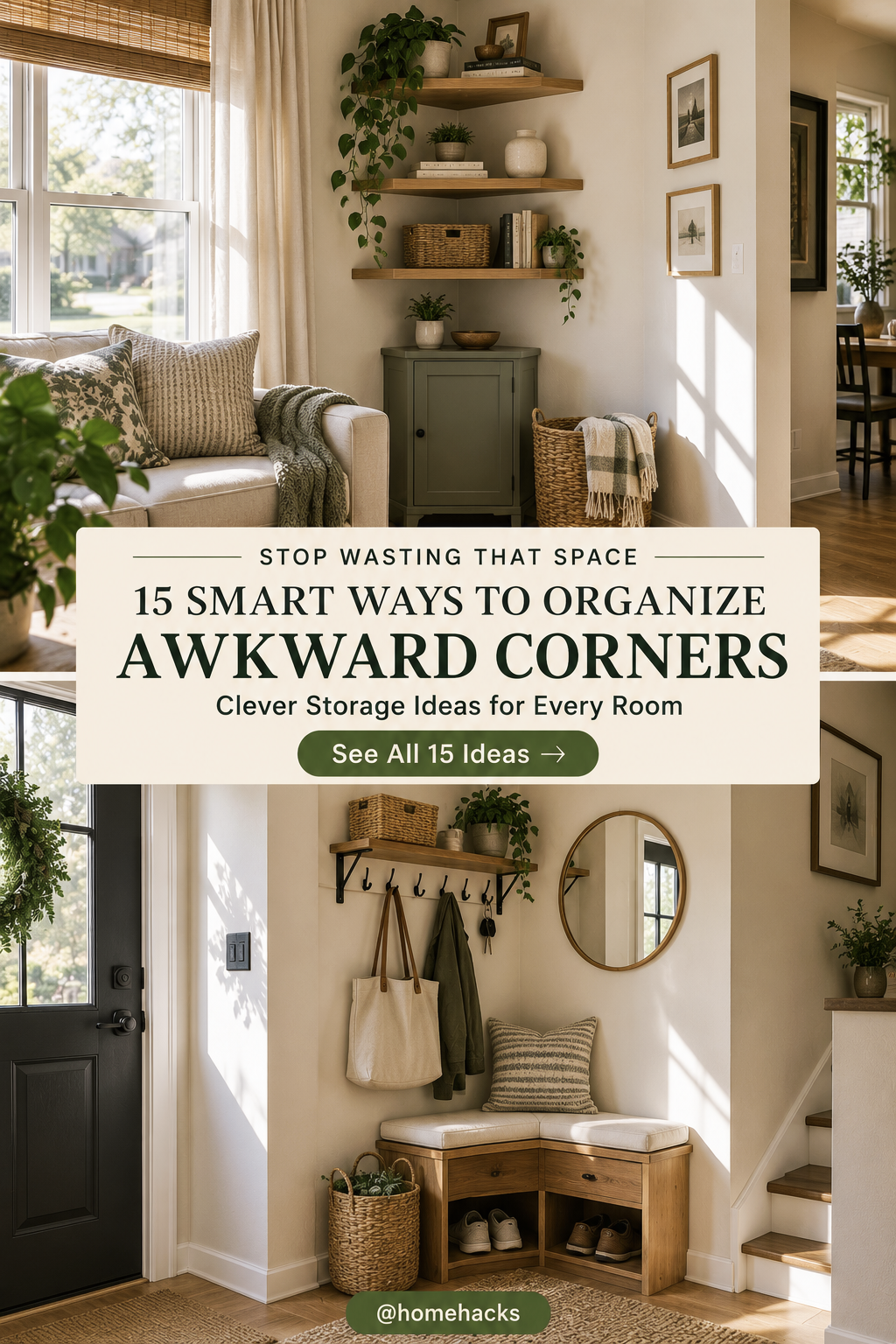
There always seems to be at least one corner in a home that nobody quite knows what to do with.
Maybe it’s the narrow space beside the sofa. Maybe it’s an empty corner in the bathroom that’s too small for proper furniture. Or perhaps it’s that strange little spot behind a door where things slowly start piling up because nothing else fits there.
For a long time, I thought awkward corners were simply wasted space. But once you stop trying to squeeze normal furniture into them, they become surprisingly useful.
The trick is to work with the shape of the space instead of against it.
Floating shelves, narrow cabinets, baskets, wall hooks, corner benches, and vertical storage can turn even a tiny forgotten area into something genuinely useful. And you don’t need a custom renovation to make most of these ideas work.
If you’re short on storage—or simply tired of looking at an empty, awkward corner—here are 15 smart ways to organize awkward corners in your home.
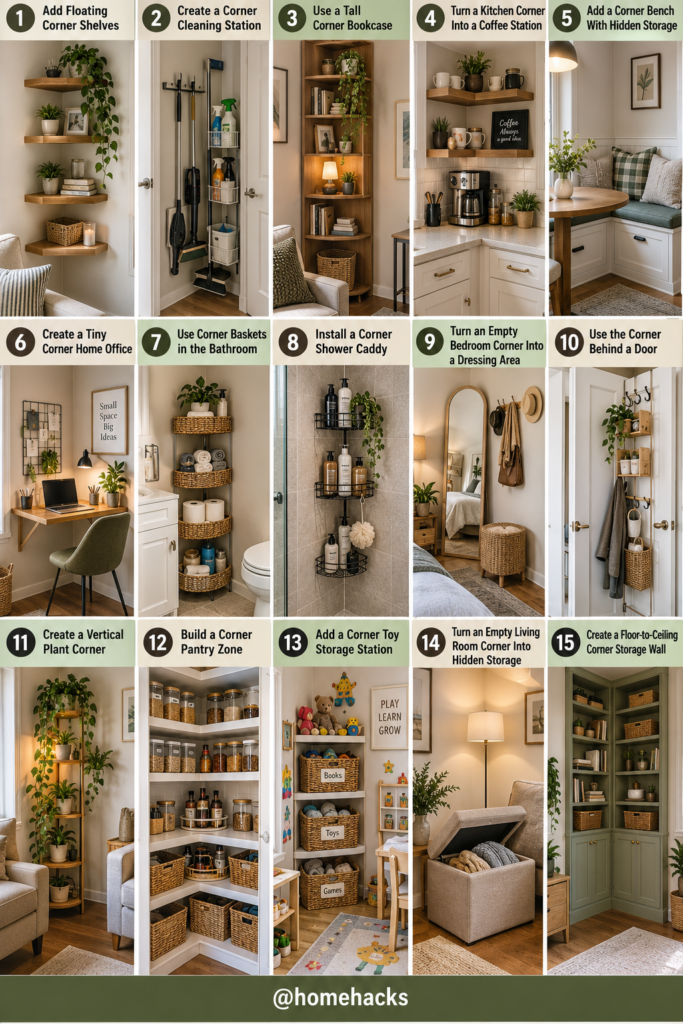
1. Add Floating Corner Shelves
One of the simplest solutions for an empty corner is to look up.
Floating shelves let you use wall space without adding another bulky piece of furniture to the room. They’re particularly useful when the corner is too narrow for a standard bookcase.
In a living room, use them for a few books, small baskets, or everyday items you actually need nearby.
In the kitchen, they could hold frequently used dishes or appropriate pantry items.
In a bathroom, they can provide extra space for folded hand towels and toiletries.
The secret is not to overload them.
Three thoughtfully arranged shelves usually look better than six shelves completely packed with objects.
And always make sure shelves are properly installed for the weight they’ll carry.
2. Create a Corner Cleaning Station
Brooms and mops have an incredible talent for ending up in exactly the wrong place.
If you have a narrow corner in a laundry room, utility room, mudroom, or pantry, turn it into a dedicated cleaning station.
Install suitable wall-mounted holders for brooms, mops, dusters, and other long-handled tools.
A slim basket underneath can hold washable cleaning cloths or accessories.
If you have children or pets, store household cleaning products securely according to their labels rather than leaving bottles openly accessible.
The best part about this setup is that cleaning equipment stops falling over every time you open a closet.
3. Use a Tall Corner Bookcase
When floor space is limited, vertical storage is your friend.
A tall, narrow bookcase can provide a surprising amount of storage while occupying relatively little floor area.
This works especially well in living rooms, bedrooms, offices, and even large hallways.
Use the easiest-to-reach shelves for things you access regularly.
Less frequently used objects can go higher up.
If you’re using baskets, give each one a purpose instead of creating several mysterious containers filled with miscellaneous stuff.
And for tall furniture, follow the manufacturer’s instructions regarding wall anchoring, especially in homes with children.
4. Turn a Kitchen Corner Into a Coffee Station
That forgotten section of kitchen counter might be exactly where your morning coffee belongs.
Instead of spreading coffee supplies across several cabinets, group them together in one compact corner.
Keep your coffee maker there if it’s suitable for the space, then use a small tray for everyday accessories.
A shelf above can hold mugs or containers, provided everything is securely installed and positioned safely away from heat and steam.
You don’t need to display every coffee-related object you own.
A coffee station works best when it contains the things you genuinely use every morning.
Suddenly, an awkward countertop corner has a job.
5. Add a Corner Bench With Hidden Storage
This is particularly useful in entryways and breakfast nooks.
A small corner bench gives you somewhere to sit while also creating an opportunity for hidden storage underneath.
In an entryway, you could store seasonal accessories, reusable shopping bags, or other appropriate household items inside.
Add a couple of hooks above for everyday bags and jackets.
Just resist the temptation to turn the bench into another dumping ground.
The top should remain mostly clear so you can actually sit on it.
Storage furniture is much more useful when you can still use the furniture.
6. Create a Tiny Corner Home Office
You don’t necessarily need an entire spare room to create a functional workspace.
Sometimes all you need is a quiet corner.
A compact wall-mounted or narrow desk can fit into spaces that would otherwise remain empty. Add a comfortable chair and one small shelf above for office essentials.
Keep cables controlled and make sure electrical equipment is used safely.
If the corner is near a window, even better. Natural light can make a tiny workspace feel much less cramped.
When you’re finished working, clear the desk.
That simple habit helps a tiny workstation blend back into the room rather than permanently looking like an office exploded in the corner.
7. Use Baskets in an Empty Bathroom Corner
Bathrooms rarely seem to have enough storage.
If you’ve got an empty corner that isn’t exposed to constant water, a tall basket or small stack of suitable storage baskets can be surprisingly useful.
Use them for rolled towels, spare toilet paper, or other dry bathroom essentials.
Choose materials appropriate for humid environments.
You don’t need to fill the corner from floor to ceiling either.
One attractive basket with a clear purpose can be far more useful than adding another piece of furniture.
It’s a particularly good solution for renters because it doesn’t necessarily require drilling into walls.
8. Make Better Use of Shower Corners
The shower floor shouldn’t have to double as a storage shelf.
A properly designed corner shower caddy can keep shampoo, conditioner, and other shower essentials organized while freeing up floor space.
Choose a solution that’s suitable for wet environments and compatible with your shower surface.
Then edit what you’re storing.
Do you really need six nearly empty shampoo bottles in there?
Probably not.
Keep your everyday products accessible and move backups elsewhere.
The shower immediately feels cleaner when every bottle isn’t competing for space.
9. Create a Small Dressing Corner
An empty bedroom corner can become a surprisingly practical getting-ready area.
Start with a full-length or appropriately sized mirror.
Add a few securely installed hooks for frequently used accessories, and place a small basket or compact stool nearby if space allows.
You could keep tomorrow’s outfit here or use the corner for a robe and everyday bag.
But keep it intentional.
There’s a very fine line between a “dressing corner” and “the chair where every piece of clothing ends up.”
The fewer items you keep there, the more useful the space will remain.
10. Don’t Forget the Corner Behind a Door
This might be some of the most overlooked space in the entire house.
Look behind your bedroom, bathroom, pantry, or laundry-room doors.
Depending on the clearance, there may be room for slim wall hooks, a narrow organizer, or another low-profile storage solution.
Before installing anything, open the door completely and measure carefully.
You don’t want your clever new organizer preventing the door from opening properly.
In the right location, however, this hidden area can be excellent for lightweight items that otherwise create clutter elsewhere.
11. Build a Vertical Plant Corner
Not every organization solution needs to hide belongings.
Sometimes organizing a collection is enough.
If your houseplants are scattered across every available windowsill, consider grouping several of them into one dedicated plant corner.
Use a tall plant stand or appropriately installed staggered shelves to create different heights.
This lets you display several plants without covering a huge amount of floor space.
Just remember that plants have individual light requirements.
A corner that looks beautiful but receives almost no usable light won’t magically become suitable because Pinterest says it should.
Choose plants that actually suit the conditions.
12. Fix That Difficult Pantry Corner
Deep pantry corners can be frustrating.
Things disappear into the back, you buy another jar because you can’t see the one you already have, and six months later you discover three unopened duplicates.
Instead of stacking everything randomly, divide the area into categories.
Depending on your shelving, appropriately sized bins, shelf risers, or turntables can make items easier to see and reach.
Put frequently used ingredients where they’re accessible.
Less frequently used supplies can go farther back.
And don’t buy an organizer until you’ve measured the shelf.
A beautifully organized bin that prevents your pantry door from closing isn’t much of an upgrade.
13. Create a Corner Toy Station
Children’s toys tend to migrate.
You find one under the sofa, another in the kitchen, and somehow three more have reached the hallway.
A dedicated corner storage area can help contain them.
Use sturdy, age-appropriate baskets or low storage units so frequently used toys have obvious homes.
Simple categories work well.
Blocks in one basket.
Stuffed animals in another.
Art supplies somewhere appropriate.
Avoid complicated systems that require perfect sorting every time. If tidying up takes fifteen steps, nobody will do it.
The best toy organization is easy enough to maintain on an ordinary Tuesday evening.
14. Hide Living Room Clutter in Plain Sight
Some corners don’t need shelves.
They need somewhere to hide the things you actually use.
A storage ottoman, lidded basket, or small closed cabinet can work beautifully in an empty living-room corner.
Use it for things like throws, board games, or other everyday living-room clutter.
This is particularly helpful if you prefer a calmer-looking room but don’t want your home to feel sterile.
You can still own things.
They just don’t all need to be visible at the same time.
Add a lamp or one simple decorative object nearby, and the corner looks intentional rather than like you’ve shoved a storage container there.
15. Go Floor-to-Ceiling When You Really Need Storage
If you’re dealing with a genuinely difficult corner and need serious storage, this is where vertical thinking can make the biggest difference.
Floor-to-ceiling shelving or cabinetry can turn a completely wasted corner into one of the hardest-working areas in the room.
Use closed cabinets for things you don’t want to see every day.
Reserve some open shelving for objects that are attractive or frequently used.
This creates a balance between practical storage and visual calm.
Built-ins aren’t the only option. Modular systems can sometimes achieve a similar effect without requiring a major renovation.
Whatever you choose, make sure tall units are safely installed according to the manufacturer’s instructions.
How to Organize an Awkward Corner Without Making It Look Cluttered
There’s a danger when you discover unused space.
Suddenly, you want to fill every inch of it.
Don’t.
A corner doesn’t automatically need storage simply because it’s empty.
If your home already has enough storage, leaving a corner open can actually make the room feel larger.
When you do need the space, start with one clear purpose.
Instead of saying, “I need more storage,” decide exactly what the corner needs to hold.
Maybe it’s shoes.
Maybe it’s books.
Maybe it’s towels.
Maybe it’s your coffee supplies.
Once you know the purpose, choosing the right solution becomes much easier.
Measure Before You Buy Anything
Awkward corners are awkward for a reason.
They’re often narrower, deeper, or less square than they appear.
Measure the width.
Measure the depth.
Check baseboards.
Check outlets.
Check door clearance.
Look at window trim.
If you’re buying tall furniture, measure the height too.
And don’t forget to consider whether you’ll actually be able to reach the storage comfortably.
Pinterest has plenty of gorgeous organization ideas that work beautifully in photographs but would be incredibly annoying to use every day.
Function comes first.
Open Storage vs. Closed Storage
This decision can completely change how organized a room feels.
Open shelving is wonderful for books, attractive baskets, plants, and things you use regularly.
But everything remains visible.
If you’re storing cables, paperwork, random household supplies, toys, or miscellaneous objects, closed storage often creates a calmer result.
A combination of both is usually ideal.
Hide the ugly-but-useful things.
Display a small number of attractive or frequently used things.
And leave a little empty space.
Don’t Turn Every Corner Into a Decor Display
This is another easy mistake.
You install floating shelves because you need storage.
Then you fill them with candles, framed pictures, decorative beads, tiny vases, and objects you bought specifically to decorate the shelves.
Congratulations—you’ve created less storage than you started with.
Decor is wonderful, but let functional spaces remain functional.
If you’re organizing a small home, make useful objects part of the styling.
A beautiful basket can hold actual things.
Books can be books you actually read.
A ceramic container can store something you use.
Organization works better when it supports your life rather than simply creating another surface to decorate.
Which Awkward Corner Should You Start With?
Start with the one that’s currently annoying you.
Not the prettiest one.
If shoes pile up beside the front door every evening, fix the entryway.
If you’re constantly moving toiletries around the bathroom, work on that corner.
If your coffee maker occupies half the kitchen because everything is scattered, build the coffee station.
The best organization projects solve real problems.
And you don’t need to transform the entire house at once.
One useful corner is a good start.
Final Thoughts
Awkward corners aren’t necessarily wasted space.
Sometimes they’re simply spaces that haven’t been given the right job yet.
A few floating shelves can turn an empty living-room corner into storage. A narrow bench can make an entryway more functional. A forgotten kitchen corner can become your coffee station. And an unused wall can provide vertical storage without taking away precious floor space.
But the goal isn’t to fill every available inch.
It’s to make the home easier to live in.
Before buying another storage cabinet, walk through your rooms and look at the corners you’ve stopped noticing.
Beside the window.
Behind the door.
Next to the shower.
At the end of the hallway.
Under an awkward sloping wall.
You may already have more storage space than you think.
You just haven’t started using it yet.