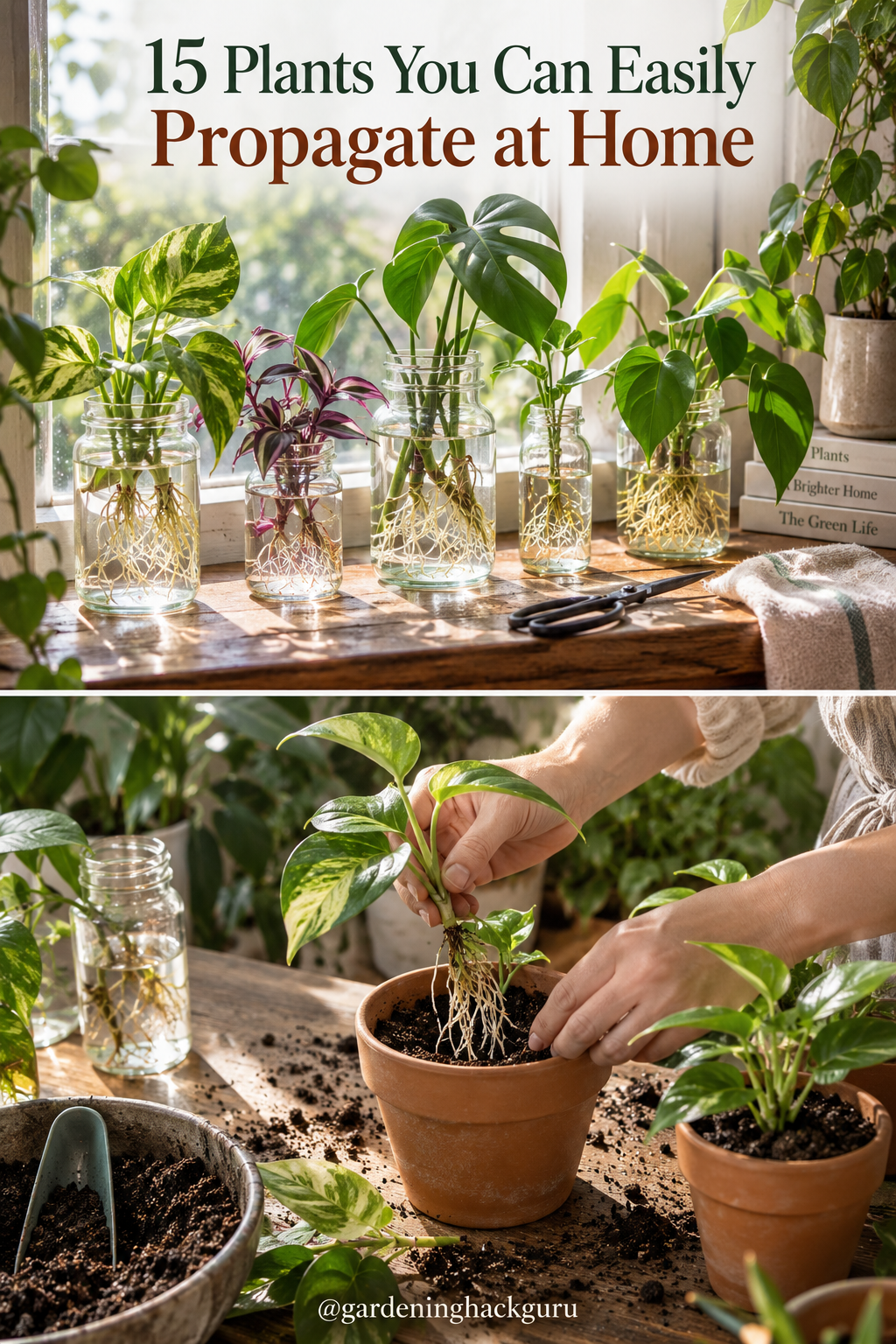
There’s something incredibly satisfying about turning one plant into two.
You take a small cutting, place it in water or soil, wait patiently, and one day you notice the first tiny white root beginning to appear. A few weeks later, that cutting that looked like nothing more than a clipped stem is becoming an entirely new plant.
That’s what makes plant propagation so addictive.
It’s also one of the easiest ways to grow your houseplant collection without constantly buying new plants. You can fill empty shelves, create new plants for different rooms, rescue an overgrown houseplant, or make thoughtful little gifts for friends.
And you don’t need a greenhouse or expensive propagation equipment to begin. For many common plants, a clean pair of scissors, a jar of water, and a bright windowsill are enough.
If you’ve never tried it before, these 15 plants you can easily propagate at home are a great place to start.
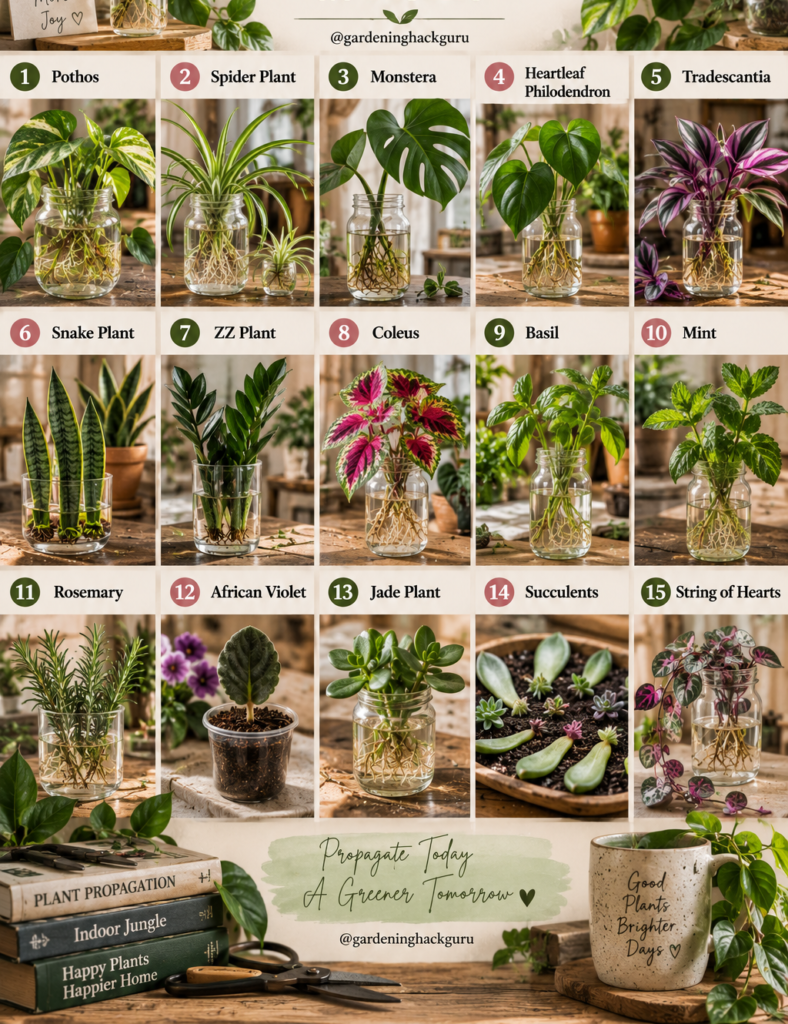
1. Pothos
If someone asked me which plant they should propagate first, I’d probably say pothos.
It’s forgiving, grows quickly under good conditions, and roots are easy to watch developing in water.
The most important thing is finding a node. Look along the vine where a leaf joins the stem. You’ll often notice a small bump or aerial root around this area.
Make your cutting below a node and remove any leaf that would otherwise sit underwater.
Place the node in clean water while keeping the leaves above the surface.
Then wait.
You may eventually notice tiny white roots emerging from the node. Once the cutting has developed a healthy root system, it can be transferred into an appropriate potting mix.
One fun idea is to take several cuttings from the same plant and eventually pot them together. This can create a fuller-looking plant instead of one lonely vine.
2. Spider Plant
Spider plants practically do part of the propagation work for you.
Healthy mature plants often produce long stems carrying little baby plants known as plantlets or spiderettes.
They look like miniature versions of the parent.
Once a plantlet has developed sufficiently, it can be separated and rooted. Some gardeners place it in water first, while others plant suitable plantlets directly into moist potting mix.
You can even leave the baby attached to the mother plant temporarily while encouraging it to root in a nearby pot.
It’s one of the most beginner-friendly ways to experience propagation because you don’t have to worry about finding the correct place to cut a long vine.
3. Monstera
Monstera propagation is easy once you understand one crucial rule:
You need a node.
A beautiful Monstera leaf by itself may survive in water for quite a while, but a leaf without the appropriate stem tissue and node won’t develop into a complete new vine.
Look for the thicker section of stem where the leaf emerges. You may also notice an aerial root nearby.
Take a clean cutting that includes a healthy node and place it in water or an appropriate propagation medium.
If using water, keep the node positioned correctly while avoiding unnecessarily submerging the foliage.
Monstera cuttings look especially beautiful in clear glass containers while their roots develop.
4. Heartleaf Philodendron
If you like pothos propagation, you’ll probably enjoy propagating heartleaf philodendron too.
Its trailing vines have easy-to-identify nodes, and stem cuttings can root readily under suitable conditions.
Take a section of healthy vine containing at least one node. Remove leaves that would sit below the waterline and place the node into water.
Keep the cutting somewhere with bright, indirect light rather than harsh direct sun.
Once you see healthy root development, move the cutting into potting mix.
Several rooted cuttings planted together can create a much fuller plant.
5. Tradescantia
Tradescantia is one of those plants that makes you feel very good at propagation.
Stem cuttings can root remarkably easily.
Take healthy pieces of stem containing nodes and place them into water or directly into suitable moist potting mix.
Because Tradescantia can become long and sparse over time, propagation is also useful for refreshing an older plant.
Trim long stems, root the healthy cuttings, and plant them back into the original pot to create denser growth.
Instead of buying another plant, you’re essentially recycling the one you already have.
6. Snake Plant
Snake plants require a little more patience, but they’re fascinating to propagate.
One option is division.
If a mature snake plant has developed multiple shoots and rhizomes, you can carefully separate suitable sections during repotting and give each division its own container.
Certain snake plants can also be propagated from leaf cuttings.
Healthy leaves can be divided into sections and rooted in an appropriate medium.
However, there’s an interesting catch: some variegated cultivars may not reproduce the same variegation when propagated through leaf cuttings.
If maintaining a particular variegated appearance matters to you, division is often the better approach.
7. ZZ Plant
ZZ plants aren’t exactly in a hurry.
That’s worth knowing before you start.
They can be propagated through division and, with patience, from suitable leaf or stem material.
Division is usually the quickest option if your established plant has multiple sections that can be safely separated.
Leaf propagation is much slower but interesting to watch.
The cutting has to develop the structures needed to support future growth, and that process can take quite a while.
So don’t throw it away because nothing dramatic happened after two weeks.
ZZ propagation is a lesson in patience.
8. Coleus
Coleus is one of my favorite plants to propagate because the results can be surprisingly quick.
Choose a healthy stem and take a cutting below a node.
Remove the lower leaves and place the stem in water, ensuring that at least one appropriate node is submerged.
Keep the cutting somewhere bright but protected from overly harsh conditions.
Once roots develop, the new plant can be transferred to potting mix.
This is especially useful at the end of the outdoor growing season. Instead of saying goodbye to a favorite coleus, you can take cuttings and potentially keep new plants growing indoors.
9. Basil
Yes, your herb garden counts too.
Basil can be propagated from healthy stem cuttings, which means one good plant can potentially give you several more.
Take a healthy non-woody stem and remove leaves from the lower section.
Place the stem in water so the bare nodes are submerged but the upper leaves remain above water.
Once a healthy root system develops, transfer it to potting mix.
This is particularly useful when you buy a basil variety you really enjoy.
Instead of immediately starting again from seed, take a few cuttings while the original plant is healthy.
10. Mint
Mint is famously enthusiastic about growing.
That’s wonderful when you’re propagating it—and sometimes less wonderful when it’s taking over a garden bed.
Take a healthy stem cutting, remove the lowest leaves, and place the stem in water with the lower nodes submerged.
Under suitable conditions, roots can develop relatively quickly.
Once established, transplant the cutting into a pot.
And that last part is worth emphasizing: a pot can be a smart choice for mint.
Many mints spread vigorously outdoors, so keeping them contained makes them much easier to manage.
11. Rosemary
Rosemary requires a little more patience than pothos or mint, but it can still be propagated at home.
Choose healthy, relatively young growth rather than an old, heavily woody stem.
Take a cutting and remove foliage from the lower section.
Rosemary cuttings are commonly rooted in a suitable propagation medium. Keep the environment appropriately moist without leaving the growing medium waterlogged.
Not every cutting will necessarily succeed, so taking several gives you better odds.
Once you learn how to propagate rosemary successfully, it’s a lovely way to create additional herb plants without repeatedly buying them.
12. African Violet
African violets show just how strange and wonderful plant propagation can be.
You don’t need an entire stem covered in leaves.
A healthy leaf with its petiole can be enough to begin the process.
Choose a healthy mature leaf—not the oldest damaged leaf and not necessarily the tiniest new one.
Remove it cleanly with a portion of the leaf stalk attached.
The cutting can then be rooted using an appropriate African violet propagation method, commonly in a light growing medium.
Eventually, tiny new plantlets may begin appearing around the base.
It isn’t instant, but watching a cluster of baby plants emerge from one leaf is incredibly rewarding.
13. Jade Plant
Jade plants are another wonderful option for beginners.
They can be propagated from healthy stem cuttings and, under suitable conditions, individual leaves.
With succulent-type plants, it’s often important to allow a fresh cut surface to dry and callus appropriately before placing it into a suitable well-draining growing medium.
This helps reduce problems associated with excessive moisture.
Once planted, resist the temptation to keep the soil constantly wet.
Jade plants store moisture in their leaves and stems, so they don’t need the same watering routine as a tropical pothos cutting.
Propagation is much easier when you treat the plant according to what it actually is rather than giving every cutting identical care.
14. Succulents
“Succulent” covers an enormous range of plants, so there isn’t one propagation method that works for every species.
But many popular succulents can be propagated through offsets, stem cuttings, or leaves.
For species that propagate from leaves, remove a healthy intact leaf carefully and allow the wound to callus appropriately.
Eventually, under the right conditions, roots and tiny new growth may develop.
Other succulents produce offsets around the mother plant that can eventually be separated.
Before propagating a particular succulent, identify what you have. Some varieties propagate wonderfully from leaves, while others don’t.
That small bit of research can save a lot of waiting for a leaf that was never going to produce a new plant.
15. String of Hearts
String of Hearts looks delicate, but it gives you several interesting propagation possibilities.
Healthy vines containing nodes can be propagated using suitable methods, including rooting stem sections.
You can also encourage nodes to contact an appropriate growing medium while parts of the vine remain attached to the parent plant. Once those sections establish roots, they can eventually be separated.
This can be particularly useful if your plant has become long but looks thin near the top.
Instead of simply cutting everything away, propagation can help you create additional growth and eventually make the pot look fuller.
Water Propagation or Soil Propagation?
This is probably the biggest question beginners have.
And the answer is:
It depends on the plant.
Water propagation is popular because it’s incredibly satisfying. You can see exactly what’s happening.
You notice the first tiny root.
You can see whether the stem is healthy.
And let’s be honest—a row of glass propagation jars filled with cuttings looks beautiful on a sunny shelf.
But water isn’t automatically the best method for every plant.
Some plants establish very well directly in an appropriate growing medium. Succulents have completely different moisture requirements from tropical vines. Woody herbs may respond differently again.
Instead of trying to propagate all 15 plants in identical jars, learn the preferred method for the particular species you’re working with.
How to Take a Good Plant Cutting
Most propagation failures begin before the cutting ever reaches the jar.
Start with a healthy parent plant.
Avoid taking material from a plant that’s severely stressed, diseased, or heavily infested with pests.
Use clean, sharp scissors or pruning shears.
For plants propagated from stem cuttings, identify where the nodes are before making the cut.
And don’t make enormous cuttings simply because you think bigger means better.
A cutting has to support its leaves while developing new roots. A manageable section of healthy growth is often easier to work with.
Don’t Forget About Clean Water
If you’re propagating plants in water, don’t fill a jar once and forget about it for two months.
Keep an eye on the water.
Top it up as needed and refresh it periodically if it becomes cloudy, develops an unpleasant smell, or accumulates debris.
Make sure leaves aren’t decomposing below the waterline.
Clean containers also make it easier to monitor root development.
You don’t need a laboratory-perfect setup. You just want to avoid turning your beautiful propagation station into stagnant green soup.
Give Cuttings Light—But Be Careful With Direct Sun
Cuttings still need light.
A dark corner simply because it looks pretty isn’t necessarily a good propagation location.
For many common houseplant cuttings, bright, indirect light is a good starting point.
A bright window can work beautifully, but intense direct sun through glass may overheat containers or stress delicate foliage.
Watch the plant rather than blindly following a rule.
If foliage is scorching, wilting excessively, or otherwise struggling, adjust the conditions.
When Should You Move Water-Rooted Cuttings Into Soil?
There’s no magical root length that works for every plant.
You don’t necessarily need to wait until the jar contains a giant tangled mass of roots.
Once a cutting has developed a healthy, established root system appropriate for that plant, it can generally begin transitioning to potting mix.
When you do pot it up, be gentle with the roots.
Use an appropriately sized container rather than placing a tiny cutting into an enormous pot full of wet soil.
And remember that roots formed in water are suddenly adapting to a very different environment.
Give the newly potted plant time.
Why Do Some Cuttings Rot?
Sometimes propagation doesn’t work.
You take the perfect-looking cutting, place it carefully in water, and instead of producing roots, the stem turns brown and mushy.
It happens.
Possible problems include damaged or unhealthy starting material, contaminated tools or containers, incorrect moisture conditions, decomposing submerged leaves, inappropriate temperatures, or simply a cutting that wasn’t suitable for the method you chose.
If rot begins spreading through a stem, remove the affected tissue with clean tools if enough healthy material remains to try again.
And don’t let one failed cutting convince you that you’re terrible at plants.
Even experienced gardeners lose cuttings.
That’s part of propagation.
Create a Simple Propagation Station at Home
You don’t need to buy a fancy wooden propagation stand.
Start with what you already have.
Small glass jars, old spice jars, narrow bottles, and other clean containers can work beautifully for suitable water-propagated plants.
Place several together on a bright shelf or windowsill and suddenly you’ve created a tiny indoor nursery.
I actually prefer mismatched glass containers.
They make a propagation corner feel like something that naturally evolved as you collected cuttings rather than a perfectly styled display purchased in one afternoon.
Add a small pair of pruning scissors nearby, a few terracotta pots, and perhaps a watering can.
Functional can still be beautiful.
Turn One Plant Into a Fuller Plant
Propagation isn’t only about creating additional pots.
It’s also one of the best tricks for making trailing houseplants look fuller.
Take pothos as an example.
If you have one long vine with leaves spaced far apart, trimming it can encourage new growth on the parent plant.
Then you can propagate the healthy pieces you removed.
Once those cuttings establish roots, plant several back into the original container.
Instead of owning five separate tiny pothos plants, you can use propagation to create one lush, full-looking plant.
The same general idea can work beautifully with other suitable trailing plants.
Share Your Propagated Plants
One of the nicest things about propagation is that plants become easy to share.
A rooted pothos cutting in a small terracotta pot makes a lovely housewarming gift.
A cutting from your grandmother’s plant can be passed through another generation.
Friends can trade varieties without everyone having to buy another mature plant.
Over time, your collection begins telling stories.
“This came from my friend’s plant.”
“I propagated this from the first houseplant I ever bought.”
“This was one tiny cutting three years ago.”
That’s much more interesting than simply filling a shopping cart at a nursery.
Start With the Easiest Plants
If you’re completely new to propagation, don’t begin with the most expensive rare plant in your collection.
Practice first.
Take a few pothos cuttings.
Try mint.
Propagate some Tradescantia.
Watch how nodes produce roots and learn what healthy root development looks like.
Once you understand the basics, you’ll feel much more confident experimenting with plants that require more patience.
And before long, you’ll probably find yourself saving every empty glass jar because:
“That would be perfect for a cutting.”
That’s usually how it starts.
One pothos cutting becomes three.
Three become ten.
Then suddenly every windowsill has a jar containing something with roots.
But that’s the beauty of plant propagation.
You don’t need a large budget or an enormous garden to grow more plants. Sometimes all you need is one healthy plant, one small cutting, and enough patience to let nature do the rest. 🌿