
There’s something about a staircase filled with greenery that instantly changes the mood of a home.
A staircase is usually treated as a practical feature—we walk up, walk down, and perhaps hang a few family photos along the wall. But with the right plants, this everyday space can become one of the most beautiful parts of the house.
Imagine sunlight coming through a nearby window, trailing vines spilling gently from above, a few leafy plants tucked onto a wide landing, and one gorgeous statement plant greeting you at the bottom of the stairs. Suddenly, an ordinary staircase feels like a tiny indoor garden.
And you don’t need dozens of houseplants to create the effect.
Whether you have a large open staircase or just a small landing that needs some life, here are 12 staircase plant ideas that can make your home feel warmer, greener, and just a little magical.
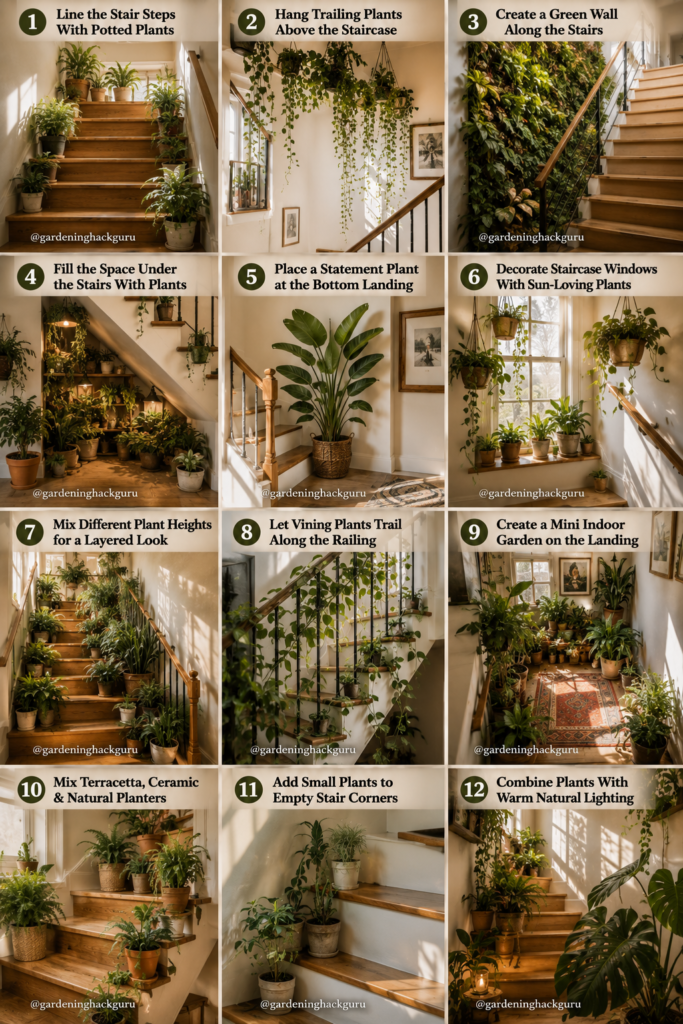
1. Line the Stair Steps With Potted Plants
One of the prettiest staircase plant ideas is also one of the simplest: arrange a few potted plants along the steps.
The key word here is a few.
You don’t want every stair covered with pots. Apart from looking cluttered, that could create a tripping hazard. Instead, this works best on unusually wide staircases where plants can sit completely outside the walking path.
Choose several plants in different sizes rather than repeating identical pots.
A small fern might sit near the bottom, followed by a slightly taller leafy plant several steps above. The uneven placement makes everything feel relaxed and natural.
If your staircase is narrow or busy, skip the actual steps and create the same look on the landing instead.
2. Hang Trailing Plants Above the Staircase
If you don’t have much floor space, look up.
Hanging plants are fantastic around staircases because stairwells often have more vertical space than other parts of the home.
Trailing pothos, heartleaf philodendron, spider plants, and other suitable cascading houseplants can create beautiful movement overhead.
Rather than hanging everything at exactly the same height, vary the positions slightly.
One vine might fall a little farther than another, creating that lush indoor-jungle feeling without taking up valuable walking space.
Just make sure hanging planters are securely installed and positioned where nobody will walk into them.
3. Create a Green Wall Along the Stairs
A large blank staircase wall is basically waiting to become something interesting.
Instead of filling it entirely with artwork, consider adding greenery.
You could use wall-mounted planters, small plant shelves, or a carefully designed vertical planting system.
The effect can be dramatic even with relatively few plants.
Imagine warm white walls with several leafy plants appearing at different heights as you move upstairs.
If you’re using wall-mounted planters, think carefully about watering. You don’t want water dripping down a freshly painted wall every Tuesday morning.
Removable pots inside decorative holders can make maintenance much easier.
4. Fill the Space Under the Stairs With Plants
That awkward space underneath a staircase can become a surprisingly beautiful indoor garden.
Instead of trying to squeeze furniture into it, create a layered plant display.
Place taller plants toward the back and smaller plants toward the front. Mix broad leaves with finer foliage so the arrangement doesn’t look like one solid block of green.
You might combine a palm or another suitable taller houseplant with ferns, philodendrons, and smaller foliage plants.
But first, check the light.
Under-stair areas can be quite dark, and “low-light tolerant” doesn’t mean “doesn’t need light.”
If the area receives very little natural light, choose plants accordingly and consider whether supplemental grow lighting would be appropriate.
5. Place a Statement Plant at the Bottom Landing
Sometimes one great plant is more effective than fifteen little ones.
If you want a clean, uncluttered staircase, place a large statement houseplant near the bottom.
A fiddle-leaf fig, monstera, rubber plant, bird of paradise, or another appropriately sized plant can instantly soften all the hard lines created by stairs and railings.
Choose the plant based on the actual light available rather than appearance alone.
Then give it a planter that feels substantial enough for the space.
A large warm ceramic pot, textured stone-look planter, or simple natural basket can make the entire corner feel intentional.
6. Decorate Staircase Windows With Sun-Loving Plants
If your staircase has a large window, you’ve already got one of the best ingredients for beautiful plant styling.
Use that natural light.
Depending on the direction and intensity of the sunlight, you may be able to grow plants that wouldn’t be happy in darker areas of your home.
Arrange plants around the window rather than completely blocking it.
You still want light entering the stairwell.
A combination of plants on the sill, floor, and nearby landing can create layers of greenery while allowing sunlight to filter through the leaves.
The resulting shadows on the wall can be just as beautiful as the plants themselves.
7. Mix Different Plant Heights for a Layered Look
One mistake that can make an indoor plant display look strangely flat is keeping everything at approximately the same height.
Nature doesn’t work like that.
Mix tall plants, medium plants, small plants, and trailing plants.
For example, place a tall leafy plant on the floor, a medium fern on a plant stand, and a small trailing plant on a nearby shelf.
Your eye naturally moves through the different levels.
You can also use planters and stands to create height without needing every plant to grow tall.
This is especially useful when decorating staircase landings.
8. Let Vining Plants Trail Along the Staircase
A little trailing greenery can make a staircase feel wonderfully romantic.
Pothos and certain philodendrons are popular for this kind of look because their vines can become long and flowing under suitable growing conditions.
But don’t wrap plants tightly around functional handrails.
Railings need to remain easy to grip, and stairs need to stay safe.
Instead, allow vines to cascade from nearby shelves, wall planters, or hanging pots so they visually follow the staircase without interfering with it.
The goal is “secret indoor garden,” not “fight through the jungle to reach the bedroom.”
9. Create a Mini Indoor Garden on the Landing
If your staircase has a generous landing, you’ve found the perfect location for a little plant corner.
Start with one larger plant.
Add two or three medium plants.
Finish with a smaller trailing or flowering plant if conditions allow.
That’s often enough.
A landing garden looks especially beautiful near a window because the plants can receive useful natural light while creating a peaceful transition between floors.
You could even add a small wooden stool or vintage plant stand to give one pot extra height.
Keep the main walking route completely clear.
10. Mix Terracotta, Ceramic & Natural Planters
Plants are only half of the look.
The pots matter too.
Instead of buying ten identical containers, mix materials that share a similar natural feeling.
Try combining:
- warm terracotta
- cream ceramic
- aged stone finishes
- neutral textured pots
- simple woven baskets used appropriately around inner pots
Keeping the overall palette earthy prevents the arrangement from feeling chaotic even when the pots don’t match.
Personally, I love slightly aged terracotta around staircases. A little variation and weathering makes the whole display feel collected over time rather than purchased in one afternoon.
11. Add Small Plants to Empty Stair Corners
Not every staircase needs to become an indoor jungle.
Sometimes there is simply an empty corner that looks unfinished.
Add one plant.
That’s it.
A fern on a landing, a small leafy plant beside a window, or a compact plant on a safe shelf can be enough to bring the area to life.
This approach works particularly well in minimalist homes where you want greenery without visual clutter.
Think of plants as punctuation.
You don’t need one after every word.
12. Combine Plants With Warm Natural Lighting
Plants look their best when light becomes part of the design.
If your staircase receives beautiful morning or afternoon sunlight, arrange your greenery so that light can move through the leaves.
You’ll get gorgeous shadows across the walls, steps, and railings.
For evenings, warm ambient lighting can keep the staircase feeling cozy.
The important distinction is that decorative lighting and plant-growing light aren’t necessarily the same thing. If your plants don’t receive enough natural light, ordinary ceiling lights won’t automatically provide what they need.
Design for beauty, but grow plants according to their actual requirements.
How to Keep Staircase Plants Looking Beautiful
Creating a plant-filled staircase is the fun part.
Keeping it looking good requires a little planning.
Start by choosing plants for the conditions you actually have.
Watch how sunlight moves through the staircase during the day. A bright stairwell beside a large south- or west-facing window can behave very differently from an enclosed staircase in the center of a house.
Also consider temperature.
Some stairwells can become noticeably warmer upstairs, while plants positioned beside drafty windows may experience cooler conditions.
Then think about watering.
Carrying dripping plants up and down stairs isn’t particularly enjoyable. Use appropriate saucers or cachepots, and protect wooden surfaces from moisture.
For hanging plants, consider how you’ll safely reach them before installing them.
If watering a planter requires balancing on the third stair while holding a watering can above your head, you’ve probably chosen the wrong location.
Don’t Overcrowd the Staircase
This is probably the most important design rule.
Pinterest can make us believe that more plants automatically means a prettier room.
Not necessarily.
Allow some empty space between your plants.
Let the staircase itself remain visible.
If you have beautiful wooden steps, show them.
If sunlight creates interesting shadows on a cream wall, don’t cover the entire wall.
Plants usually look more special when each one has a little breathing room.
And, most importantly, never sacrifice staircase safety for decoration. Walking surfaces, handrails, entrances, and landings should remain clear and easy to use.
Choose Plants for Your Home, Not the Photograph
It’s easy to see a beautiful staircase online and think, “I need exactly those plants.”
But that staircase might receive six hours of bright natural light while yours receives very little.
The best staircase plant is one that can actually thrive in your staircase.
Before buying anything, consider the available light, temperature, humidity, space, mature plant size, and how easily you’ll be able to care for it.
A healthy, modest plant will always look better than an impressive plant slowly struggling in the wrong location.
Let Your Staircase Garden Grow Slowly
You don’t need to finish the entire look in one weekend.
Start with a large plant at the bottom.
Live with it for a while.
Then perhaps add a trailing plant near the landing.
Later, find the perfect terracotta pot for that empty corner.
Maybe a vine eventually becomes long enough to cascade beautifully beside the stairs.
That’s how the most interesting indoor gardens tend to develop—one plant at a time.
Eventually, the staircase starts to feel less like a passage between two floors and more like a little journey through greenery.
Morning sunlight filters through the leaves. Vines soften the railings. Plants fill those awkward corners that never quite looked finished before.
And suddenly, walking upstairs feels a little different.
A little warmer.
A little greener.
And, yes, maybe even a little magical. 🌿🪴