Green will always be beautiful, but there’s something about discovering a plant with splashes of blush, bubblegum pink, cream, and deep burgundy that makes you stop and look twice.
Pink houseplants can almost seem unreal.
Some have tiny freckles of color scattered across their leaves. Others produce dramatic blocks of pink variegation, while a few combine green, cream, silver, and rose tones on the same plant.
And that’s exactly what makes collecting them so much fun.
But there’s one thing worth knowing before you start hunting for every pink plant you see online: pink doesn’t always mean rare, and some plants sold with exciting names aren’t as unusual—or as permanently pink—as marketing makes them sound.
So rather than simply chasing the pinkest photograph on Pinterest, it’s worth learning what each plant actually looks like and what it needs to stay beautiful.
If you’re ready to bring something different into your indoor garden, here are 12 beautiful pink houseplants to consider adding to your plant collection.
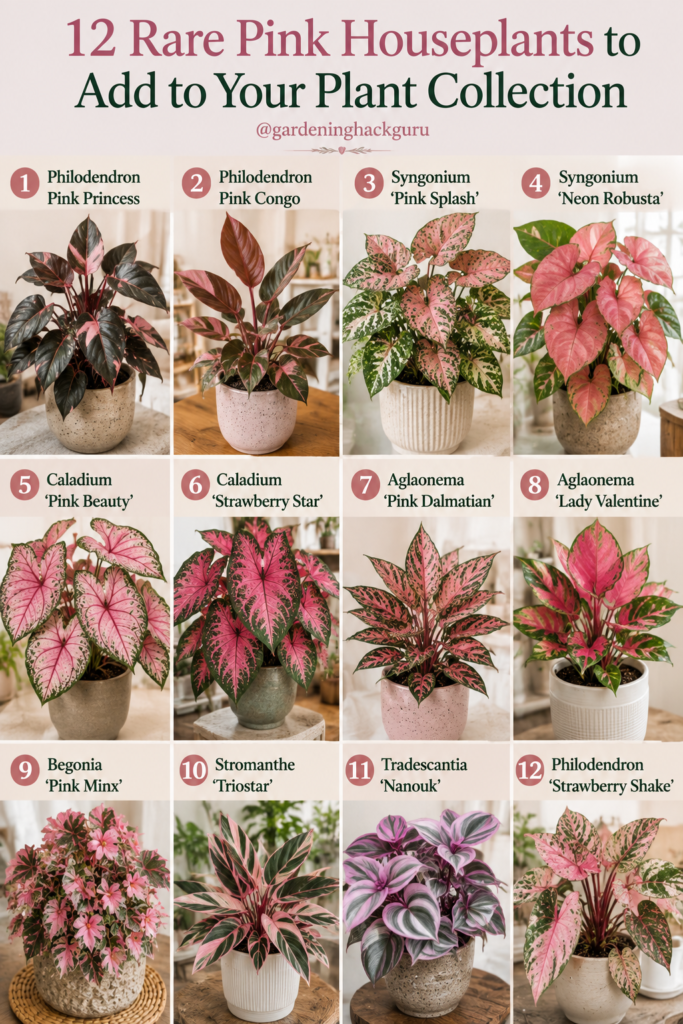
1. Philodendron ‘Pink Princess’
Let’s start with probably the most famous pink houseplant of them all.
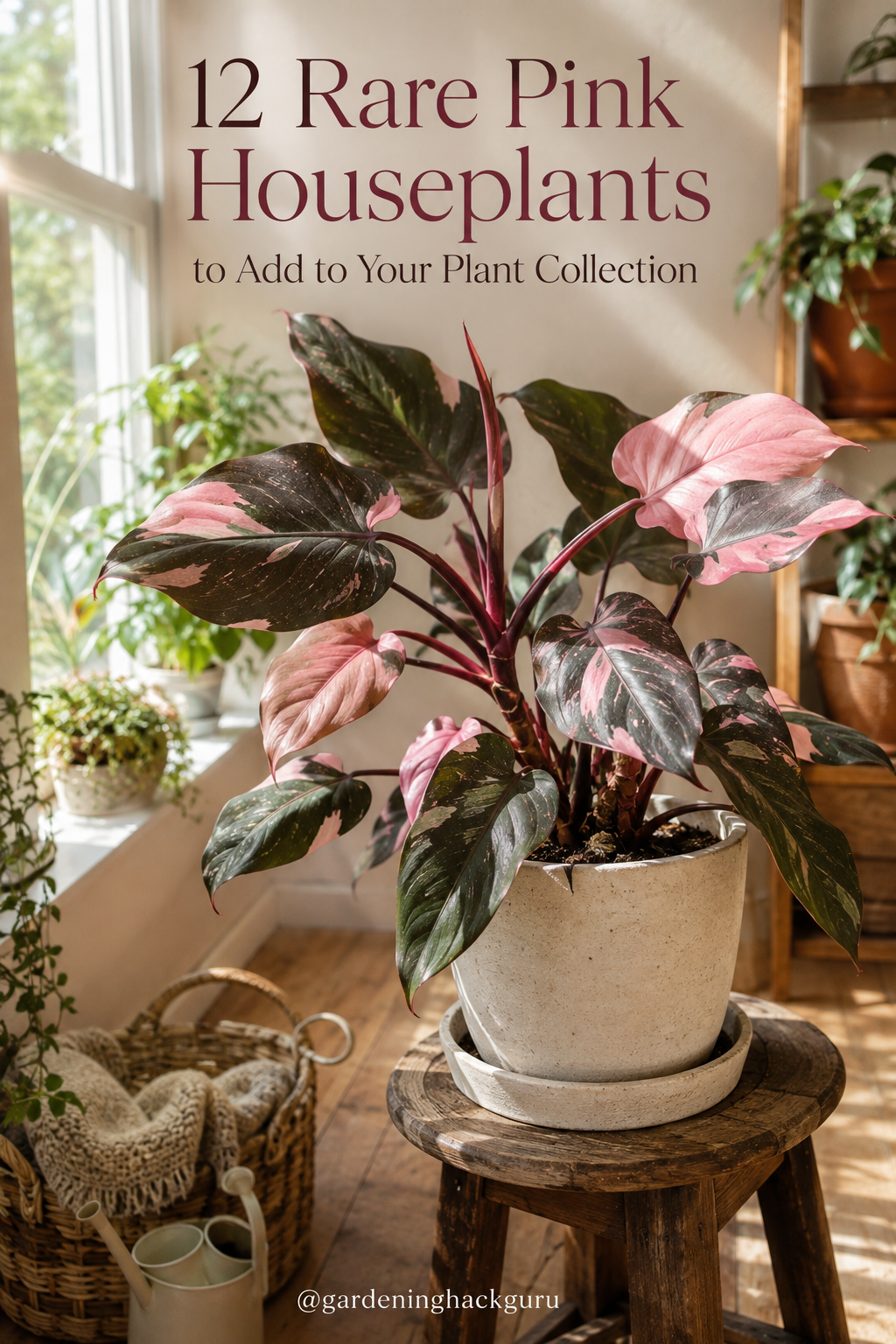
Philodendron ‘Pink Princess’ became a collector favorite because of its incredible contrast. Its dark green to burgundy leaves can develop irregular splashes, streaks, and larger sections of pink variegation.
And that’s part of the appeal—you never quite know what the next leaf will look like.
One might have a tiny pink splash.
The next could emerge with a dramatic section of pink.
Give Pink Princess plenty of bright, indirect light to support healthy growth and attractive coloration, while protecting it from harsh conditions that can scorch the foliage.
It also appreciates an airy, well-draining growing medium rather than constantly wet soil.
Don’t expect every leaf to be half pink. Natural variation is part of what makes this plant interesting.
2. Philodendron ‘Pink Congo’
This one comes with an important story.
You may have seen Pink Congo philodendrons online with unbelievably bright bubblegum-pink foliage.
Unlike stable naturally pink-variegated cultivars, the intense pink coloration associated with commercially sold Pink Congo plants has been produced through treatment and is temporary.
As the plant continues growing, new foliage eventually returns toward green.
That doesn’t necessarily mean you can’t enjoy one if you encounter it, but you should know what you’re buying—especially if someone is charging a premium price because they claim the plant will stay permanently pink.
For collectors, this is a perfect reminder to research unusual plants before paying “rare plant” prices.
3. Syngonium ‘Pink Splash’
If you like plants that look slightly different every time a new leaf opens, Syngonium ‘Pink Splash’ is gorgeous.
Its arrow-shaped leaves typically combine green with irregular pink splashes and mottling.
Some leaves may contain a lot of pink.
Others might remain predominantly green.
That randomness gives the plant a beautifully artistic appearance.
As it matures, Syngonium can develop a climbing habit, so you can either keep it compact through pruning or allow it to climb an appropriate support.
Bright, indirect light and sensible watering generally help keep it growing well.
4. Syngonium ‘Neon Robusta’
Not every pink plant needs dramatic variegation.
Syngonium ‘Neon Robusta’ offers something softer.
Its foliage can have beautiful rosy, dusty-pink, or pinkish-green tones that create a much gentler look than the high-contrast Pink Splash.
I particularly like this plant in neutral ceramic pots because the soft leaf color becomes the focus.
It’s also a lovely choice if you want to introduce pink into an indoor plant collection without making the entire room feel overly colorful.
Place it somewhere with appropriate bright, indirect light and avoid allowing the potting mix to remain permanently saturated.
5. Caladium ‘Pink Beauty’
If your goal is dramatic foliage, caladiums are hard to beat.
Caladium ‘Pink Beauty’ can produce thin, almost paper-like leaves with combinations of pink, green, and contrasting veins.
It’s the sort of plant that looks like someone painted the foliage by hand.
Caladium care is a little different from keeping a typical philodendron on the same shelf year after year.
Many caladiums grow from tubers and naturally enter dormancy, particularly as conditions change.
So if the foliage eventually declines at the end of its growing cycle, don’t immediately assume you’ve killed the plant.
Understanding its natural growth pattern makes keeping it much less confusing.
6. Caladium ‘Strawberry Star’
For a lighter, more delicate look, Caladium ‘Strawberry Star’ is beautiful.
Its leaves can appear predominantly pale or creamy, with green edging and pink to reddish speckling or veining.
Placed among darker green houseplants, it immediately stands out.
The light foliage also makes it particularly attractive in a bright, airy room with natural wood and neutral planters.
As with other caladiums, remember that dormancy can be part of the plant’s normal life cycle.
It’s not necessarily a plant that will maintain identical foliage twelve months of the year.
7. Aglaonema ‘Pink Dalmatian’
If you prefer pink that looks like someone scattered paint across the leaves, Aglaonema ‘Pink Dalmatian’ is worth a look.
The green foliage develops pink spots and speckles, giving each leaf its own pattern.
The result is colorful without being overwhelming.
Aglaonemas are popular indoor plants partly because many varieties can adapt to typical household conditions, though brighter indirect light can help colorful cultivars show their best coloration.
Avoid treating “tolerates lower light” as “wants to live in a dark room.”
There’s a difference between surviving and thriving.
8. Aglaonema ‘Lady Valentine’
Aglaonema ‘Lady Valentine’ turns the pink level up considerably.
Depending on the plant and growing conditions, leaves can display generous areas of bright pink surrounded by green margins and speckling.
It’s an excellent statement plant.
You could place one on a wooden side table or plant stand and barely need anything else around it.
The foliage already provides plenty of color.
Keep it in appropriate indirect light, avoid extreme temperature changes, and don’t let the roots sit continuously in soggy potting mix.
One healthy Lady Valentine can bring as much visual interest as an entire shelf of smaller plants.
9. Begonia ‘Pink Minx’
Begonias are dangerous for plant collectors.
You buy one because the leaves are interesting.
Then you discover another with silver markings.
Then one with pink.
Then suddenly you have a begonia shelf.
A plant sold as Begonia ‘Pink Minx’ can bring beautiful pink-toned foliage into a collection, but begonias deserve a little more attention than some easy-going houseplants.
They often appreciate good humidity and appropriate moisture while still needing airflow and a growing medium that doesn’t remain waterlogged.
Avoid keeping foliage unnecessarily wet for long periods.
And because begonia cultivar names can sometimes vary among sellers, buy from a reputable nursery when you’re looking for a specific named plant.
10. Stromanthe ‘Triostar’
This might be one of the most beautiful plants on the entire list.
Stromanthe ‘Triostar’ combines green, cream, and pink tones, often with rich pinkish or burgundy coloring underneath the leaves.
When sunlight gently illuminates the foliage, the colors can look incredible.
But Triostar isn’t necessarily the plant I’d choose if you want something completely carefree.
It can be sensitive to inconsistent watering, dry indoor conditions, poor water quality, and other environmental stress.
Brown leaf edges aren’t unusual when conditions aren’t ideal.
Still, when it’s happy, very few indoor foliage plants have the same soft, watercolor-like appearance.
11. Tradescantia ‘Nanouk’
For something trailing, Tradescantia ‘Nanouk’ is a lovely change from all the upright plants on this list.
Its striped leaves combine green, cream, and pinkish-purple tones, while the undersides can add even more color.
Place it in a hanging planter or near the edge of a shelf and allow the stems to cascade naturally.
Good light helps maintain compact, colorful growth.
If stems become overly long or sparse, pruning can encourage a fuller appearance, and healthy cuttings can often be propagated.
That makes Nanouk especially fun if you enjoy turning one plant into several.
12. Philodendron ‘Strawberry Shake’
Now we’re getting into serious collector territory.
Philodendron ‘Strawberry Shake’ is loved for its unpredictable variegation, which can include shades of cream, yellow, peach, orange-pink, green, and reddish tones.
No two leaves necessarily look alike.
And that’s precisely the attraction.
A beautifully variegated Strawberry Shake can become the centerpiece of an entire houseplant collection.
Like other variegated philodendrons, it needs enough light to support healthy growth without exposing delicate variegated sections to overly harsh conditions.
If you’re buying an expensive specimen, look carefully at the whole plant rather than judging it from one spectacular leaf.
Are Rare Pink Houseplants Actually Rare?
This is where plant collecting gets interesting.
The word “rare” is used very loosely online.
A plant may genuinely be difficult to find in one country while being widely propagated and readily available somewhere else.
And plants that once sold for enormous prices can become much more affordable once commercial growers begin producing them at scale.
Pink Princess is a good example of how quickly availability can change.
So don’t assume that a high price automatically means a plant is genuinely rare.
Before buying, check several reputable nurseries, research the cultivar, and compare prices.
Sometimes you’re paying for scarcity.
Sometimes you’re paying for hype.
How to Keep Pink Houseplants Colorful
Here’s the question everyone eventually asks:
How do I make my plant more pink?
The answer depends entirely on the plant.
For naturally variegated plants, appropriate light can help support good growth and maintain attractive coloration. Too little light may contribute to less impressive growth in some cultivars.
But you can’t simply put a plant in intense sunlight and force it to become pink.
In fact, delicate variegated sections often contain less chlorophyll and can be more vulnerable to damage.
The goal is healthy growth—not maximum pink at any cost.
And don’t believe strange internet hacks suggesting you can turn ordinary green houseplants permanently pink by watering them with random household ingredients.
Plant genetics don’t work that way.
Don’t Buy a Plant Based on One Leaf
This is especially important when shopping for expensive variegated plants.
A seller shows you one incredible leaf that’s almost entirely pink.
It looks amazing.
But look at the rest of the plant.
Excessively pink or white foliage isn’t necessarily better because those areas contain less chlorophyll. A plant needs enough functional green tissue to photosynthesize effectively.
Also inspect the stem and growth points when evaluating variegated plants.
One beautiful leaf doesn’t guarantee every future leaf will look the same.
Buy the whole plant, not the Instagram moment.
How to Style Pink Plants at Home
Pink houseplants already have plenty of personality, so I wouldn’t surround them with too much colorful decor.
Let the foliage do the work.
I love pink plants paired with:
- warm natural wood
- aged terracotta
- cream ceramic planters
- woven baskets
- soft beige walls
- simple wooden plant stands
- ordinary green houseplants
The surrounding green actually makes the pink stand out more.
Try placing one colorful plant among three or four predominantly green varieties rather than creating an entire shelf where every leaf is competing for attention.
Start Your Pink Plant Collection Slowly
It’s very easy to look at a list like this and suddenly decide you need all 12 plants.
You don’t.
Choose one.
Learn what conditions it prefers.
See how it responds to the light and humidity in your home.
Then add another.
Over time, you’ll discover whether you enjoy philodendrons, begonias, caladiums, aglaonemas, or perhaps something completely different.
The best plant collections rarely look like somebody ordered the entire inventory of a nursery in one afternoon.
They grow gradually.
One cutting from a friend.
One plant you searched months to find.
One unexpected nursery discovery.
One plant you nearly lost and somehow brought back.
That’s what gives a collection personality.
A Final Note About Pets
If you share your home with cats, dogs, or young children, research each plant individually before bringing it home.
Several popular houseplants—including many philodendrons, syngoniums, and aglaonemas—shouldn’t be treated as edible or assumed to be pet-safe.
Placement matters, but knowing exactly what you’re growing matters more.
A beautiful plant collection should work safely with the household living around it.
Final Thoughts
Pink houseplants prove that an indoor garden doesn’t have to be fifty shades of green.
There can be burgundy.
Cream.
Peach.
Blush.
Hot pink.
Soft rose.
And sometimes all of them appear on one leaf.
Whether you start with the dramatic Philodendron ‘Pink Princess’, the speckled Aglaonema ‘Pink Dalmatian’, the soft colors of Stromanthe ‘Triostar’, or a collector plant such as Philodendron ‘Strawberry Shake’, choose plants because you genuinely enjoy them—not simply because they’re currently labeled rare.
Give them appropriate light.
Learn how they like to be watered.
Let their leaves be imperfect.
And most importantly, give your collection time to grow.
Because the best part of owning a rare pink houseplant isn’t the photograph you take the day you buy it.
It’s waiting for that next leaf to unfurl and discovering what colors it decided to make this time. 🌿🌸