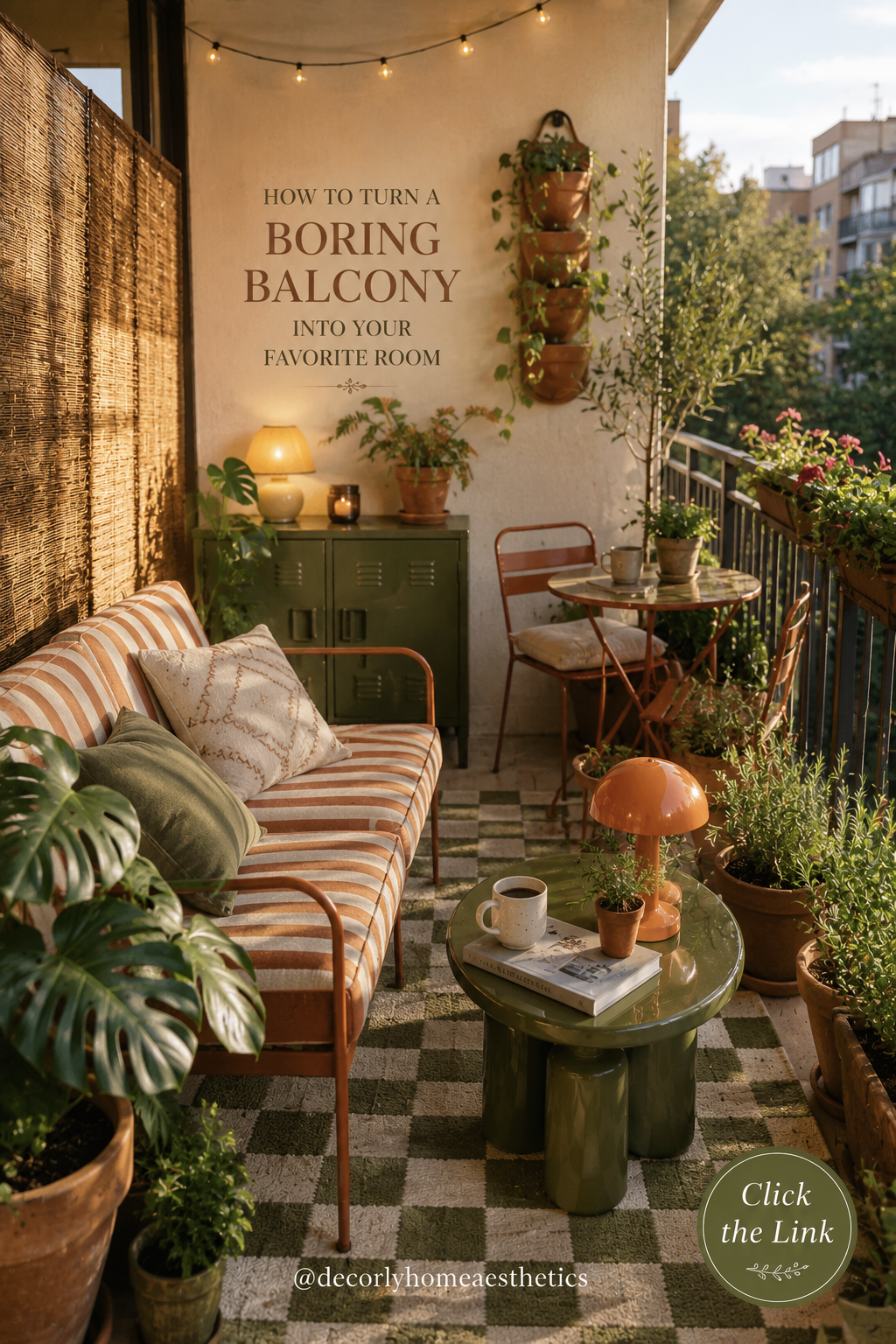
A balcony can be one of the nicest spaces in an apartment, yet somehow it often ends up being the most ignored.
Maybe there’s one lonely chair out there. A couple of plant pots you keep meaning to repot. Possibly a drying rack. And despite having this little patch of outdoor space, you rarely actually sit there.
I think the problem is that we tend to decorate balconies as balconies instead of treating them like rooms.
The moment you start thinking of your balcony as a tiny outdoor living room, everything changes.
You start thinking about what goes underfoot. Where you’ll put your coffee. Whether the chair is comfortable enough to sit in for an hour. What the lighting feels like after sunset. And whether there’s anything out there that actually makes you happy when you open the door.
And you don’t need a huge terrace to do it.
Even a narrow apartment balcony can become somewhere you genuinely look forward to spending time.
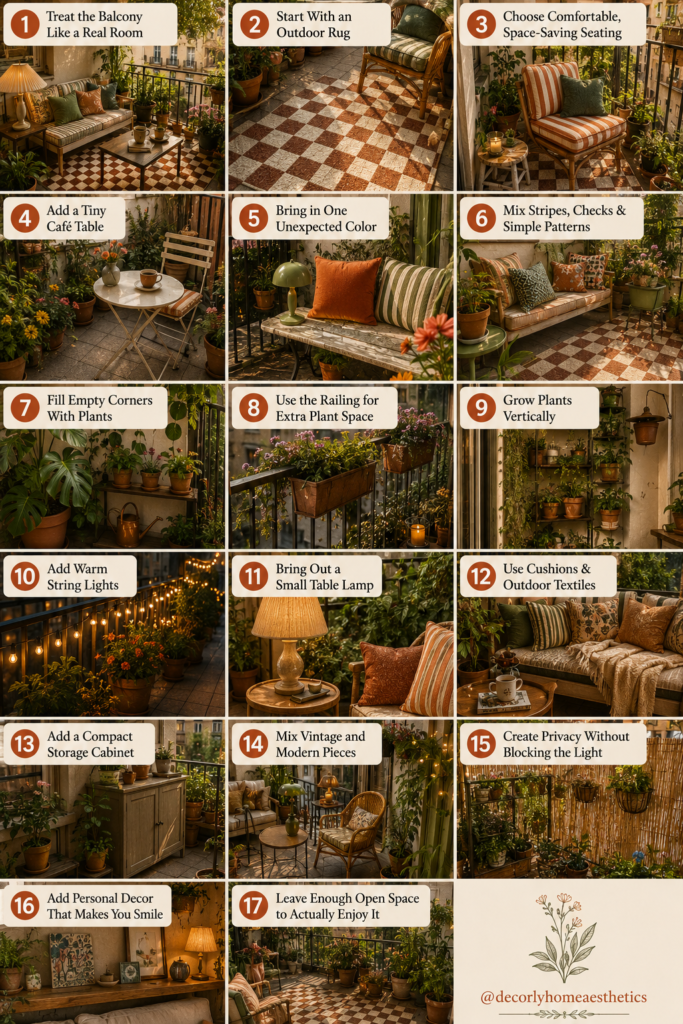
Here are 17 ways to turn a boring balcony into your favorite room in the house.
1. Treat the Balcony Like a Real Room
Before buying anything, decide what you actually want to do on your balcony.
Do you imagine drinking coffee there in the morning?
Reading after work?
Having dinner with someone?
Growing herbs?
Sitting outside with a glass of something cold on summer evenings?
Your answer should shape the space.
If you mostly want somewhere to relax, prioritize a comfortable chair or small loveseat instead of filling the balcony with a dining set.
If you love eating outside, a tiny café table may be much more useful.
Trying to make one small balcony do six different jobs usually results in a cluttered space that doesn’t do any of them particularly well.
Pick its main purpose first.
Then decorate around it.
2. Start With an Outdoor Rug
If I could add only one decorative piece to a plain balcony, it might be a rug.
Concrete or basic outdoor tile immediately makes a balcony feel utilitarian. Cover part of it with a rug and suddenly the space begins feeling like a room.
And this is a great place to have a little fun.
A checkerboard pattern like the one in the inspiration image can completely transform the space. Stripes, subtle geometrics, faded vintage-style patterns and simple woven textures work beautifully too.
Choose an outdoor-rated material that can handle your local weather.
And make sure the rug is large enough.
A tiny rug floating underneath one chair usually makes the balcony feel smaller. Ideally, at least the front legs of your main seating should sit on it.
3. Choose Comfortable, Space-Saving Seating
Small balconies need furniture that earns its place.
That doesn’t mean choosing the smallest chair you can find.
If it’s uncomfortable, you won’t use it.
A compact loveseat can sometimes work better than two separate lounge chairs because it creates a proper place to stretch out without scattering furniture across the balcony.
For narrower spaces, consider a slim bench, folding chairs, or one genuinely comfortable lounge chair.
Look at depth as well as width when measuring furniture. A sofa that’s technically short enough may still project so far into the balcony that you can barely walk past it.
And always measure before buying.
Balcony furniture looks much smaller in a showroom than it does once you’re trying to squeeze around it with a cup of coffee.
4. Add a Tiny Café Table
There’s something about a little round table on a balcony that instantly makes the space feel more usable.
Suddenly you have somewhere for coffee, breakfast, a book, or dinner for two.
Round tables are particularly useful in small spaces because there are no sharp corners sticking into your walking path.
If space is extremely limited, try a folding table or one that attaches to the railing.
You don’t need a full outdoor dining set.
Sometimes a small café table and two slim chairs are exactly enough.
5. Bring in One Unexpected Color
Balconies are a wonderful place to be slightly braver with color than you might be indoors.
In the inspiration for this article, that burnt orange immediately gives the space personality.
You could do something similar with rust, mustard, olive green, deep blue, burgundy, or terracotta.
The trick is choosing one stronger color and repeating it a few times rather than introducing every color you like.
For example, burnt orange might appear on a chair frame, striped cushion and small lamp.
Then let cream, wood, green plants and other quieter tones balance it.
The result feels colorful without becoming chaotic.
6. Mix Stripes, Checks & Simple Patterns
Outdoor spaces can handle pattern beautifully.
A striped cushion against a checkerboard rug shouldn’t necessarily work on paper, but when the colors are related, it can look incredibly charming.
The secret is varying the scale.
If your rug has a large checkerboard pattern, choose narrower stripes for the cushions. Add one simple geometric pillow rather than another equally bold print.
And leave some pieces plain.
Pattern needs somewhere for the eye to rest.
A palette like burnt orange + olive + cream + chocolate brown makes mixing patterns especially easy because everything already feels connected.
7. Fill Empty Corners With Plants
Plants are probably the quickest way to stop a balcony from feeling like a concrete box.
But you don’t need thirty of them.
Start with the corners.
A taller plant or small tree can soften an awkward empty corner beautifully. Around it, add a few smaller pots at different heights.
Depending on your climate and the amount of sunlight your balcony receives, you might use herbs, flowering plants, ornamental grasses, hardy foliage plants, or a small container-grown tree.
Don’t choose plants solely because they looked beautiful on somebody else’s balcony.
A plant that loves full sun isn’t going to enjoy living on a deeply shaded north-facing balcony.
Match the plants to your actual conditions.
8. Use the Railing for Extra Plant Space
When floor space is limited, the railing becomes valuable.
Railing planters let you add flowers and greenery without sacrificing space for chairs or tables.
Trailing plants are especially pretty because they soften the hard edge of metal railings.
You could also grow herbs here if the railing gets enough sunlight.
Just make sure every planter is securely attached and suitable for balcony use, particularly if you’re several floors above the ground.
Nothing should be able to fall from the balcony during strong wind.
9. Grow Plants Vertically
Walls are another area people often forget about.
Instead of lining every plant along the floor, bring some greenery upward.
A wall-mounted planter, narrow trellis, plant shelf, or climbing plant can create height without taking up much usable space.
Vertical planting also makes a small collection feel more lush because your eye moves upward rather than seeing everything at one level.
Just don’t cover every wall.
One green wall moment is usually more effective than attaching planters to every available surface.
10. Add Warm String Lights
Once the sun goes down, lighting determines whether you keep using the balcony.
A simple strand of warm outdoor lights can make even an ordinary apartment balcony feel special.
Keep them understated.
One strand loosely following the ceiling or railing is often enough.
You don’t need to wrap every surface in lights.
Also look for products specifically designed for outdoor conditions and install them securely according to the manufacturer’s instructions.
During the day, the lights should almost disappear.
At night, they provide that little glow that makes you want to stay outside longer.
11. Bring Out a Small Table Lamp
This is one of my favorite ways to make a balcony feel like an actual room.
A tiny lamp on a side table or cabinet instantly makes outdoor seating feel more intimate.
There are plenty of rechargeable cordless lamps now, which means you don’t necessarily need an electrical outlet beside the seating area.
Choose something with personality.
A little retro mushroom lamp can be especially fun on a colorful balcony.
Again, make sure anything left outdoors is designed for the conditions it will encounter, or bring it inside when you’re finished using it.
12. Use Cushions & Outdoor Textiles
Hard outdoor furniture becomes much more inviting once you add fabric.
A seat cushion.
Two pillows.
Maybe a lightweight throw for cooler evenings.
That’s enough.
Look for outdoor-rated fabrics where possible, especially if the balcony is exposed to sun or rain.
And don’t feel that every cushion needs to match.
I actually prefer a slightly collected combination: perhaps one stripe, one solid olive cushion and one simple geometric pattern.
The balcony starts feeling less like a patio furniture display and more like part of your home.
13. Add a Compact Storage Cabinet
Storage isn’t glamorous, but it makes a huge difference.
Without it, gardening tools, candles, watering cans, outdoor cushions and random little things eventually end up scattered around.
A narrow outdoor cabinet can hide all of that.
It can also double as a surface for a lamp, plant or drink.
Look for something proportional to the space rather than installing a giant storage unit.
If your balcony is tiny, a storage bench can be even more practical because one piece of furniture does two jobs.
14. Mix Vintage and Modern Pieces
One reason the most interesting balconies feel so personal is that nothing looks like it came from one matching outdoor furniture collection.
Try mixing things.
A contemporary café table with vintage-inspired metal chairs.
A modern loveseat with a retro lamp.
An old terracotta pot beside a cleaner ceramic planter.
A thrifted stool used as a plant stand.
These combinations make the space feel collected.
You don’t need genuine 1970s furniture to create a retro mood, either. Sometimes color, shape and pattern are enough.
15. Create Privacy Without Blocking the Light
Balcony privacy can be tricky.
You want to feel comfortable sitting outside, but you probably don’t want to build a wall around yourself.
Try something that filters rather than completely blocks.
A slim outdoor screen can work.
So can tall container plants, climbing greenery, bamboo screening, or an outdoor curtain where permitted.
Position privacy features where you actually need them rather than covering the entire balcony.
You may only need to screen one neighboring window or one exposed side.
Keeping some openness preserves daylight, airflow and the view.
16. Add Personal Decor That Makes You Smile
This is where the balcony stops looking like an inspiration photo and starts feeling like yours.
Hang a piece of outdoor-safe artwork.
Use a funny little planter.
Bring in that orange lamp you’ve always liked.
Put your favorite coffee mug on the table.
Add a vintage tray, patterned pot, small sculpture, or colorful cushion.
Not everything needs to fit a design trend.
In fact, the slightly unexpected pieces are usually what make a space memorable.
The goal isn’t to make your balcony look professionally styled.
It’s to make you want to open the door and go outside.
17. Leave Enough Open Space to Actually Enjoy It
This is probably the most important small-balcony rule.
Don’t fill every inch.
Pinterest can make it tempting to keep adding things—another plant, another table, another lantern, another basket.
Eventually, your beautifully decorated balcony becomes an obstacle course.
You should be able to walk from the door to the seating without turning sideways.
You should be able to pull a chair out.
You should have somewhere to put your feet.
And ideally, there should be a little empty floor visible.
Empty space isn’t wasted space.
On a small balcony, it’s what makes everything else usable.
A Color Palette That Makes a Balcony Feel Warm and Fun
If you love the retro look from the inspiration image, try:
Burnt orange + olive green + warm cream + terracotta + chocolate brown + natural greenery
Use cream as the calming base.
Let plants provide plenty of natural green.
Then bring olive and orange into the furniture, rug and smaller accessories.
Terracotta pots naturally bridge all those colors together.
If you’re nervous about orange, start small. One striped cushion or painted metal chair might be enough to give the whole balcony more energy.
How to Make a Small Balcony Look Bigger
The answer isn’t necessarily buying miniature everything.
Instead, reduce the number of individual objects.
One comfortable loveseat can look calmer than four tiny chairs.
One large plant often looks better than six little pots scattered across the floor.
One generous outdoor rug can visually connect the entire seating area.
Also use your vertical space.
Once plants, lighting and storage move onto walls and railings, the floor becomes much easier to navigate.
And avoid pushing unrelated little objects into every corner.
A small space usually feels larger when the design has a few clear focal points.
How to Make a Balcony Cozy at Night
Daytime balconies are easy.
Nighttime is where good lighting matters.
Start with one soft overhead source such as warm string lights. Then add a lower light near the seating—a rechargeable table lamp or outdoor lantern works beautifully.
If safe and appropriate for your space, enclosed candles can add another layer of atmosphere, though flameless options are often easier on balconies.
Keep the light warm rather than bright white.
You want enough illumination to see your coffee, book or dinner—not enough to make the balcony feel like a parking lot.
You Don’t Need a Huge Budget
A balcony makeover can become expensive very quickly if you replace everything at once.
You don’t have to.
Start with whatever is making the biggest difference.
If you already have decent chairs, keep them and add cushions.
If the floor is ugly, prioritize the rug.
Use terracotta pots instead of expensive decorative planters.
Look for secondhand stools and side tables.
Repurpose a small indoor piece if it’s suitable for protected outdoor use, or choose inexpensive outdoor furniture that you can personalize.
Paint can also completely transform certain suitable pieces.
A plain metal chair suddenly becomes interesting in rust orange or olive green.
Build the space slowly.
That’s often how it ends up looking more personal anyway.
Don’t Forget the Practical Side
Before decorating, check the rules for your building or rental.
Some apartments restrict attaching objects to exterior walls, hanging planters outside railings, installing privacy screens, or using certain types of lighting.
Weather matters too.
Outdoor cushions need somewhere dry to go during heavy rain.
Plants need appropriate sun exposure.
Lightweight furniture may need extra consideration in windy locations.
And nothing placed near or on a balcony railing should create a falling hazard.
A beautiful balcony isn’t worth much if you’re constantly worrying about everything blowing away.
Make It Look Lived In, Not Perfect
The balconies I love most don’t look untouched.
There’s a coffee cup on the table.
One plant is growing slightly sideways toward the sun.
The throw isn’t folded perfectly.
The terracotta pots don’t all match.
A chair has moved a little from where it was yesterday.
Those details give the space life.
Don’t spend so much time arranging your balcony that you become afraid to actually use it.
Sit there.
Eat breakfast there.
Read there.
Grow herbs there.
Have a friend over for coffee.
Let the space become part of your routine.
Final Thoughts
Turning a boring balcony into your favorite room isn’t really about fitting as much decor as possible into a tiny outdoor space.
It’s about giving the balcony a reason to be used.
Start with comfortable seating and an outdoor rug. Add a small table so you have somewhere to put your coffee. Bring in plants to soften the edges. Add warm lighting for evenings. Introduce a little color and pattern so the space feels connected to your personality.
Then stop before it becomes crowded.
Whether your balcony overlooks a garden, another apartment building, or a busy city street doesn’t really matter.
With a comfortable chair, a few healthy plants, warm evening light and enough room to put your feet up, even a very ordinary balcony can become the place you automatically head to when you have twenty quiet minutes to yourself.
And that’s when it stops feeling like a balcony.
It starts feeling like another room.