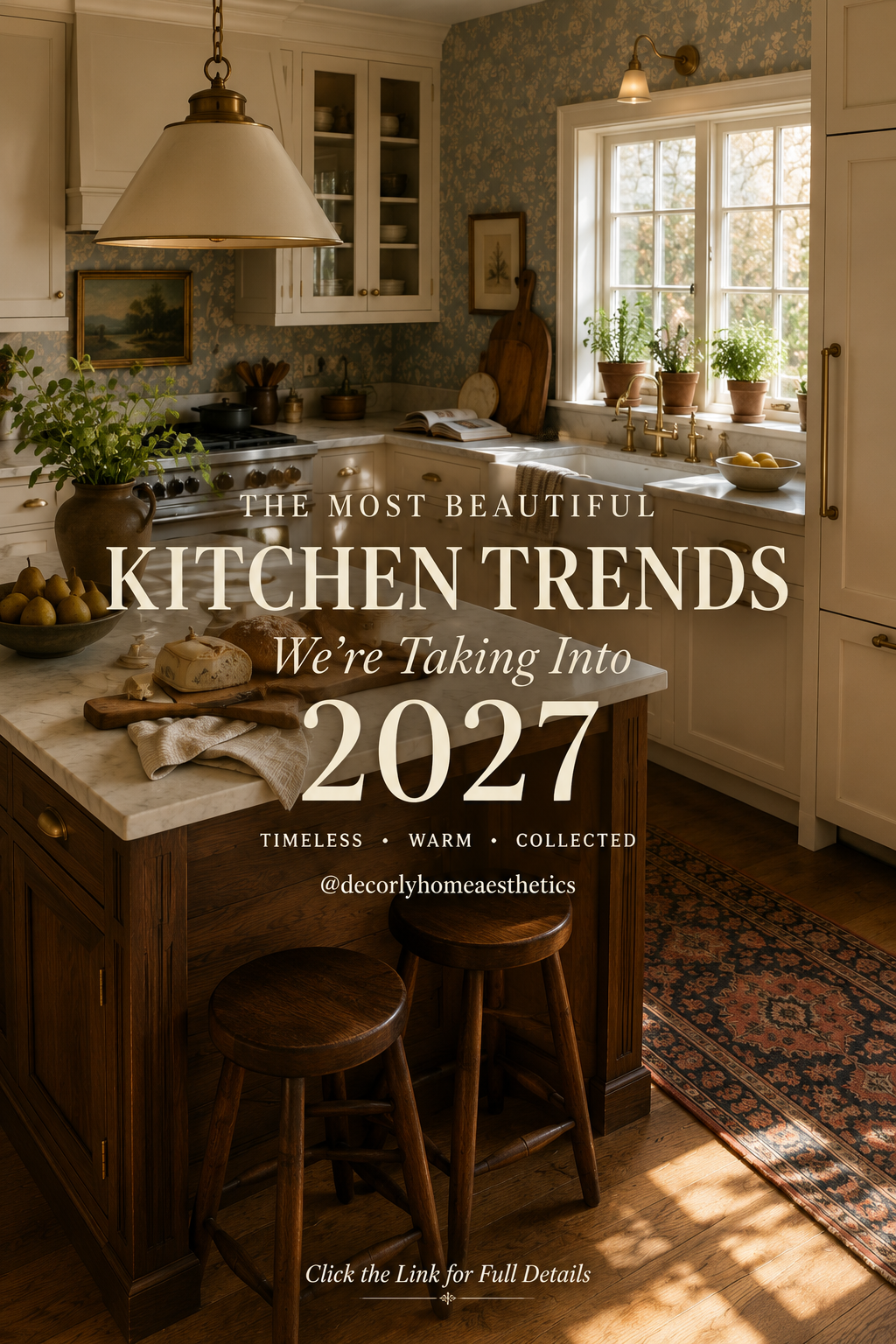
For a while, kitchens seemed to be getting cleaner, brighter, and more minimal every year.
White cabinets. White counters. Pale floors. Hidden appliances. Hardly anything sitting on the worktops.
They photographed beautifully, but somewhere along the way, a lot of kitchens started feeling a little too perfect.
What I’m loving about the direction we’re heading into 2027 is that warmth is coming back. Kitchens are beginning to look less like showrooms and more like rooms where people actually cook, eat, talk, make coffee, leave a cookbook open, and gather at the end of the day.
There’s more wood. More pattern. Softer whites. Older-looking metals. Handmade pieces. And perhaps best of all, not everything has to match.
If you’re thinking about updating your kitchen—or simply want a few ideas for making the one you already have feel warmer—these are the kitchen trends I’d happily take with me into 2027.
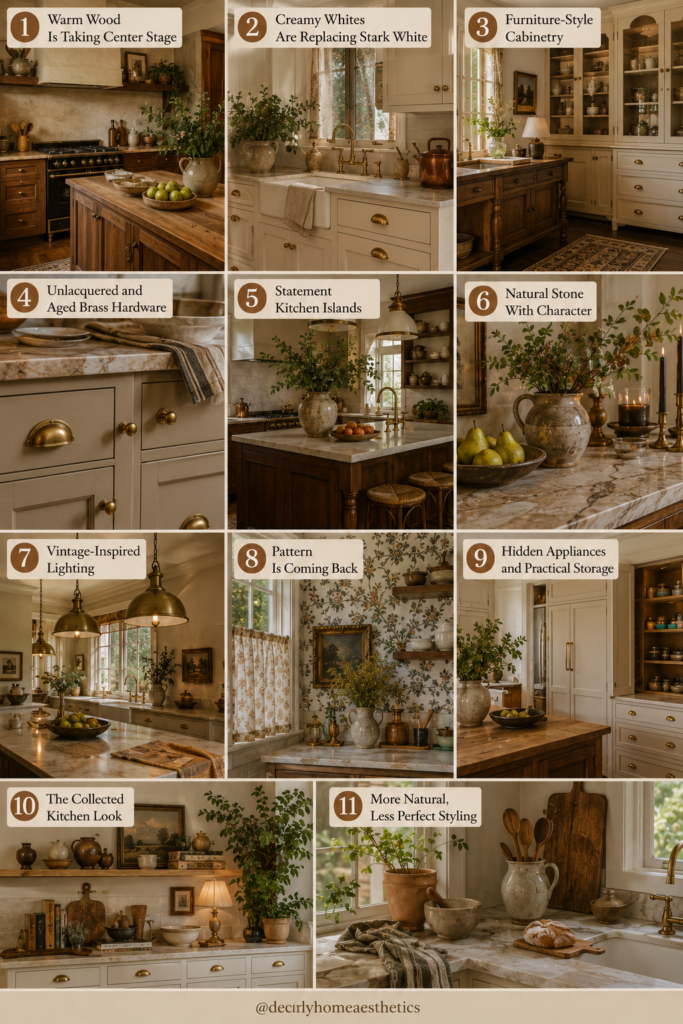
1. Warm Wood Is Taking Center Stage
One of the biggest changes is the return of genuinely warm wood.
After years of painted cabinetry dominating kitchen inspiration, natural oak, walnut, and other medium-to-dark woods feel refreshing again.
And I don’t think this means every cabinet needs to be wood.
Actually, some of my favorite kitchens mix it.
Imagine warm cream cabinets around the walls with a rich walnut island in the middle. The contrast immediately makes the kitchen feel more layered.
Wood also brings something that painted surfaces can’t quite replicate. Every board has slightly different grain and coloring, so the kitchen naturally feels less uniform.
If replacing cabinets isn’t an option, you can still bring this feeling into an existing kitchen with wooden stools, cutting boards, shelves, bowls, or a small vintage table.
Sometimes just a few natural materials are enough to warm everything up.
2. Cream Is Becoming the New White
I’m not saying white kitchens are disappearing.
But the whites themselves are getting warmer.
Instead of brilliant, almost blue-white cabinetry, we’re seeing more ivory, oatmeal, putty, mushroom, and creamy off-white.
It’s a subtle difference until you see the two next to each other.
Warm cream feels softer, especially when paired with natural wood and brass.
It also works beautifully with older homes because it doesn’t feel quite as sharp against traditional moldings, vintage furniture, and aged finishes.
If you’re choosing paint, don’t rely entirely on the little sample card in the store. Warm whites change dramatically throughout the day.
Paint a large sample and look at it in your actual kitchen during the morning, afternoon, and evening before committing.
3. Cabinets Are Starting to Look More Like Furniture
This might be one of my favorite kitchen directions.
Instead of cabinetry looking like one continuous wall of identical boxes, designers are introducing details that make individual sections feel more like furniture.
That could mean inset doors, decorative feet, glass-front cabinets, wooden interiors, traditional latches, or a freestanding pantry cupboard.
Even kitchen islands are starting to feel more like old worktables or substantial pieces of furniture.
It creates a kitchen that feels as though it has evolved.
And you don’t necessarily need custom cabinetry to get some of that character. Replacing a few upper doors with glass fronts, changing the hardware, or adding a freestanding vintage cabinet can introduce the same feeling on a much smaller budget.
4. Aged Brass Is Better Than Perfect Brass
Brass has been around for a while, but the version I’m drawn to now is much less shiny.
Aged brass, antique brass, and unlacquered finishes have a warmth that works beautifully with cream cabinets and dark wood.
They’re also allowed to change.
A handle that’s touched every day might eventually look slightly different from one on a cabinet you rarely open.
I actually like that.
There’s something reassuring about a kitchen where every surface doesn’t need to stay exactly as it looked on installation day.
If you’re updating hardware, don’t feel like you need to replace everything with something elaborate. Simple knobs and traditional pulls in a warm metal finish can make a surprisingly noticeable difference.
5. The Island Is Becoming the Star
For years, matching the kitchen island to all the surrounding cabinetry was the safe choice.
Now, contrast feels much more interesting.
A dark walnut island surrounded by cream cabinetry can completely anchor a kitchen.
Painted islands work too. Deep olive, mushroom, muted blue, or brown can introduce color without committing to colorful cabinetry throughout the whole room.
The countertop can be slightly different as well.
What matters is that the island still feels connected to the rest of the kitchen through something—perhaps the hardware, stone, wood tone, or overall color palette.
The result feels layered rather than mismatched.
6. Natural Stone Doesn’t Need to Be Perfect
There’s a difference between stone that looks expensive and stone that simply looks dramatic.
I’m leaning toward the first.
Natural-looking marble, quartzite, limestone, and other stone surfaces with subtle movement can add so much character to a kitchen.
And the variation is part of the appeal.
Not every vein has to be perfectly positioned. Not every section needs to look identical.
In fact, quieter stone often works better in a kitchen that’s already using wood, wallpaper, brass, and patterned textiles.
You don’t need the countertop to be the loudest thing in the room.
7. Vintage-Inspired Lighting Is Softening Kitchens
Lighting is becoming decorative again.
Rather than automatically putting three identical industrial pendants over an island, consider fixtures that feel as though they could have been in the house for years.
Pleated fabric shades, aged brass fittings, milk glass, ceramic sconces, and simple traditional pendants can all work.
They introduce softness into a room filled with hard surfaces.
I especially love a small lamp on a kitchen counter.
It might sound unnecessary until you turn it on after dinner instead of using every overhead light.
Suddenly the kitchen feels like part of the home again rather than a workspace waiting for tomorrow morning.
8. Pattern Is Finding Its Way Back Into the Kitchen
Kitchens don’t have to be entirely solid-colored.
We’re seeing more little moments of pattern, and they make these spaces much more interesting.
A faded botanical wallpaper behind glass-front cabinets.
A small café curtain over the sink.
A vintage runner between the island and cabinets.
Striped linen on a window.
Maybe even patterned tile used sparingly.
The key word is sparingly.
If you have patterned wallpaper, you probably don’t need a wildly patterned backsplash, rug, curtains, and upholstery too.
One or two patterns surrounded by quieter materials are enough.
9. Appliances Are Becoming Less Visually Dominant
We obviously still need modern appliances.
We just don’t necessarily need them to be the first thing we notice.
Integrated refrigerators and dishwashers are one solution, but there are plenty of less expensive ways to reduce visual clutter.
A microwave can be moved away from the main sightline. Small appliances can live inside an appliance garage or pantry cupboard. The toaster doesn’t necessarily have to sit permanently in the middle of your prettiest counter.
I wouldn’t take this to extremes.
If you use your coffee maker three times every morning, hiding it behind a cabinet door may become annoying very quickly.
A beautiful kitchen still needs to work.
10. The Collected Kitchen Is Replacing the Perfect Kitchen
This is probably the trend I hope lasts the longest.
Kitchens are starting to feel collected again.
A stack of cookbooks beside the range.
An old landscape painting.
Wooden boards leaning against the backsplash.
A handmade ceramic bowl filled with pears.
A slightly battered stool.
A jug that belonged to someone’s grandmother.
None of these things needs to be particularly expensive.
What matters is that the room doesn’t feel as though every decorative object arrived in the same delivery box.
If everything in your kitchen is new, try adding just one older piece.
It can make the whole room feel more established.
11. We’re Letting Kitchens Look Lived In Again
A beautiful kitchen can have a tea towel hanging from the oven.
There can be herbs growing beside the window.
A cookbook can be open.
There can even be bread sitting on a cutting board.
Obviously, nobody wants a dirty or chaotic kitchen. But there’s a difference between clean and completely sterile.
A room that’s used every day should have some evidence of life.
That might be the biggest shift of all.
Instead of designing kitchens solely around how they’ll look in a photograph, we’re remembering how they’re supposed to feel when we’re actually standing inside them.
What This Means If You Aren’t Remodeling
The good news is that many of these ideas don’t require a new kitchen.
If you already have a perfectly functional space, start small.
Swap very cool bulbs for warmer lighting. Bring in a vintage runner. Replace a few pieces of hardware. Put an old wooden board against the backsplash.
Add a little lamp.
Bring home a piece of pottery you genuinely love.
Grow herbs by the window.
If your cabinets are stark white, warmer accessories can soften them without repainting everything.
A kitchen doesn’t need to follow every trend to feel current.
Sometimes the most convincing updates are the ones nobody immediately identifies as an “update.”
The 2027 Kitchen Color Palette I Love
If I were putting together a kitchen right now, I’d start with:
Warm cream + walnut + mushroom + aged brass + natural stone + muted sage + faded blue
Cream would form the base.
Walnut would add depth.
Brass would introduce warmth.
Then sage or faded blue could appear in smaller details such as wallpaper, textiles, ceramics, or artwork.
It’s colorful enough to be interesting without feeling tied to one particular year.
And that’s important.
A kitchen is far too expensive to redesign every time Pinterest changes its mind.
Don’t Try to Use Every Trend
This is probably the most useful advice I can give.
You don’t need warm wood and wallpaper and glass cabinets and brass and patterned curtains and a vintage rug and dramatic stone.
Choose the things that actually suit your home.
A modern house may only need warm wood and softer lighting.
A traditional house might look wonderful with cream cabinetry, brass hardware, and botanical wallpaper.
A tiny apartment kitchen may simply benefit from a vintage runner, wooden boards, and one beautiful lamp.
Trends are much more useful as inspiration than instructions.
Final Thoughts
The kitchens I’m most excited about for 2027 aren’t necessarily the biggest or most expensive ones.
They’re the ones that feel warm.
They have wood you want to touch, stone with natural variation, slightly aged brass, soft lighting, and objects that seem to have stories behind them.
They’re polished, but not precious.
Beautiful, but still practical.
And most importantly, they look like someone actually lives there.
If that’s where kitchen design is heading, it’s one trend I’m very happy to take into 2027.