
For most hip-hop fans, the idea of being a fly on the wall during a studio session with Dr. Dre and Eminem is the stuff of legend — the kind of behind-the-scenes magic whispered about but rarely confirmed.
Now, thanks to a recent revelation from acclaimed producer Mark Batson, one of those legendary moments has resurfaced, and it’s as wild, gritty, and chaotic as you’d imagine.

In a candid reflection, Batson described the session as “the grimiest I’ve ever seen,” recalling the raw energy that unfolded in the studio when two of rap’s most dominant forces collided.
It wasn’t polished, pretty, or even entirely sane — but it was real. And according to him, that’s exactly what made it powerful.
“There was no script, no structure, no ‘this is how we do things,’” Batson said. “It was just Dre, Em, and pure creative madness. Cigs burning, verses flying, beats getting torn apart and rebuilt on the spot. It was a storm — and I was just trying to hold on.”
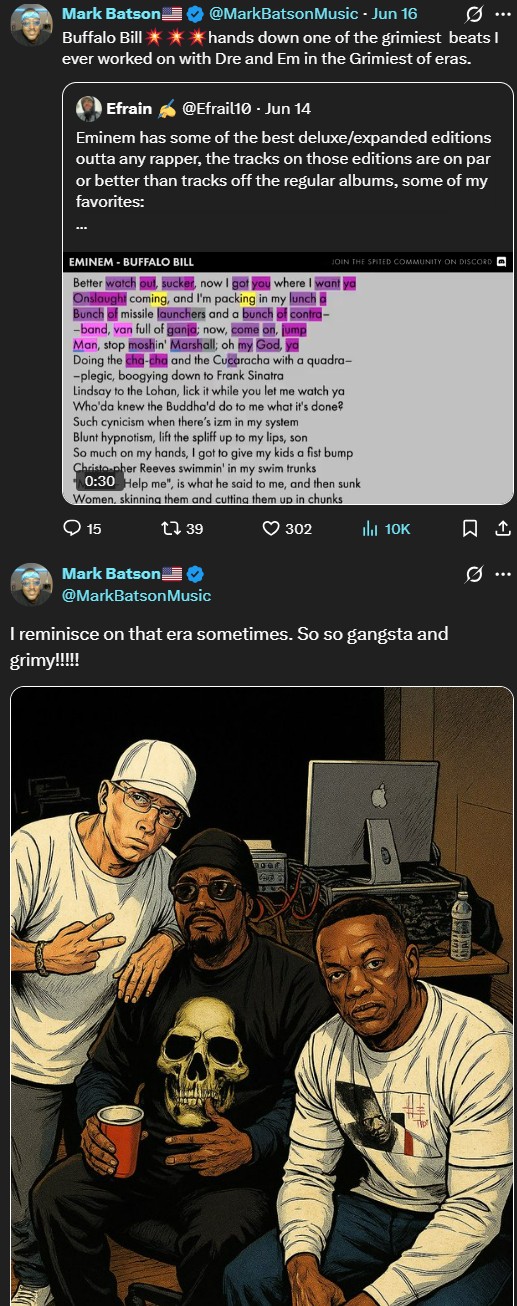
Batson, known for his work with Jay-Z, Alicia Keys, and Beyoncé, is no stranger to high-level sessions.
But the Dre-Eminem dynamic, he says, was on another level entirely — a potent combination of perfectionism, unpredictability, and genius-level artistry.
Eminem would reportedly enter a zone where nothing else existed, scribbling furious lines in the corner before stepping into the booth and unleashing verse after verse with no warning.
Dr. Dre, meanwhile, ran the room like a sonic general — equal parts architect and instigator. “He’d push Em to places no one else could,” Batson added. “And Em would push right back. It was chaos — but it was sacred chaos.”
What makes this story even more tantalizing is the suggestion that the session’s material still exists — locked deep in the Aftermath vaults, unheard by the public. Tracks that may never see the light of day, but that captured the unfiltered essence of two of hip-hop’s greatest innovators at their most unguarded.
For fans, it’s a reminder that the greatest moments in music aren’t always the ones that make it onto the album. Sometimes, the most iconic verses are left on studio floors, tangled in cigarette smoke and coffee-stained notebooks — but they live on in stories like Batson’s.
“It wasn’t pretty,” he said. “But it was real. It was hip-hop in its rawest form. And somewhere in that vault, the storm is still rumbling.